Maurice Wilkins Centre for Molecular Biodiscovery, The University of Auckland, Auckland, New Zealand; Department of Molecular Medicine and Pathology, School of Medical Sciences, The University of Auckland, Auckland, New Zealand.
Discipline of Nutrition, School of Medical Sciences, The University of Auckland, Auckland, New Zealand.
Mol Metab. 2022 May;59:101464. doi: 10.1016/j.molmet.2022.101464. Epub 2022 Feb 24.
The minor allele (A) of the rs373863828 variant (p.Arg457Gln) in CREBRF is restricted to indigenous peoples of the Pacific islands (including New Zealand Māori and peoples of Polynesia), with a frequency of up to 25% in these populations. This allele associates with a large increase in body mass index (BMI) but with significantly lower risk of type-2 diabetes (T2D). It remains unclear whether the increased BMI is driven by increased adiposity or by increased lean mass.
We undertook body composition analysis using DXA in 189 young men of Māori and Pacific descent living in Aotearoa New Zealand. Further investigation was carried out in two orthologous Arg458Gln knockin mouse models on FVB/NJ and C57BL/6j backgrounds.
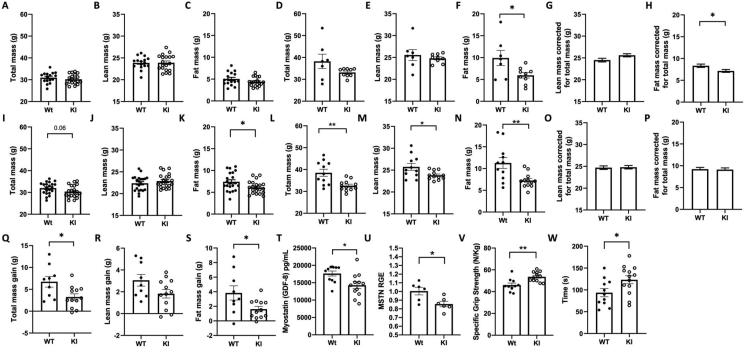
The rs373863828 A allele was associated with lower fat mass when adjusted for BMI (p < 0.05) and was associated with significantly lower circulating levels of the muscle inhibitory hormone myostatin (p < 0.05). Supporting the human data, significant reductions in adipose tissue mass were observed in the knockin mice. This was more significant in older mice in both backgrounds and appeared to be the result of reduced age-associated increases in fat mass. The older male knockin mice on C57BL/6j background also had increased grip strength (p < 0.01) and lower levels of myostatin (p < 0.05).
Overall, these results prove that the rs373863828 A-allele is associated with a reduction of myostatin levels which likely contribute to an age-dependent lowering of fat mass, at least in males.
位于 CREBRF 基因上的 rs373863828 变异(p.Arg457Gln)的次要等位基因(A)仅存在于太平洋岛屿的原住民中(包括新西兰毛利人和波利尼西亚人),这些人群中的频率高达 25%。该等位基因与体重指数(BMI)显著增加相关,但 2 型糖尿病(T2D)风险显著降低。目前尚不清楚增加的 BMI 是由脂肪量增加还是瘦体重增加驱动。
我们对生活在新西兰奥特亚罗瓦的 189 名毛利和太平洋裔年轻男性进行了使用 DXA 的身体成分分析。在 FVB/NJ 和 C57BL/6j 背景下的两个同源 Arg458Gln 敲入小鼠模型中进行了进一步研究。
在调整 BMI 后,rs373863828 A 等位基因与脂肪量降低相关(p < 0.05),与肌肉抑制素(myostatin)的循环水平显著降低相关(p < 0.05)。支持人类数据,敲入小鼠的脂肪组织质量显著减少。在两种背景下的老年小鼠中更为显著,并且似乎是由于与年龄相关的脂肪量增加减少所致。C57BL/6j 背景下的老年雄性敲入小鼠的握力也增加(p < 0.01),肌肉抑制素水平降低(p < 0.05)。
总体而言,这些结果证明 rs373863828 A 等位基因与肌肉抑制素水平降低相关,这可能导致脂肪量随年龄降低,至少在男性中如此。