
氧化应激诱导的 COVID-19 患者内皮功能障碍和血管一氧化氮减少。
Oxidative stress-induced endothelial dysfunction and decreased vascular nitric oxide in COVID-19 patients.
机构信息
Department of Critical Care Medicine, Intensive Care Unit, Cliniques Universitaires Saint-Luc and Université catholique de Louvain (UCLouvain), 10 avenue Hippocrate, Brussels B-1200, Belgium; Institute of Experimental and Clinical Research (IREC), Pharmacology and Therapeutics (FATH), Université Catholique de Louvain (UCLouvain), Brussels, Belgium.
Institute of Experimental and Clinical Research (IREC), Pharmacology and Therapeutics (FATH), Université Catholique de Louvain (UCLouvain), Brussels, Belgium.
出版信息
EBioMedicine. 2022 Mar;77:103893. doi: 10.1016/j.ebiom.2022.103893. Epub 2022 Feb 23.
BACKGROUND
SARS-CoV-2 targets endothelial cells through the angiotensin-converting enzyme 2 receptor. The resulting endothelial injury induces widespread thrombosis and microangiopathy. Nevertheless, early specific markers of endothelial dysfunction and vascular redox status in COVID-19 patients are currently missing.
METHODS
Observational study including ICU and non-ICU adult COVID-19 patients admitted in hospital for acute respiratory failure, compared with control subjects matched for cardiovascular risk factors similar to ICU COVID-19 patients, and ICU septic shock patients unrelated to COVID-19.
FINDINGS
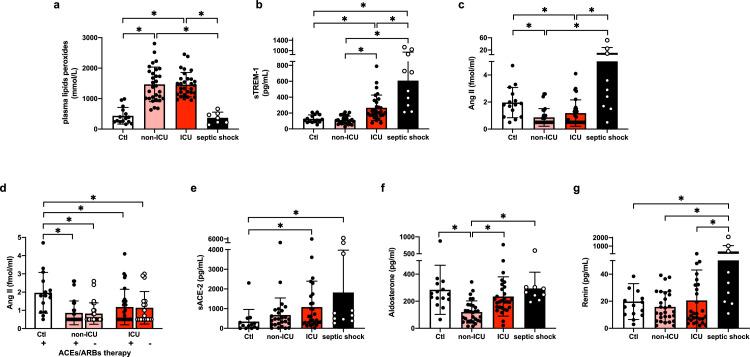
Early SARS-CoV-2 infection was associated with an imbalance between an exacerbated oxidative stress (plasma peroxides levels in ICU patients vs. controls: 1456.0 ± 400.2 vs 436 ± 272.1 mmol/L; P < 0.05) and a reduced nitric oxide bioavailability proportional to disease severity (5-α-nitrosyl-hemoglobin, HbNO in ICU patients vs. controls: 116.1 ± 62.1 vs. 163.3 ± 46.7 nmol/L; P < 0.05). HbNO levels correlated with oxygenation parameters (PaO/FiO ratio) in COVID-19 patients (R = 0.13; P < 0.05). Plasma levels of angiotensin II, aldosterone, renin or serum level of TREM-1 ruled out any hyper-activation of the renin-angiotensin-aldosterone system or leucocyte respiratory burst in ICU COVID-19 patients, contrary to septic patients.
INTERPRETATION
Endothelial oxidative stress with ensuing decreased NO bioavailability appears as a likely pathogenic factor of endothelial dysfunction in ICU COVID-19 patients. A correlation between NO bioavailability and oxygenation parameters is observed in hospitalized COVID-19 patients. These results highlight an urgent need for oriented research leading to a better understanding of the specific endothelial oxidative stress that occurs during SARS-CoV-2.
FUNDING
Stated in the acknowledgments section.
背景
SARS-CoV-2 通过血管紧张素转换酶 2 受体靶向内皮细胞。由此导致的内皮损伤会引起广泛的血栓形成和微血管病变。然而,目前 COVID-19 患者中内皮功能障碍和血管氧化还原状态的早期特异性标志物仍不清楚。
方法
本观察性研究纳入了因急性呼吸衰竭而住院的 ICU 和非 ICU 成年 COVID-19 患者,并与 ICU COVID-19 患者相似的心血管危险因素相匹配的对照组患者以及与 COVID-19 无关的 ICU 感染性休克患者进行比较。
结果
早期 SARS-CoV-2 感染与氧化应激的失衡有关(ICU 患者的血浆过氧化物水平与对照组相比:1456.0 ± 400.2 比 436 ± 272.1 mmol/L;P < 0.05),并且一氧化氮生物利用度降低与疾病严重程度成正比(5-α-硝基亚血红素,HbNO 在 ICU 患者与对照组相比:116.1 ± 62.1 比 163.3 ± 46.7 nmol/L;P < 0.05)。HbNO 水平与 COVID-19 患者的氧合参数(PaO/FiO 比值)相关(R = 0.13;P < 0.05)。在 ICU COVID-19 患者中,血管紧张素 II、醛固酮、肾素或血清 TREM-1 水平均未排除肾素-血管紧张素-醛固酮系统的过度激活或白细胞呼吸爆发,这与感染性休克患者不同。
解释
内皮氧化应激导致随后的一氧化氮生物利用度降低,似乎是 ICU COVID-19 患者内皮功能障碍的一个潜在致病因素。在住院 COVID-19 患者中观察到 NO 生物利用度与氧合参数之间的相关性。这些结果强调了迫切需要进行有针对性的研究,以更好地了解 SARS-CoV-2 期间发生的特定内皮氧化应激。
基金
在致谢部分说明。




 Zotero 插件