Shanghai Zhaxin Traditional Chinese and Western Medicine Hospital, Shanghai, China.
Shanghai Yangzhi Rehabilitation Hospital, Shanghai, China.
Front Neural Circuits. 2022 Feb 10;15:789095. doi: 10.3389/fncir.2021.789095. eCollection 2021.
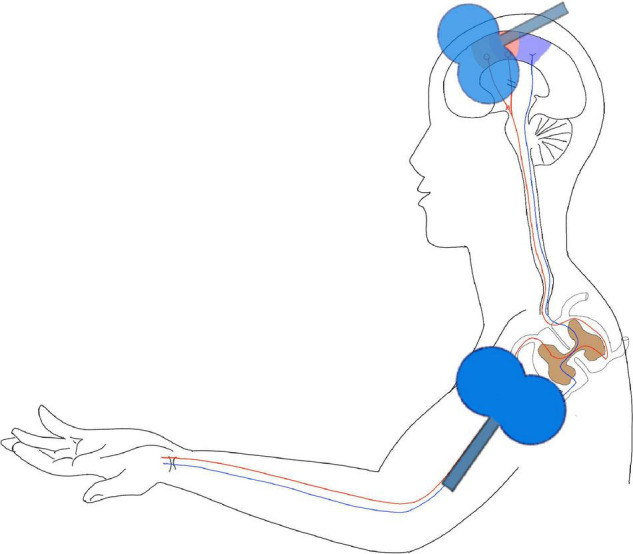
Upper-extremity hemiplegia after stroke remains a significant clinical problem. The supplementary motor area (SMA) is vital to the motor recovery outcomes of chronic stroke patients. Therefore, rebuilding the descending motor tract from the SMA to the paralyzed limb is a potential approach to restoring arm motor function after stroke. Paired associative stimulation (PAS), which is based on Hebbian theory, is a potential method for reconstructing the connections in the impaired motor neural circuits. The study described in this protocol aims to assess the effects of cortico-peripheral Hebbian-type stimulation (HTS), involving PAS, for neural circuit reconstruction to rescue the paralyzed arm after stroke.
The study is a 4-month double-blind randomized sham-controlled clinical trial. We will recruit 90 post-stroke individuals with mild to moderate upper limb paralysis. Based on a 1:1 ratio, the participants will be randomly assigned to the HTS and sham groups. Each participant will undergo 5-week HTS or sham stimulation. Assessments will be conducted at baseline, immediately after the 5-week treatment, and at a 3-month follow-up. The primary outcome will be the Wolf Motor Function Test (WMFT). The secondary outcomes will be Fugl-Meyer Assessment for Upper Extremity (FMA-UE), Functional Independence Measure (FIM), and functional near-infrared spectroscopy (fNIRS) parameters. The adverse events will be recorded throughout the study.
Upper-limb paralysis in stroke patients is due to neural circuit disruption, so the reconstruction of effective motor circuits is a promising treatment approach. Based on its anatomical structure and function, the SMA is thought to compensate for motor dysfunction after focal brain injury at the cortical level. Our well-designed randomized controlled trial will allow us to analyze the clinical efficacy of this novel Hebbian theory-based neuromodulation strategy regarding promoting the connection between the cortex and peripheral limb. The results may have significance for the development and implementation of effective neurorehabilitation treatments.
[www.ClinicalTrials.gov], identifier [ChiCTR2000039949].
脑卒中后上肢偏瘫仍然是一个重大的临床问题。运动辅助区(SMA)对慢性脑卒中患者的运动康复结果至关重要。因此,重建 SMA 至瘫痪肢体的下行运动束是恢复脑卒中后手臂运动功能的一种潜在方法。基于赫布理论的配对联想刺激(PAS)是一种重建受损运动神经回路连接的潜在方法。本研究方案旨在评估皮质-外周赫布型刺激(HTS),包括 PAS,用于神经回路重建以拯救脑卒中后瘫痪手臂的效果。
该研究是一项为期 4 个月的双盲随机假对照临床试验。我们将招募 90 名轻度至中度上肢瘫痪的脑卒中后患者。根据 1:1 的比例,参与者将被随机分配到 HTS 组和假刺激组。每位参与者将接受 5 周的 HTS 或假刺激治疗。评估将在基线、5 周治疗结束时和 3 个月随访时进行。主要结局将是沃尔夫运动功能测试(WMFT)。次要结局将是上肢 Fugl-Meyer 评估(FMA-UE)、功能独立性测量(FIM)和功能近红外光谱(fNIRS)参数。整个研究过程中记录不良事件。
脑卒中患者的上肢瘫痪是由于神经回路中断,因此有效运动回路的重建是一种有前途的治疗方法。基于其解剖结构和功能,SMA 被认为可以补偿皮质水平局灶性脑损伤后的运动功能障碍。我们精心设计的随机对照试验将使我们能够分析这种基于赫布理论的新型神经调节策略促进皮质与外周肢体之间连接的临床疗效。研究结果可能对开发和实施有效的神经康复治疗具有重要意义。