Björnsson Einar S, Vucic Vesna, Stirnimann Guido, Robles-Díaz Mercedes
Faculty of Medicine, University of Iceland, Reykjavik, Iceland.
Department of Gastroenterology, Landspitali University Hospital Reykjavik, Reykjavik, Iceland.
Front Pharmacol. 2022 Feb 10;13:820724. doi: 10.3389/fphar.2022.820724. eCollection 2022.
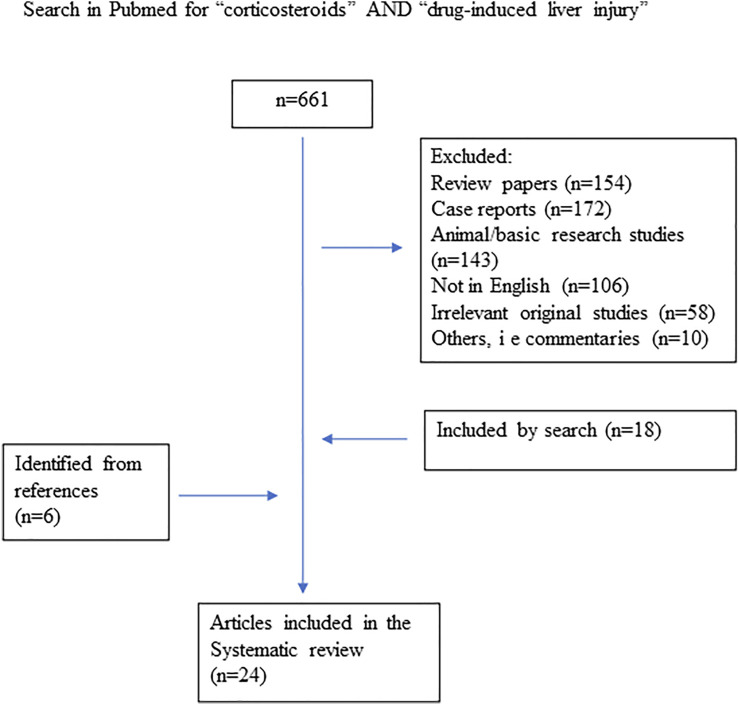
Apart from cessation of the implicated agent leading to drug-induced liver injury (DILI), there is no standard therapy for DILI. Corticosteroids have been used in DILI, although their efficacy is unclear. Published data showed either beneficial effects or no improvement associated with steroid therapy. The aim of the current study was to perform a systematic review of the role of corticosteroids in the treatment of DILI. A search was performed in PubMed, searching for the terms: "corticosteroids" and "drug-induced liver injury". Observation studies were included, but case reports excluded. A total of 24 papers were retrieved. Most of these were observational studies on the effects of corticosteroids in moderate/severe DILI (n = 8), reports on the corticosteroid treatment in patients with drug-induced autoimmune hepatitis (DI-AIH) (n = 5), and effects of corticosteroids in drug-induced fulminant acute liver failure (ALF, n = 2). Furthermore, treatment of corticosteroids in patients with liver injury due to check point inhibitors (CPIs) was addressed in nine studies. In moderate/severe DILI, six out of eight studies suggested steroid treatment to be beneficial, whereas two studies showed negative results. All five observational studies on the effects of corticosteroids in DI-AIH showed good therapeutic response with rapid and long lasting effects after discontinuation of corticosteroids and without evidence of relapse. Steroid therapy was not associated with improved overall survival in patients with drug-induced fulminant ALF. CPIs-induced liver injury was found to improve spontaneously in 33-50% without corticosteroids, and the rate of patients who were treated responded to steroids in 33-100% (mean 72%). The majority of studies analyzing the effects of corticosteroids in moderate/severe DILI have demonstrated beneficial effects. However, this was not the case in drug-induced fulminant ALF. Patients with DI-AIH had an excellent response to corticosteroids. The majority of those with CPIs-induced liver injury responded to corticosteroids; however, patients without treatment usually recovered spontaneously. The observational design and comparison with historical controls in these studies makes it very difficult to draw conclusions on the efficacy of corticosteroids in DILI. Therefore, there is a strong need for a randomized controlled trial to properly assess the role of corticosteroids in DILI.
除了停用导致药物性肝损伤(DILI)的相关药物外,目前尚无针对DILI的标准治疗方法。皮质类固醇已被用于治疗DILI,但其疗效尚不清楚。已发表的数据显示,类固醇治疗要么有益,要么没有改善。本研究的目的是对皮质类固醇在DILI治疗中的作用进行系统评价。我们在PubMed上进行了检索,搜索词为:“皮质类固醇”和“药物性肝损伤”。纳入观察性研究,但排除病例报告。共检索到24篇论文。其中大多数是关于皮质类固醇在中度/重度DILI中的作用的观察性研究(n = 8)、关于药物性自身免疫性肝炎(DI-AIH)患者皮质类固醇治疗的报告(n = 5)以及皮质类固醇在药物性暴发性急性肝衰竭(ALF,n = 2)中的作用。此外,有9项研究探讨了皮质类固醇在检查点抑制剂(CPI)所致肝损伤患者中的治疗情况。在中度/重度DILI中,8项研究中有6项表明类固醇治疗有益,而2项研究显示结果为阴性。所有5项关于皮质类固醇在DI-AIH中的作用的观察性研究均显示出良好的治疗反应,停用皮质类固醇后效果迅速且持久,且无复发迹象。在药物性暴发性ALF患者中,类固醇治疗与总体生存率的改善无关。发现33%-50%的CPI所致肝损伤患者在未使用皮质类固醇的情况下可自发改善,接受类固醇治疗的患者的有效率为33%-100%(平均72%)。大多数分析皮质类固醇在中度/重度DILI中的作用的研究都显示出有益效果。然而,在药物性暴发性ALF中并非如此。DI-AIH患者对皮质类固醇有良好反应。大多数CPI所致肝损伤患者对皮质类固醇有反应;然而,未经治疗的患者通常可自发恢复。这些研究中的观察性设计以及与历史对照的比较使得很难就皮质类固醇在DILI中的疗效得出结论。因此,迫切需要进行一项随机对照试验,以正确评估皮质类固醇在DILI中的作用。