Miller Clare B, Parsons Michael B, Jamieson Heather E, Ardakani Omid H, Patterson R Timothy, Galloway Jennifer M
Centre for Ore Deposits and Earth Sciences (CODES), Department of Earth Science, University of Tasmania, Hobart, TAS 7001 Australia.
Department of Geological Sciences and Geological Engineering, Queen's University, Kingston, ON K7L 3N6 Canada.
Environ Earth Sci. 2022;81(4):137. doi: 10.1007/s12665-022-10213-2. Epub 2022 Feb 16.
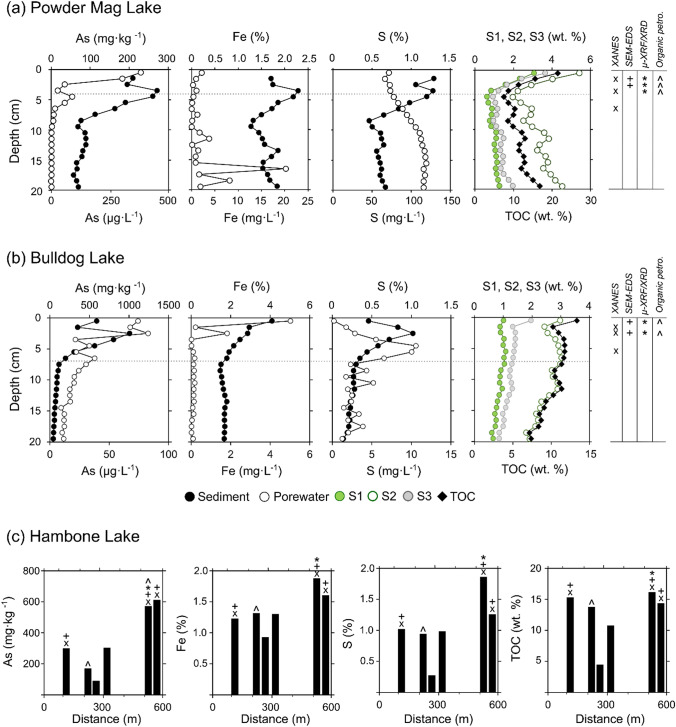
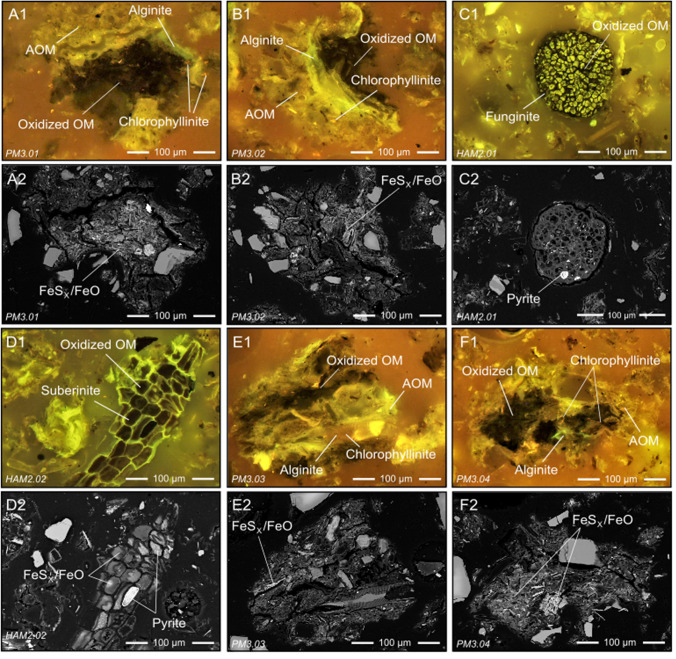
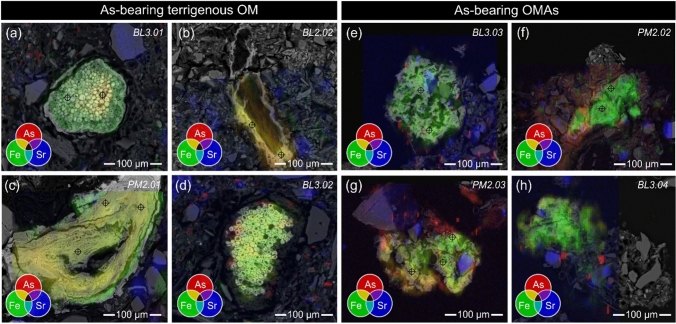
Arsenic (As) is commonly sequestered at the sediment-water interface (SWI) in mining-impacted lakes through adsorption and/or co-precipitation with authigenic iron (Fe)-(oxy)hydroxides or sulfides. The results of this study demonstrate that the accumulation of organic matter (OM) in near-surface sediments also influences the mobility and fate of As in sub-Arctic lakes. Sediment gravity cores, sediment grab samples, and porewaters were collected from three lakes downstream of the former Tundra gold mine, Northwest Territories, Canada. Analysis of sediment using combined micro-X-ray fluorescence/diffraction, K-edge X-ray Absorption Near-Edge Structure (XANES), and organic petrography shows that As is associated with both aquatic (benthic and planktonic alginate) and terrestrially derived OM (e.g., cutinite, funginite). Most As is hosted by fine-grained Fe-(oxy)hydroxides or sulfide minerals (e.g., goethite, orpiment, lepidocrocite, and mackinawite); however, grain-scale synchrotron-based analysis shows that As is also associated with amorphous OM. Mixed As oxidation states in porewater (median = 62% As (V), 18% As (III); = 20) and sediment (median = 80% As (-I) and (III), 20% As (V); = 9) indicate the presence of variable redox conditions in the near-surface sediment and suggest that post-depositional remobilization of As has occurred. Detailed characterization of As-bearing OM at and below the SWI suggests that OM plays an important role in stabilizing redox-sensitive authigenic minerals and associated As. Based on these findings, it is expected that increased concentrations of labile OM will drive post-depositional surface enrichment of As in mining-impacted lakes and may increase or decrease As flux from sediments to overlying surface waters.
The online version contains supplementary material available at 10.1007/s12665-022-10213-2.
在受采矿影响的湖泊中,砷(As)通常通过与自生铁(Fe)的(氢)氧化物或硫化物发生吸附和/或共沉淀作用,而被截留在沉积物 - 水界面(SWI)处。本研究结果表明,近地表沉积物中有机质(OM)的积累也会影响亚北极湖泊中砷的迁移性和归宿。从加拿大西北地区前苔原金矿下游的三个湖泊采集了沉积物重力岩心、沉积物抓取样本和孔隙水。利用微X射线荧光/衍射联用、K边X射线吸收近边结构(XANES)以及有机岩石学对沉积物进行分析,结果表明砷与水生(底栖和浮游藻酸盐)和陆源有机质(如角质体、真菌体)均有关联。大部分砷赋存于细粒Fe - (氢)氧化物或硫化物矿物(如针铁矿、雌黄矿、纤铁矿和硫铁矿)中;然而,基于同步加速器的粒度分析表明,砷也与无定形有机质有关。孔隙水中混合的砷氧化态(中位数 = 62% As(V),18% As(III);n = 20)和沉积物中的砷氧化态(中位数 = 80% As(-I)和(III),20% As(V);n = 9)表明近地表沉积物中存在可变的氧化还原条件,并表明砷发生了沉积后再迁移。对SWI处及以下含砷有机质的详细表征表明,有机质在稳定对氧化还原敏感的自生矿物及相关砷方面发挥着重要作用。基于这些发现,预计不稳定有机质浓度的增加将促使受采矿影响的湖泊中砷在沉积后在表层富集,并可能增加或减少从沉积物到上覆地表水的砷通量。
在线版本包含可在10.1007/s12665 - 022 - 10213 - 2获取的补充材料。