Elbaih Adel Hamed, El-Setouhy Maged, Hirshon Jon Mark, El-Hariri Hazem Mohamed, Ismail Monira Taha, El-Shinawi Mohamed
Emergency Medicine Department, Faculty of Medicine, Suez Canal University, Ismailia, Egypt.
Department of Community, Environmental and Occupational Medicine, Ain Shams University, Cairo, Egypt.
Afr J Emerg Med. 2022 Jun;12(2):89-96. doi: 10.1016/j.afjem.2022.01.002. Epub 2022 Feb 12.
Trauma deaths account for 8% of all deaths in Egypt. Patients with multiple injuries are at high risk but may be saved with a good triage system and a well-trained trauma team in dedicated institutions. The incidence of missed injuries in the Emergency Centre (EC) of Suez Canal University Hospital (SCUH) was found to be 9.0% after applying Advanced Trauma Life Support (ATLS) guidelines. However, this rate is still high compared with many trauma centers.
Improve the quality of management of polytrauma patients by decreasing the incidence of missed injuries by implementing the Sequential Trauma Education Programs (STEPs) course in the EC at SCUH.
This interventional training study was conducted in the SCUH EC that adheres to CONSORT guidelines. The study was conducted during the one month precourse and for 6 months after the implementation of the STEPs course for EC physicians. Overall, 458 polytrauma patients were randomly selected, of which 45 were found to have missed injuries after applying the inclusion and exclusion criteria. We assessed the clinical relevance of these cases for missed injuries before and after the STEPs course.
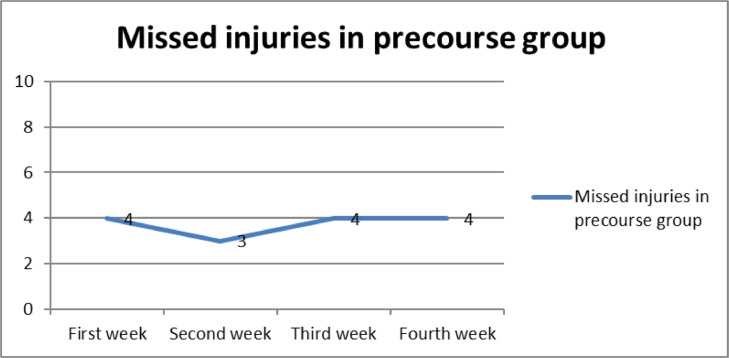
Overall, 45 patients were found to have missed injuries, of which 15 (12%) were pre-STEPs and 30 (9%) were post-STEPs course. The STEPs course significantly increased adherence to vital data recording, but the reduction of missed injuries (3.0%) was not statistically significant in relation to demographic and trauma findings. However, the decrease in missed injuries in the post-STEPs course group was an essential clinically significant finding.
STEPs course implementation decreased the incidence of missed injuries in polytrauma patients. Thus, the STEPs course can be considered at the same level of other advanced trauma courses as a training skills program or possibly better in dealing with trauma patients. Repetition of this course by physicians should be mandatory to prevent more missed injuries. Therefore, the validation of STEPs course certification should be completed at least every two years to help decrease the number of missed injuries, especially in low-income countries and low-resource settings.
创伤死亡占埃及所有死亡人数的8%。多发伤患者面临高风险,但在专业机构中,通过良好的分诊系统和训练有素的创伤团队,他们有可能获救。在苏伊士运河大学医院(SCUH)急诊中心(EC)应用高级创伤生命支持(ATLS)指南后,发现漏诊损伤的发生率为9.0%。然而,与许多创伤中心相比,这一比率仍然很高。
通过在SCUH的EC实施序贯创伤教育计划(STEPs)课程,降低漏诊损伤的发生率,提高多发伤患者的管理质量。
这项干预性培训研究在遵循CONSORT指南的SCUH急诊中心进行。该研究在EC医生参加STEPs课程前的一个月以及课程实施后的6个月内进行。总体而言,随机选择了458例多发伤患者,在应用纳入和排除标准后,发现其中45例存在漏诊损伤。我们评估了这些病例在STEPs课程前后漏诊损伤的临床相关性。
总体而言,发现45例患者存在漏诊损伤,其中15例(12%)在STEPs课程之前,30例(9%)在STEPs课程之后。STEPs课程显著提高了对重要数据记录的依从性,但与人口统计学和创伤发现相关的漏诊损伤减少率(3.0%)在统计学上并不显著。然而,STEPs课程后漏诊损伤的减少是一个重要的具有临床意义的发现。
STEPs课程的实施降低了多发伤患者漏诊损伤的发生率。因此,STEPs课程可被视为与其他高级创伤课程处于同一水平的培训技能项目,或者在处理创伤患者方面可能更好。医生应强制重复该课程以防止更多漏诊损伤。因此,应至少每两年完成一次STEPs课程认证的验证,以帮助减少漏诊损伤的数量,特别是在低收入国家和资源匮乏地区。