Chen Peng Sheng, Li Jing, Kim Seung-Yong
Department of Physical Education, Xianyang Normal University, Xianyang, China.
Physical Education, Graduate School of Education, Kyonggi University, Suwon-si, Gyeonggi-do, Republic of Korea.
Iran J Public Health. 2021 Nov;50(11):2263-2273. doi: 10.18502/ijph.v50i11.7582.
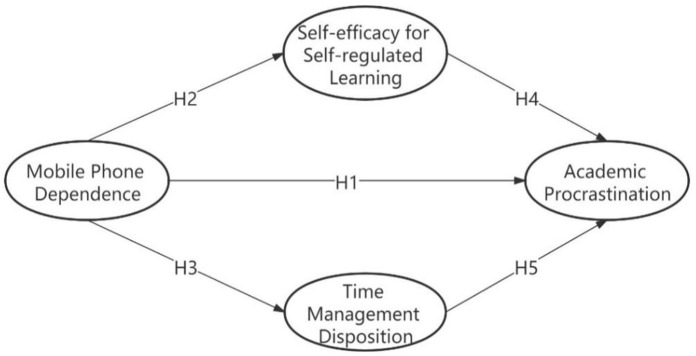
We aimed to investigate the relationship among mobile phone dependence, self-efficacy for self-regulated learning, time management disposition, and academic procrastination in Chinese students majoring in physical education. In addition, we explored the mediating roles of self-efficacy for self-regulated learning and time management disposition in the relationship between mobile phone dependence and academic procrastination.
We adopted a random sampling method to identify 324 physical education majors at five universities in Shaanxi Province, China in 2020. Data were analyzed via exploratory factor analysis, confirmatory factor analysis, correlation analysis, structural equation model analysis, and path analysis.
Mobile phone dependence had significant positive effects on academic procrastination (<0.001) and self-efficacy for self-regulated learning (<0.05) but a significant negative effect on time management disposition (<0.001). Self-efficacy for self-regulated learning had a significant positive effect on academic procrastination (<0.001), while time management disposition had a significant negative effect on academic procrastination (<0.01). Notably, self-efficacy for self-regulated learning and time management disposition mediated the relationship between mobile phone dependence and academic procrastination (<0.05).
In addition to its direct effect on academic procrastination, mobile phone dependence exerts an indirect effect via time management disposition and self-regulated learning efficacy. Reducing students' dependence on mobile phones is necessary for attenuating academic procrastination on university campuses. Thus, universities should aim to restrict the use of mobile phones in the classroom, actively cultivate students' confidence in their self-regulated learning ability, and educate them regarding appropriate time values.
我们旨在调查中国体育专业学生的手机依赖、自我调节学习自我效能感、时间管理倾向与学业拖延之间的关系。此外,我们还探讨了自我调节学习自我效能感和时间管理倾向在手机依赖与学业拖延关系中的中介作用。
我们采用随机抽样方法,于2020年在中国陕西省五所大学选取了324名体育专业学生。通过探索性因素分析、验证性因素分析、相关性分析、结构方程模型分析和路径分析对数据进行分析。
手机依赖对学业拖延(<0.001)和自我调节学习自我效能感(<0.05)有显著正向影响,但对时间管理倾向有显著负向影响(<0.001)。自我调节学习自我效能感对学业拖延有显著正向影响(<0.001),而时间管理倾向对学业拖延有显著负向影响(<0.01)。值得注意的是,自我调节学习自我效能感和时间管理倾向在手机依赖与学业拖延的关系中起中介作用(<0.05)。
手机依赖除了对学业拖延有直接影响外,还通过时间管理倾向和自我调节学习效能产生间接影响。减少学生对手机的依赖对于减轻大学校园中的学业拖延是必要的。因此,大学应旨在限制课堂上手机的使用,积极培养学生对自我调节学习能力的信心,并对他们进行适当时间价值观的教育。