Faculty of Medicine University of Turku Turku Finland.
Heart Center Turku University Hospital Turku Finland.
J Am Heart Assoc. 2022 Mar 15;11(6):e024119. doi: 10.1161/JAHA.121.024119. Epub 2022 Mar 1.
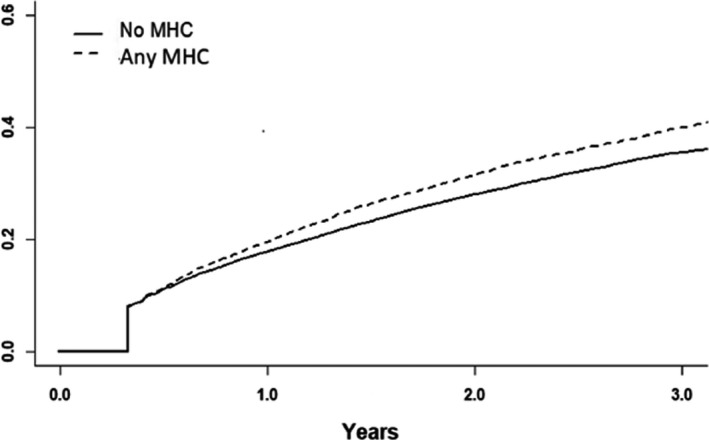
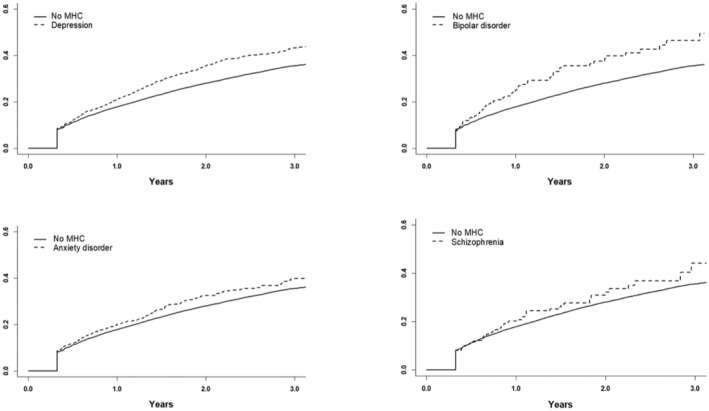
Background Mental health conditions (MHCs) are associated with poor outcomes in patients with atrial fibrillation. However, persistence of oral anticoagulation therapy in patients with atrial fibrillation and MHCs is unknown. We aimed to evaluate the effect of MHCs on the persistence of direct oral anticoagulant (DOAC) use in patients with atrial fibrillation based on a nationwide cohort. Methods and Results The nationwide registry-based FinACAF (Finnish Anticoagulation in Atrial Fibrillation) cohort included 67 503 patients with incident atrial fibrillation and indication for permanent oral anticoagulation (CHADS-VASc score >1 in men and >2 in women) starting DOAC therapy between 2011 and 2018. MHCs of interest were depression, bipolar disorder, anxiety disorder, schizophrenia, and composite of any MHC. The main outcome was nonpersistence of DOAC use, defined as the first 120-day period without DOAC purchases after drug initiation. The mean age of the patients was 75.3±8.9 years, 53.6% were women, and the prevalence of any MHC was 17.8%. Persistence after 1 year from DOAC initiation was 79.3% in patients without MHCs and 77.2% in patients with any MHC, and after 2 years were 64.4% and 60.6%, respectively (<0.001). Higher incidence of nonpersistence to DOACs was observed in all MHC categories: adjusted subdistribution hazard ratios, 1.16 (95% CI, 1.11-1.21) for any MHC, 1.32 (95% CI, 1.22-1.42) for depression, 1.44 (95% CI, 1.15-1.80) for bipolar disorder, 1.25 (95% CI, 1.11-1.41) for anxiety disorder, and 1.30 (95% CI, 1.02-1.64) for schizophrenia. However, patients with only anxiety disorder without other MHCs were not at higher risk of nonpersistence. Conclusions MHCs are associated with nonpersistence of DOAC use. Registration URL: https://www.clinicaltrials.gov; Unique identifier: NCT04645537.
背景 精神健康状况(MHCs)与房颤患者的不良结局相关。然而,房颤患者中口服抗凝治疗的持续情况仍不清楚。我们旨在根据一项全国性队列研究,评估 MHCs 对房颤患者直接口服抗凝剂(DOAC)使用持续时间的影响。
方法和结果 这项全国范围内基于登记的 FinACAF(芬兰房颤抗凝)队列纳入了 67503 例新发房颤且有永久性口服抗凝指征(男性 CHADS-VASc 评分>1,女性>2)的患者,他们在 2011 年至 2018 年期间开始使用 DOAC 治疗。感兴趣的 MHC 包括抑郁症、双相情感障碍、焦虑症、精神分裂症和任何 MHC 的综合症。主要结局是非 DOAC 药物的持续使用,定义为药物起始后 120 天内首次无 DOAC 购买的时间段。患者的平均年龄为 75.3±8.9 岁,53.6%为女性,任何 MHC 的患病率为 17.8%。在 DOAC 起始后 1 年时,无 MHC 的患者中有 79.3%的患者持续使用 DOAC,而有任何 MHC 的患者中有 77.2%的患者持续使用,2 年后分别为 64.4%和 60.6%(<0.001)。在所有 MHC 类别中,观察到非 DOAC 药物的持续使用发生率更高:调整后的亚分布危险比,任何 MHC 为 1.16(95%CI,1.11-1.21),抑郁症为 1.32(95%CI,1.22-1.42),双相情感障碍为 1.44(95%CI,1.15-1.80),焦虑症为 1.25(95%CI,1.11-1.41),精神分裂症为 1.30(95%CI,1.02-1.64)。然而,仅有焦虑症而无其他 MHC 的患者非持续使用的风险并未增加。
结论 MHCs 与 DOAC 药物的非持续使用相关。