de Sousa Paulo Cesar Alves, Silva E Souza Stênio Steferson, Nogueira Gabriela Ferreira, de Araújo Silva-Cardoso Inaê Mariê, Scherwinski-Pereira Jonny Everson
Universidade de Brasília, Campus Universitário Darcy Ribeiro, Brasília, DF, 70910-900, Brazil.
Posdoctoral Fellows from the Conselho Nacional de Desenvolvimento Científico e Tecnológico (CNPq, Brasília, Brazil)/Embrapa Recursos Genéticos e Biotecnologia, Brasília, DF, Brazil.
J Genet Eng Biotechnol. 2022 Mar 1;20(1):40. doi: 10.1186/s43141-022-00323-6.
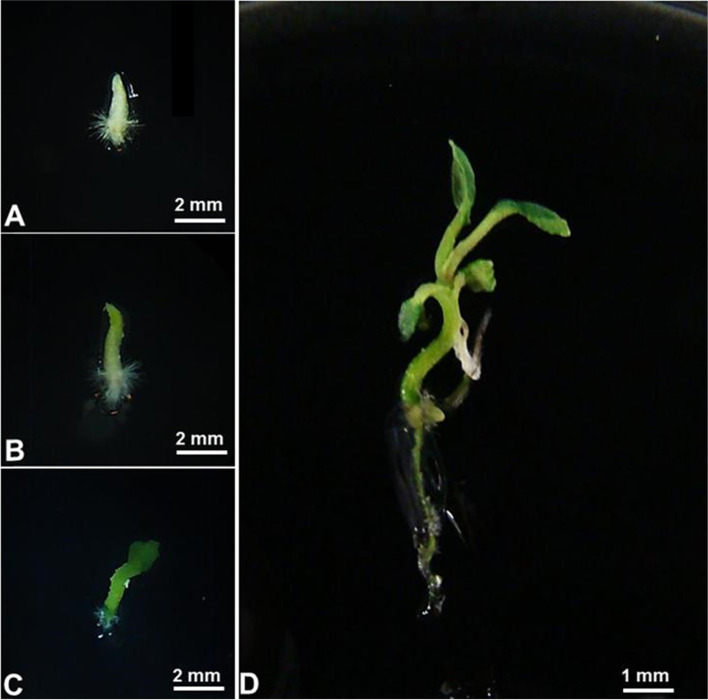
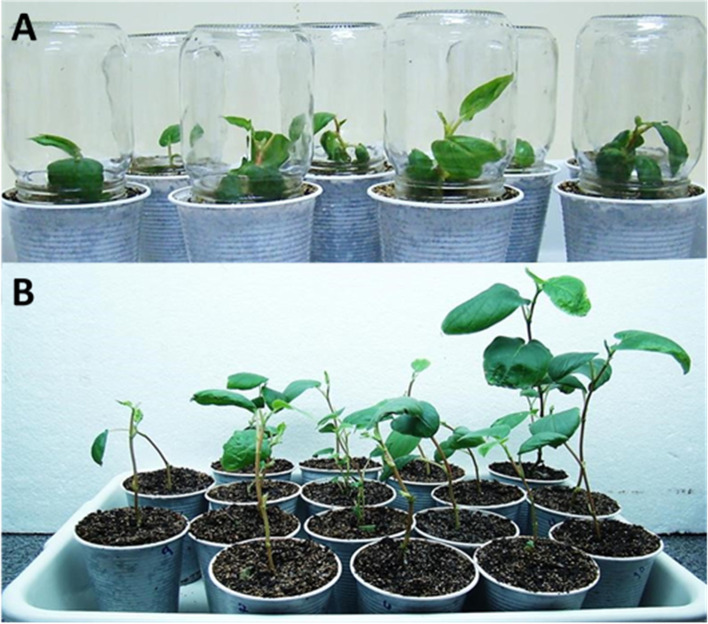
Piper hispidinervum is a species native from the Amazon region with great economic potential, given its scientifically proven insecticidal properties. In this study, an efficient protocol of plant regeneration via indirect somatic embryogenesis has been established for the first time. In a first experiment, for the induction of calluses, foliar explants of non-discriminated accesses of P. hispidinervum were inoculated in MS medium supplemented with α-naphtalenacetic acid (NAA) and 6-benzylaminopurine (BAP), in different combinations. For a second experiment, foliar explants from five different accesses of P. hispidinervum (PH17, PH21, PH28, PH37, and PH39) were analyzed regarding the formation of calluses when cultivated in MS medium with 5 mg L NAA + 2.5 mg L BAP. To obtain somatic embryos-like structures, calluses were cultivated in MS medium with 10 mg L NAA + 2.5 mg L of BAP. The somatic embryos-like structures obtained were inoculated in MS medium devoid of growth regulators and the plantlets were subjected to acclimatization. Calluses and somatic embryos-like structures were subjected to anatomical analysis and genetic stability of regenerated plants was analyzed by flow cytometry.
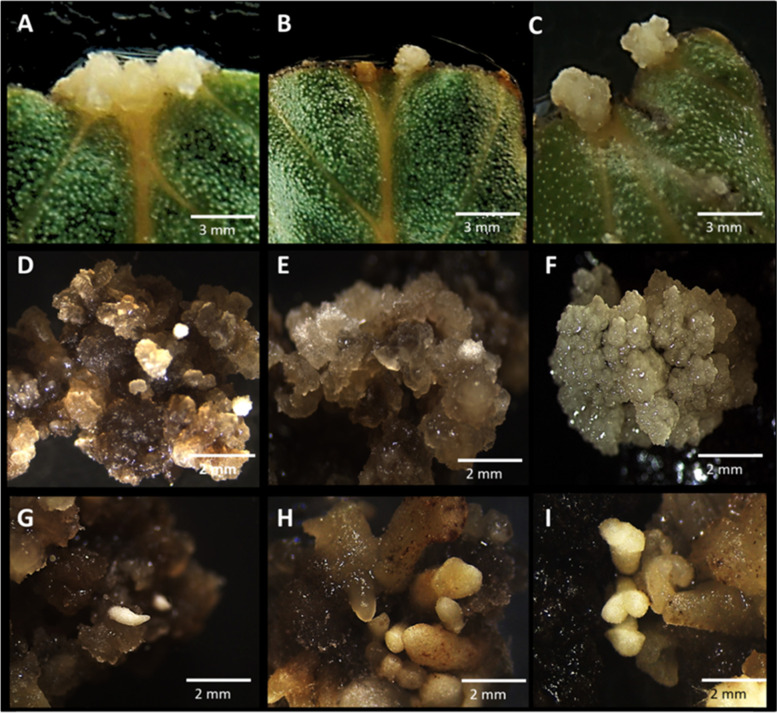
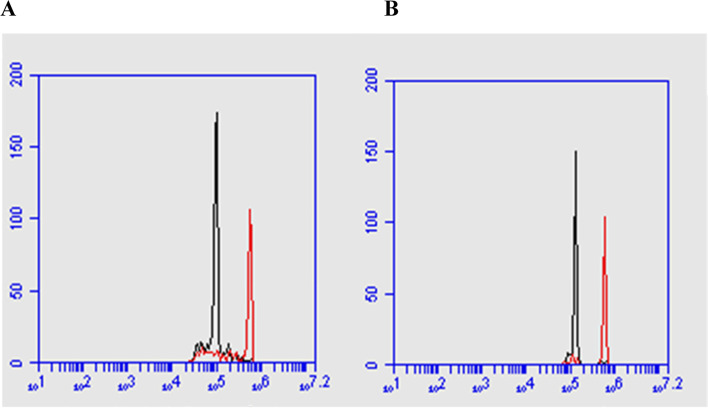
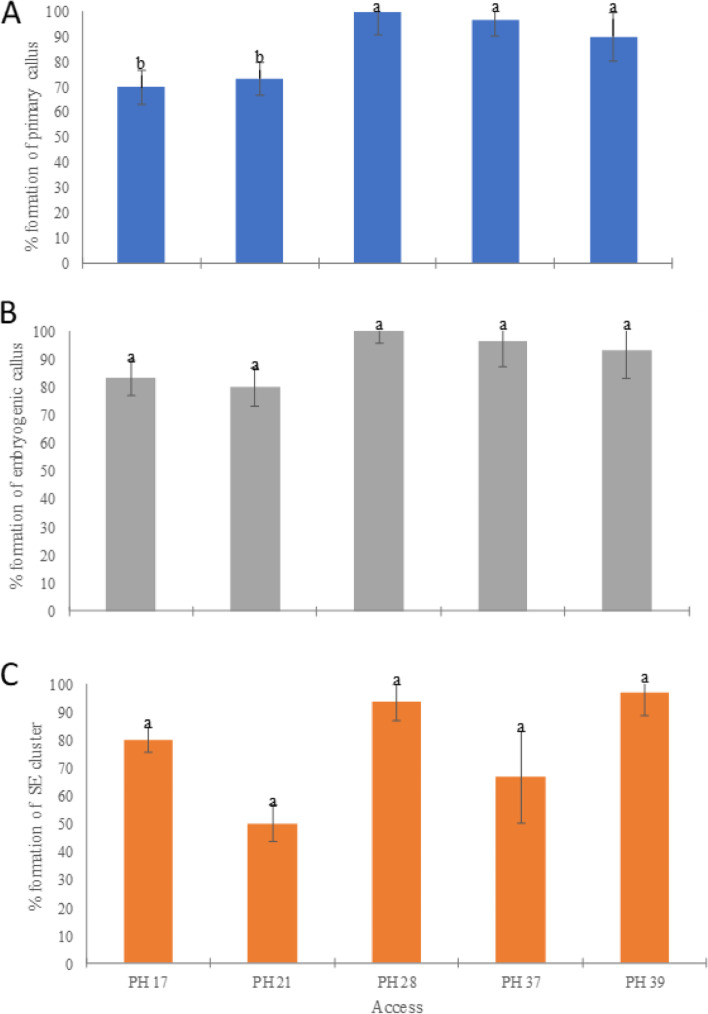
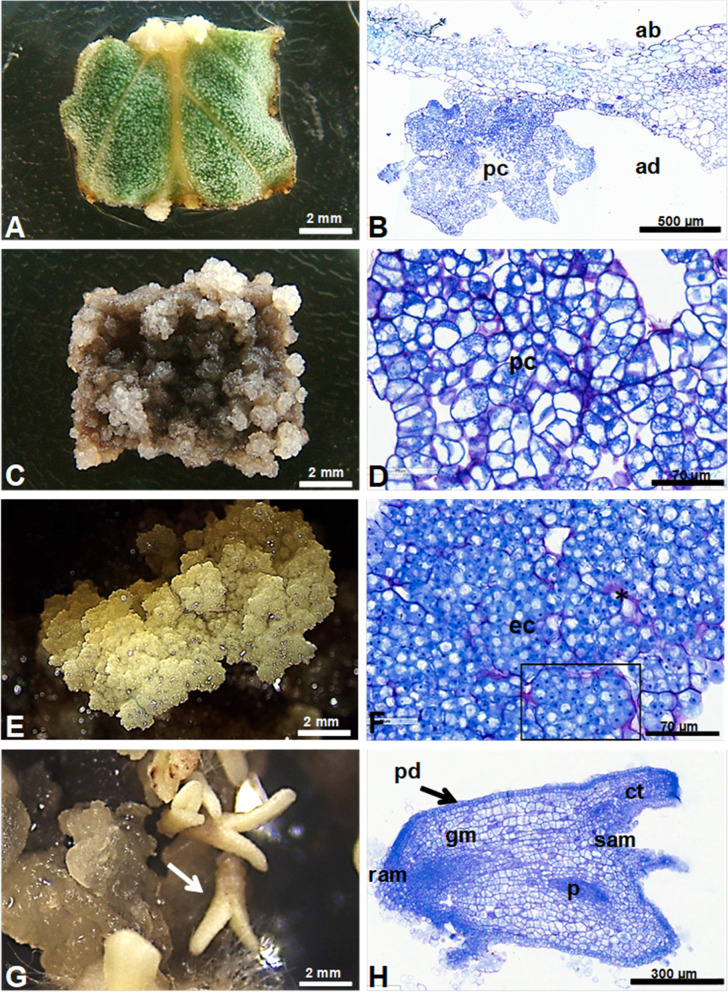
The treatments 2.5 mg L BAP and 5 mg L NAA + 2.5 mg L BAP, after 60 days of cultivation, provided each 32% of primary callus, not being verified the formation of calluses in medium devoid of BAP. It was found that accesses differed among them with respect to the formation of primary calluses, with emphasis on accesses PH28, PH37, and PH39, with mean percentage of 95.3%. Regarding the percentage of embryogenic calluses and formation of somatic embryos-like structures, there were no statistical differences between accesses, with mean values of 90.6% and 77.3%, respectively. The somatic embryos-like structures of P. hispidinervum have conspicuous morphoanatomical similarities with the zygotic embryo, and flow cytometry analysis showed no significant variation in nuclear DNA size among plants regenerated in vitro and plants coming from seed germination, which indicates ploidy level stability.
This protocol is the first cited in the literature that demonstrates an efficient micropropagation process by somatic embryogenesis of P. hispidinervum. It can be used either to enable large-scale vegetative production or to subsidize germplasm conservation or genetic engineering of P. hispidinervum.
糙脉胡椒是一种原产于亚马逊地区的植物,鉴于其已被科学证实的杀虫特性,具有巨大的经济潜力。在本研究中,首次建立了通过间接体细胞胚胎发生进行植物再生的有效方案。在第一个实验中,为了诱导愈伤组织,将糙脉胡椒未区分种质的叶片外植体接种在添加了α-萘乙酸(NAA)和6-苄基腺嘌呤(BAP)的不同组合的MS培养基中。在第二个实验中,分析了糙脉胡椒五个不同种质(PH17、PH21、PH28、PH37和PH39)的叶片外植体在含有5 mg/L NAA + 2.5 mg/L BAP的MS培养基中培养时愈伤组织的形成情况。为了获得体细胞胚样结构,将愈伤组织培养在含有10 mg/L NAA + 2.5 mg/L BAP的MS培养基中。将获得的体细胞胚样结构接种在不含生长调节剂的MS培养基中,并对植株进行驯化。对愈伤组织和体细胞胚样结构进行了解剖分析,并通过流式细胞术分析了再生植株的遗传稳定性。
培养60天后,2.5 mg/L BAP和5 mg/L NAA + 2.5 mg/L BAP处理分别产生了32%的初级愈伤组织,在不含BAP的培养基中未观察到愈伤组织的形成。发现不同种质在初级愈伤组织的形成上存在差异,其中PH28、PH37和PH39种质表现突出,平均百分比为95.3%。关于胚性愈伤组织的百分比和体细胞胚样结构的形成,不同种质之间没有统计学差异,平均值分别为90.6%和77.3%。糙脉胡椒的体细胞胚样结构在形态解剖学上与合子胚有明显的相似之处,流式细胞术分析表明,体外再生植株和种子萌发植株的核DNA大小没有显著差异,这表明倍性水平稳定。
本方案是文献中首次报道的通过糙脉胡椒体细胞胚胎发生实现高效微繁殖过程的方案。它可用于实现大规模营养繁殖,或为糙脉胡椒的种质保存或基因工程提供支持。