Department of Information Systems and Quantitative Methods, Business School, Université de Sherbrooke, 2500 boul. de l'Université, Sherbrooke, J1K 2X9, Canada.
Chaire Interdisciplinaire de Recherche et d'Intervention dans les Services de Santé, Université du Québec à Trois-Rivières, 3351 boul. des Forges, Trois-Rivières, G8Z 4M3, Canada.
BMC Health Serv Res. 2022 Mar 2;22(1):285. doi: 10.1186/s12913-022-07690-3.
Performance management systems have been introduced in health and social services institutions to improve organizational performance, supporting the emergence of new management behaviors that are more rooted in collaborative management practices. This study aims to understand how different leadership styles emerge through the implementation of a performance management system and its related tools, and how these can foster distributed leadership.
Over two years, the implementation of an integrated performance management system supporting the integration of social services for children, youth, and families was studied at a recently merged Canadian healthcare organization. Qualitative analysis of data collected from 15 interviews, 3 focus groups, and over 350 h of non-participant observation was conducted.
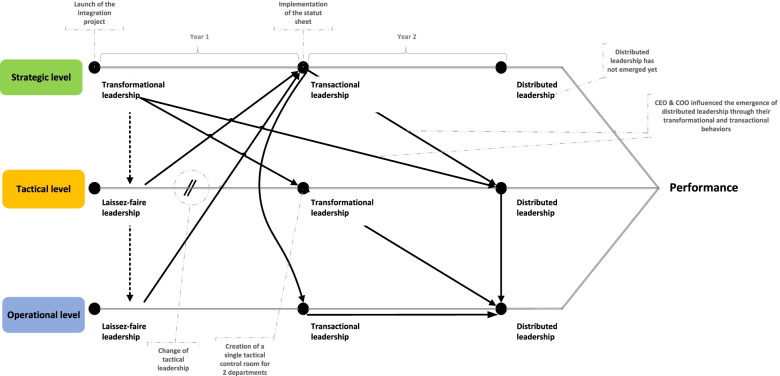
The results show that leadership evolved to adapt to the context of organizational integration and was no longer confined to a single manager. Transformational leadership was needed to encourage the emergence of a new integrated performance management system and new behaviors among middle managers and team members. Transactional leadership was legitimized through the use of a status sheet when the integration project did not deliver the expected results. Both transformational and transactional leadership paved the way to distributed leadership, which in turn promoted collaborative practices associated with activities in control rooms and dialogue stemming from the status sheets. Distributed leadership among team members made a difference in the outcome of the integration project, which became a driver of collaboration.
The integrated performance management system and the use of its tools can help renew leadership in health and social service organizations. The results lend credence to the importance of distributed leadership in promoting collaborative practices to improve services for children, youth, and families. The results also highlight how various leadership styles can contribute to the emergence of distributed leadership over time.
绩效管理系统已在卫生和社会服务机构中引入,以提高组织绩效,支持出现更扎根于协作管理实践的新管理行为。本研究旨在了解绩效管理系统及其相关工具的实施如何产生不同的领导风格,以及如何促进分布式领导。
在两年的时间里,对一家加拿大医疗保健组织最近合并后实施的综合绩效管理系统进行了研究,该系统支持儿童、青年和家庭的社会服务整合。对从 15 次访谈、3 个焦点小组和 350 多个小时的非参与观察中收集的数据进行了定性分析。
研究结果表明,领导风格已经演变以适应组织整合的背景,不再局限于单一的管理者。转型领导是必要的,以鼓励新的综合绩效管理系统和中层管理者及团队成员的新行为的出现。在整合项目没有达到预期结果时,通过使用状态表,使交易型领导合法化。转型领导和交易型领导都为分布式领导铺平了道路,而分布式领导又促进了与控制中心活动相关的协作实践和源自状态表的对话。团队成员之间的分布式领导对整合项目的结果产生了影响,从而成为协作的驱动力。
综合绩效管理系统及其工具的使用可以帮助更新卫生和社会服务组织的领导。研究结果证明了分布式领导在促进协作实践以改善儿童、青年和家庭服务方面的重要性。研究结果还强调了各种领导风格如何随着时间的推移有助于分布式领导的出现。