Université Côte d'Azur, Service Système Nerveux Périphérique & Muscle, Centre Hospitalier Universitaire de Nice, Nice, France.
Medical Affairs Department, AFM-Telethon, Evry, France.
Orphanet J Rare Dis. 2022 Mar 2;17(1):96. doi: 10.1186/s13023-021-01793-6.
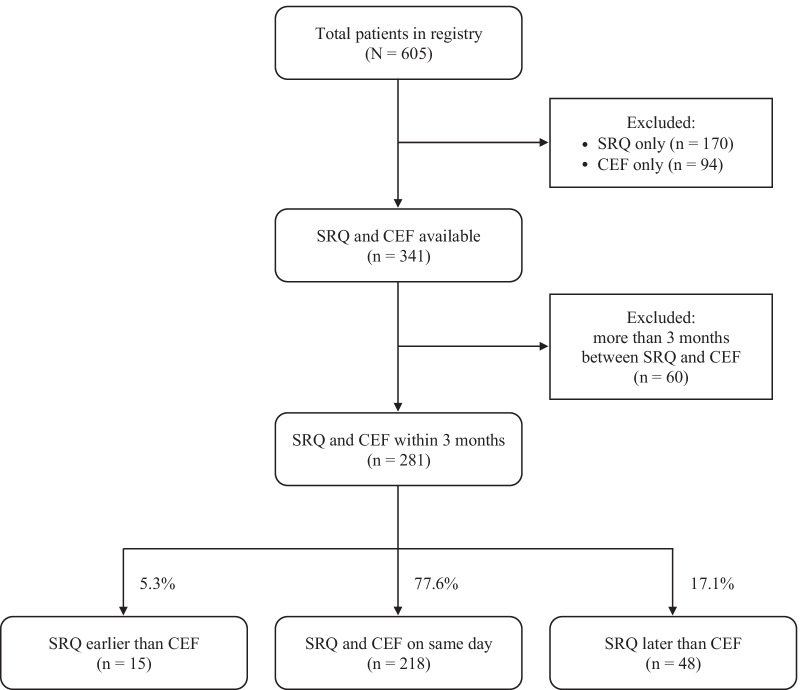
Facioscapulohumeral muscular dystrophy (FSHD) is among the most prevalent muscular dystrophies and currently has no treatment. Clinical and genetic heterogeneity are the main challenges to a full comprehension of the physiopathological mechanism. Improving our knowledge of FSHD is crucial to the development of future therapeutic trials and standards of care. National FSHD registries have been set up to this end. The French National Registry of FSHD combines a clinical evaluation form (CEF) and a self-report questionnaire (SRQ), filled out by a physician with expertise in neuromuscular dystrophies and by the patient, respectively. Aside from favoring recruitment, our strategy was devised to improve data quality. Indeed, the pairwise comparison of data from 281 patients for 39 items allowed for evaluating data accuracy. Kappa or intra-class coefficient (ICC) values were calculated to determine the correlation between answers provided in both the CEF and SRQ.
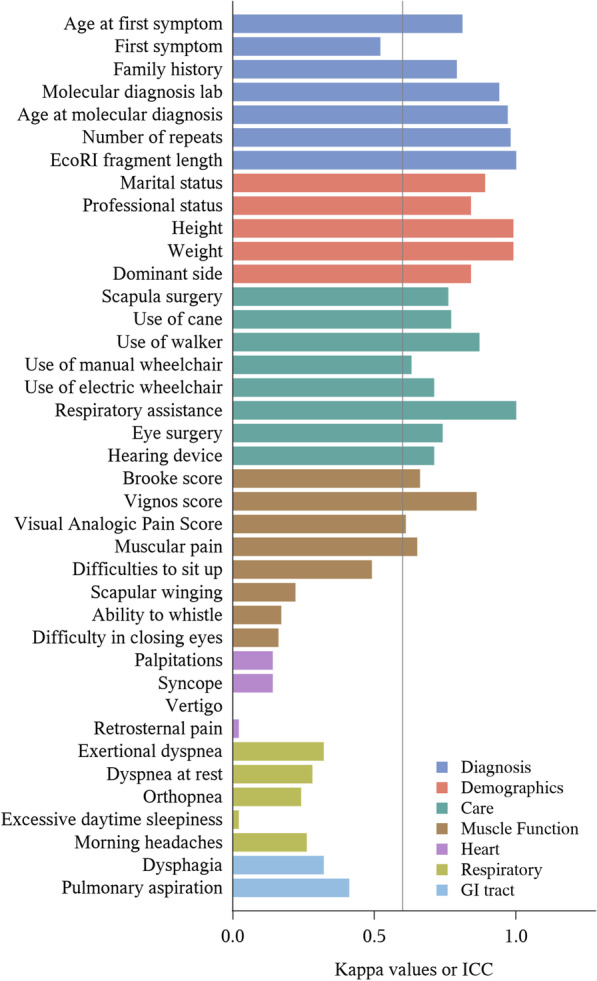
Patients and physicians agreed on a majority of questions common to the SRQ and CEF (24 out of 39). Demographic, diagnosis- and care-related questions were generally answered consistently by the patient and the medical practitioner (kappa or ICC values of most items in these groups were greater than 0.8). Muscle function-related items, i.e. FSHD-specific signs, showed an overall medium to poor correlation between data provided in the two forms; the distribution of agreements in this section was markedly spread out and ranged from poor to good. In particular, there was very little agreement regarding the assessment of facial motricity and the presence of a winged scapula. However, patients and physicians agreed very well on the Vignos and Brooke scores. The report of symptoms not specific to FSHD showed general poor consistency.
Patient and physician answers are largely concordant when addressing quantitative and objective items. Consequently, we updated collection forms by relying more on patient-reported data where appropriate. We hope the revised forms will reduce data collection time while ensuring the same quality standard. With the advent of artificial intelligence and automated decision-making, high-quality and reliable data are critical to develop top-performing algorithms to improve diagnosis, care, and evaluate the efficiency of upcoming treatments.
面肩肱型肌营养不良症(FSHD)是最常见的肌肉营养不良症之一,目前尚无治疗方法。临床和遗传异质性是全面理解生理病理机制的主要挑战。提高我们对 FSHD 的认识对于未来治疗试验和护理标准的发展至关重要。为此已经建立了国家 FSHD 登记处。法国 FSHD 国家登记处结合了临床评估表(CEF)和自我报告问卷(SRQ),分别由神经肌肉疾病专家和患者填写。除了有利于招募外,我们的策略还旨在提高数据质量。实际上,对 281 名患者的 39 项数据进行的两两比较评估了数据的准确性。卡帕或组内相关系数(ICC)值用于确定 CEF 和 SRQ 中提供的答案之间的相关性。
患者和医生对 SRQ 和 CEF 中共同的大多数问题(39 项中的 24 项)达成一致。人口统计学、诊断和护理相关问题通常由患者和医生一致回答(这些组中大多数项目的 Kappa 或 ICC 值大于 0.8)。肌肉功能相关项目,即 FSHD 特异性体征,在两种形式中提供的数据之间总体显示出中等至较差的相关性;这部分的一致性分布明显分散,范围从差到好。特别是,对面部运动和翼状肩胛骨的评估几乎没有一致意见。然而,患者和医生在 Vignos 和 Brooke 评分上非常一致。非 FSHD 特异性症状的报告总体上一致性较差。
当涉及定量和客观项目时,患者和医生的回答基本一致。因此,我们根据需要更多地依赖患者报告的数据来更新收集表格。我们希望修订后的表格将减少数据收集时间,同时确保相同的质量标准。随着人工智能和自动化决策的出现,高质量和可靠的数据对于开发高性能算法以改善诊断、护理和评估即将到来的治疗效果至关重要。