Environmental Systems Engineering, Faculty of Engineering and Applied Science, University of Regina, Regina, SK, S4S 0A2, Canada.
Industrial Systems Engineering, Faculty of Engineering and Applied Science, University of Regina, Regina, SK, S4S 0A2, Canada.
Environ Sci Pollut Res Int. 2022 Jul;29(33):50780-50789. doi: 10.1007/s11356-022-19487-2. Epub 2022 Mar 3.
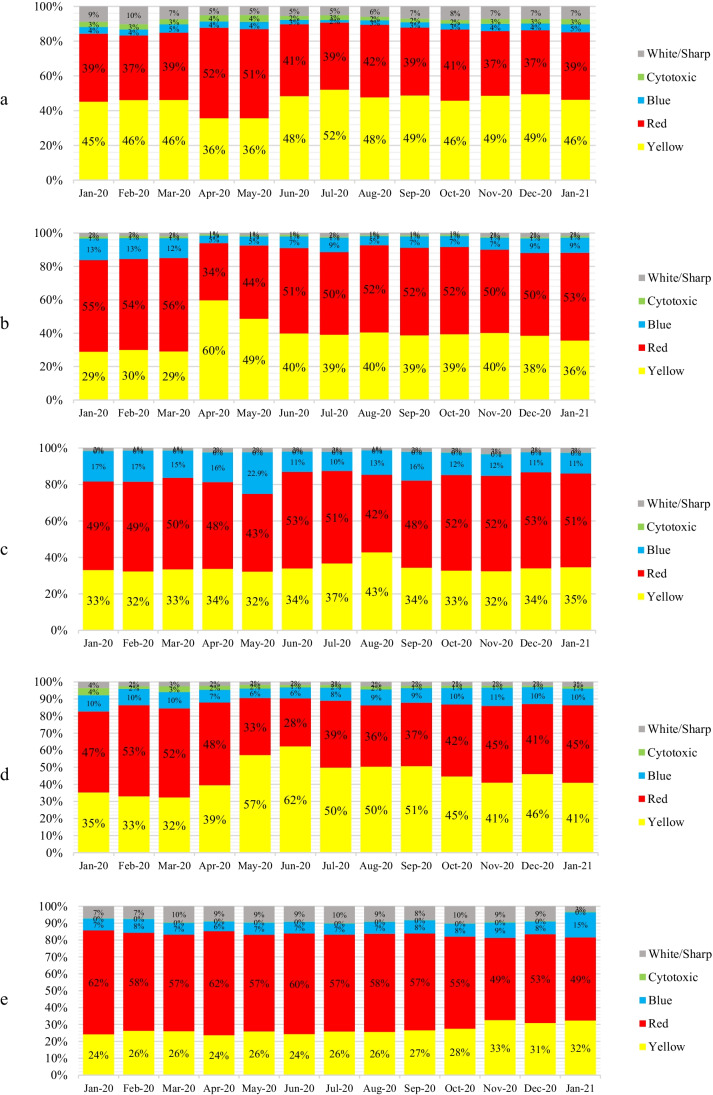
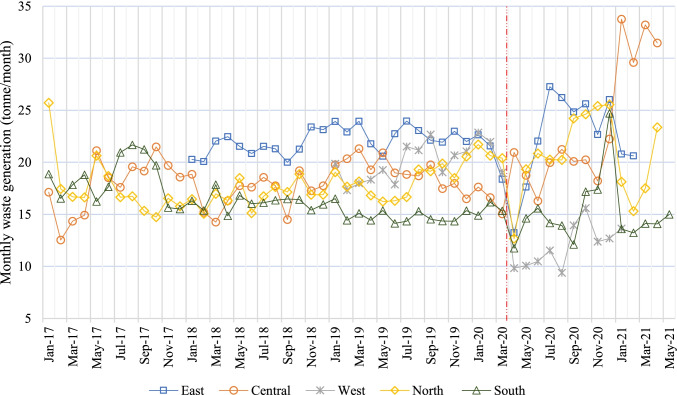
In this study, the hospital waste generation rates and compositions in Delhi were examined temporally and spatially during the first COVID-19 wave of April 2020. A total of 11 representative hospitals located in five districts were considered. The pre-COVID hospital waste generation rates were relatively consistent among the districts, ranging from 15 to 23 tonne/month. It is found that the number of hospital beds per capita may not be a significant factor in the hospital waste quantity. Strong seasonal variations were not observed. All districts experienced a drastic decrease in generation rates during the 1-month lockdown. The average rates during the COVID period ranged from 12 to 24 tonne/month. Bio-contaminated and disposable medical product wastes were the most common waste in Delhi's hospitals, representing 70-80% by weight. The changes in waste composition were however not spatially consistent. The lockdown appeared to have had a higher impact on hospital waste generation rate than on waste composition. The findings are important as the design and operation of a waste management system are sensitive to both waste quantity and quality. Waste records at source helped to minimize waste data uncertainties and allowed a closer examination of generation trends.
在这项研究中,研究人员在 2020 年 4 月首次新冠疫情期间,对德里的医院废物产生率和组成进行了时空考察。总共考虑了五个区的 11 家具有代表性的医院。在新冠疫情之前,各地区的医院废物产生率相对稳定,范围在 15 至 23 吨/月之间。研究发现,人均医院床位数量可能不是医院废物数量的重要因素。没有观察到明显的季节性变化。所有地区在为期一个月的封锁期间,废物产生率都大幅下降。新冠疫情期间的平均产生率在 12 至 24 吨/月之间。生物污染和一次性医疗产品废物是德里医院最常见的废物,占重量的 70-80%。然而,废物组成的变化在空间上并不一致。封锁似乎对医院废物产生率的影响比对废物组成的影响更大。这些发现很重要,因为废物管理系统的设计和运行对废物数量和质量都很敏感。源头废物记录有助于减少废物数据的不确定性,并更密切地检查产生趋势。