Department of Neurology, Faculty of Medicine, Juntendo University, 2-1-1 Hongo, Bunkyo-ku, 113-8421, Tokyo, Japan.
Department of Neurology, Faculty of Medicine, Toho University, 6-11-1 Omorinishi, Ota-ku, Tokyo, 143-8541, Japan.
BMC Neurol. 2022 Mar 3;22(1):71. doi: 10.1186/s12883-022-02600-w.
Levodopa remains the most effective symptomatic treatment for Parkinson's disease (PD) more than 50 years after its clinical introduction. However, the onset of motor complications can limit pharmacological intervention with levodopa, which can be a challenge when treating PD patients. Clinical data suggest using the lowest possible levodopa dose to balance the risk/benefit. Istradefylline, an adenosine A receptor antagonist indicated as an adjunctive treatment to levodopa-containing preparations in PD patients experiencing wearing off, is currently available in Japan and the US. Preclinical and preliminary clinical data suggested that adjunctive istradefylline may provide sustained antiparkinsonian benefits without a levodopa dose increase; however, available data on the impact of istradefylline on levodopa dose titration are limited. The ISTRA ADJUST PD study will evaluate the effect of adjunctive istradefylline on levodopa dosage titration in PD patients.
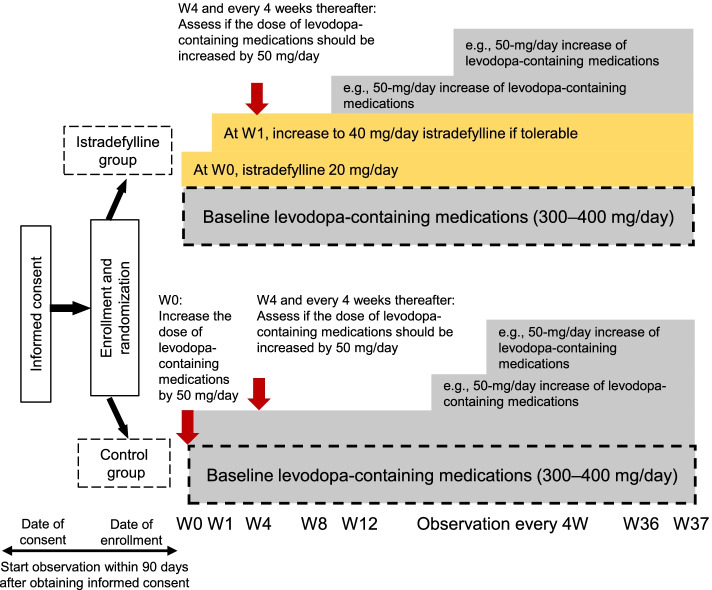
This 37-week, multicenter, randomized, open-label, parallel-group controlled study in PD patients aged 30-84 years who are experiencing the wearing-off phenomenon despite receiving levodopa-containing medications ≥ 3 times daily (daily dose 300-400 mg) began in February 2019 and will continue until February 2022. Enrollment is planned to attain 100 evaluable patients for the efficacy analyses. Patients will receive adjunctive istradefylline (20 mg/day, increasing to 40 mg/day) or the control in a 1:1 ratio, stratified by age, levodopa equivalent dose, and presence/absence of dyskinesia. During the study, the levodopa dose will be increased according to symptom severity. The primary study endpoint is the comparison of the cumulative additional dose of levodopa-containing medications during the treatment period between the adjunctive istradefylline and control groups. Secondary endpoints include changes in efficacy rating scales and safety outcomes.
This study aims to clarify whether adjunctive istradefylline can reduce the cumulative additional dose of levodopa-containing medications in PD patients experiencing the wearing-off phenomenon, and lower the risk of levodopa-associated complications. It is anticipated that data from ISTRA ADJUST PD will help inform future clinical decision-making for patients with PD in the real-world setting.
Japan Registry of Clinical Trials, jRCTs031180248 ; registered 12 March 2019.
左旋多巴在其临床应用 50 多年后仍然是治疗帕金森病(PD)最有效的对症治疗方法。然而,运动并发症的出现可能会限制左旋多巴的药物干预,这在治疗 PD 患者时是一个挑战。临床数据表明,应使用尽可能低的左旋多巴剂量来平衡风险/获益。伊曲茶碱是一种腺苷 A 受体拮抗剂,被批准作为正在经历药效波动的 PD 患者的左旋多巴制剂的辅助治疗药物,目前在日本和美国均可获得。临床前和初步临床数据表明,辅助伊曲茶碱可能在不增加左旋多巴剂量的情况下提供持续的抗帕金森病益处;然而,目前关于伊曲茶碱对左旋多巴剂量滴定影响的数据有限。ISTRA ADJUST PD 研究将评估辅助伊曲茶碱对 PD 患者左旋多巴剂量滴定的影响。
这项在 30-84 岁 PD 患者中开展的为期 37 周、多中心、随机、开放标签、平行组对照研究纳入了正在接受左旋多巴药物治疗(每日剂量 300-400mg,每日 3 次以上)且仍经历药效波动的患者,于 2019 年 2 月开始,预计将持续到 2022 年 2 月。计划招募 100 名可评估患者进行疗效分析。患者将以 1:1 的比例随机分配接受辅助伊曲茶碱(20mg/天,增至 40mg/天)或对照药物治疗,分组因素包括年龄、左旋多巴等效剂量和是否存在运动障碍。在研究过程中,将根据症状严重程度增加左旋多巴剂量。主要研究终点是治疗期间辅助伊曲茶碱组和对照组含左旋多巴药物的累积附加剂量的比较。次要终点包括疗效评定量表的变化和安全性结果。
这项研究旨在阐明辅助伊曲茶碱是否能减少正在经历药效波动的 PD 患者含左旋多巴药物的累积附加剂量,并降低与左旋多巴相关的并发症风险。预计 ISTRA ADJUST PD 研究的数据将有助于为现实世界中 PD 患者的临床决策提供信息。
日本临床试验注册处,jRCTs031180248;注册于 2019 年 3 月 12 日。