Dhokotera Tafadzwa, Asangbeh Serra, Bohlius Julia, Singh Elvira, Egger Matthias, Rohner Eliane, Ncayiyana Jabulani, Clifford Gary M, Olago Victor, Sengayi-Muchengeti Mazvita
National Cancer Registry, National Health Laboratory Science, 1 Modderfontein Road, Sandringham, Johannesburg 2192, South Africa.
Graduate School for Cellular and Biomedical Sciences, University of Bern, Uni Mittelstrasse, Mittelstrasse 43, CH-3012 Bern, Switzerland.
Ecancermedicalscience. 2022 Jan 27;16:1348. doi: 10.3332/ecancer.2022.1348. eCollection 2022.
In countries with high HIV prevalence, it is important to understand the cervical cancer (CC) patterns by HIV status to ensure targeted prevention measures. We aimed to determine the factors associated with CC compared to non-infection related cancer in women living in South Africa.
This was a cross-sectional study of women aged 15 years and older diagnosed with CC and non-infection related cancer in the South African public health sector from 2004 to 2014. The National Cancer Registry provided data on cancer, whilst HIV status was determined from routinely collected HIV related data from the National Health Laboratory Service. We explored the association of HIV infection, age, ethnicity and calendar period with CC compared to non-infection related cancer.
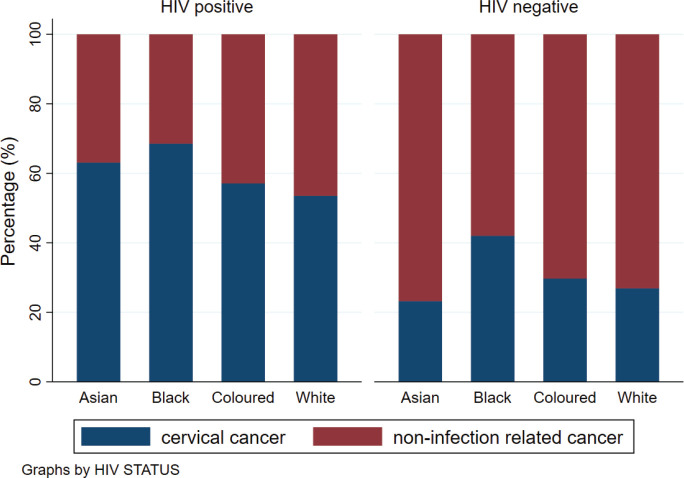
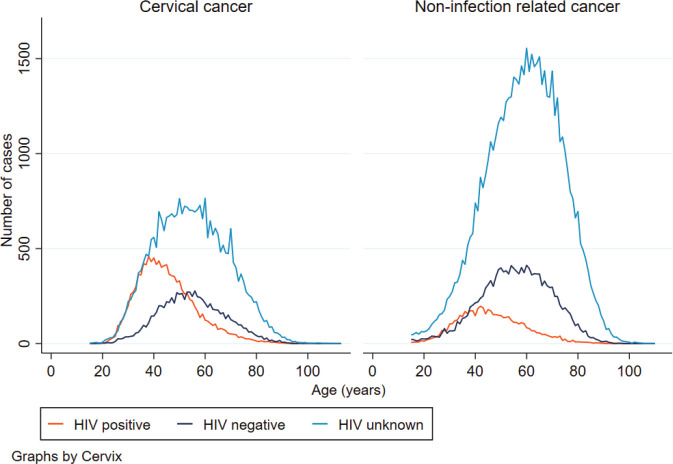
From 2004 to 2014, 49,599 women were diagnosed with CC, whilst 78,687 women had non-infection related cancer. About 40% ( = 20,063) of those with CC and 28% ( = 5,667) of those with non-infection related cancer had a known HIV status. The median age at CC diagnosis was 44 years (interquartile range (IQR): 37-52) and 54 years (IQR: 46-64) for HIV positive and negative women, respectively, and for non-infection related cancer, 45 years (IQR: 47-55) and 56 years (IQR: 47-66) for HIV negative and positive women, respectively. Diagnosis of CC was associated with HIV positivity, Black ethnicity, earlier calendar period (2004-2006) and the ages 30-49 years. In comparison with Black women, the odds of CC were 44% less in Coloured women, 50% less in Asian women and 51% less in White women.
HIV positive women presented a decade earlier with CC compared to HIV negative women. A large proportion of women with CC were unaware of their HIV status with a disproportionate burden of CC in Black women. We recommend women attending CC screening facilities to be offered HIV testing so that recommendations for their follow-up visits are given according to their HIV status.
在艾滋病毒高流行率的国家,了解不同艾滋病毒感染状况下的宫颈癌(CC)模式对于确保采取有针对性的预防措施至关重要。我们旨在确定南非女性中与宫颈癌相关的因素,并与非感染相关癌症进行比较。
这是一项横断面研究,研究对象为2004年至2014年在南非公共卫生部门被诊断为宫颈癌和非感染相关癌症的15岁及以上女性。国家癌症登记处提供癌症数据,而艾滋病毒感染状况则根据国家卫生实验室服务部门常规收集的艾滋病毒相关数据确定。我们探讨了艾滋病毒感染、年龄、种族和时间周期与宫颈癌之间的关联,并与非感染相关癌症进行比较。
2004年至2014年期间,49599名女性被诊断为宫颈癌,而78687名女性患有非感染相关癌症。宫颈癌患者中约40%(20063例)和非感染相关癌症患者中约28%(5667例)的艾滋病毒感染状况已知。宫颈癌诊断时的中位年龄,艾滋病毒阳性女性为44岁(四分位间距(IQR):37 - 52岁),艾滋病毒阴性女性为54岁(IQR:46 - 64岁);对于非感染相关癌症,艾滋病毒阴性女性为45岁(IQR:47 - 55岁),艾滋病毒阳性女性为56岁(IQR:47 - 66岁)。宫颈癌的诊断与艾滋病毒阳性、黑人种族、早期时间周期(2004 - 2006年)以及30 - 49岁年龄相关。与黑人女性相比,有色人种女性患宫颈癌的几率低44%,亚洲女性低50%,白人女性低51%。
与艾滋病毒阴性女性相比,艾滋病毒阳性女性患宫颈癌的时间提前了十年。很大一部分宫颈癌女性不知道自己的艾滋病毒感染状况,且黑人女性宫颈癌负担不成比例。我们建议为前往宫颈癌筛查机构的女性提供艾滋病毒检测,以便根据她们的艾滋病毒感染状况给出后续随访建议。