Swedish University of Agricultural Sciences, Department of Aquatic Sciences and Assessment, Uppsala, Sweden.
The PRODEO Institute, San Francisco, CA, USA.
Int J Health Policy Manag. 2022 Sep 1;11(9):1949-1952. doi: 10.34172/ijhpm.2022.7043. Epub 2022 Feb 28.
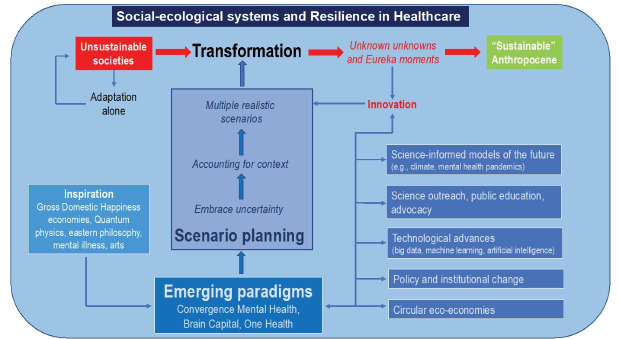
Adaptive capacity is a critical component of building resilience in healthcare (RiH). Adaptive capacity comprises the ability of a system to cope with and adapt to disturbances. However, "shocks," such as the current coronavirus disease 2019 (COVID-19) pandemic, can potentially exceed critical adaptation thresholds and lead to systemic collapse. To effectively manage healthcare systems during periods of crises, both adaptive and transformative changes are necessary. This commentary discusses adaptation and transformation as two complementary, integral components of resilience and applies them to healthcare. We treat resilience as an emergent property of complex systems that accounts for multiple, often disparately distinct regimes in which multiple processes (eg, adaptation, recovery) are subsumed and operate. We argue that Convergence Mental Health and other transdisciplinary paradigms such as Brain Capital and One Health can facilitate resilience planning and management in healthcare systems.
适应能力是构建医疗保健弹性(RiH)的关键组成部分。适应能力包括系统应对和适应干扰的能力。然而,“冲击”,如当前的 2019 年冠状病毒病(COVID-19)大流行,可能会超过关键的适应阈值并导致系统崩溃。为了在危机期间有效地管理医疗保健系统,需要进行适应性和变革性的改变。本评论将适应和转变讨论为弹性的两个互补的、不可或缺的组成部分,并将其应用于医疗保健。我们将弹性视为复杂系统的涌现属性,其中包含多个通常截然不同的状态,其中包含和运行多个过程(例如,适应、恢复)。我们认为,汇聚心理健康和其他跨学科范式,如大脑资本和同一健康,可以促进医疗保健系统的弹性规划和管理。