
用于骨髓增生异常综合征诊断中Ki-67增殖指数测定的优化门控策略及辅助流式细胞术数据
Optimized gating strategy and supporting flow cytometry data for the determination of the Ki-67 proliferation index in the diagnosis of myelodysplastic syndrome.
作者信息
Mestrum Stefan G C, Cremers Eline M P, de Wit Norbert C J, Drent Roosmarie J M, Ramaekers Frans C S, Hopman Anton H N, Leers Math P G
机构信息
Department of Molecular Cell Biology, GROW-School for Oncology and Developmental Biology, Maastricht University Medical Center, Maastricht, the Netherlands.
Department of Clinical Chemistry and Hematology, Zuyderland Medical Center, Sittard-Geleen, the Netherlands.
出版信息
Data Brief. 2022 Feb 22;41:107976. doi: 10.1016/j.dib.2022.107976. eCollection 2022 Apr.
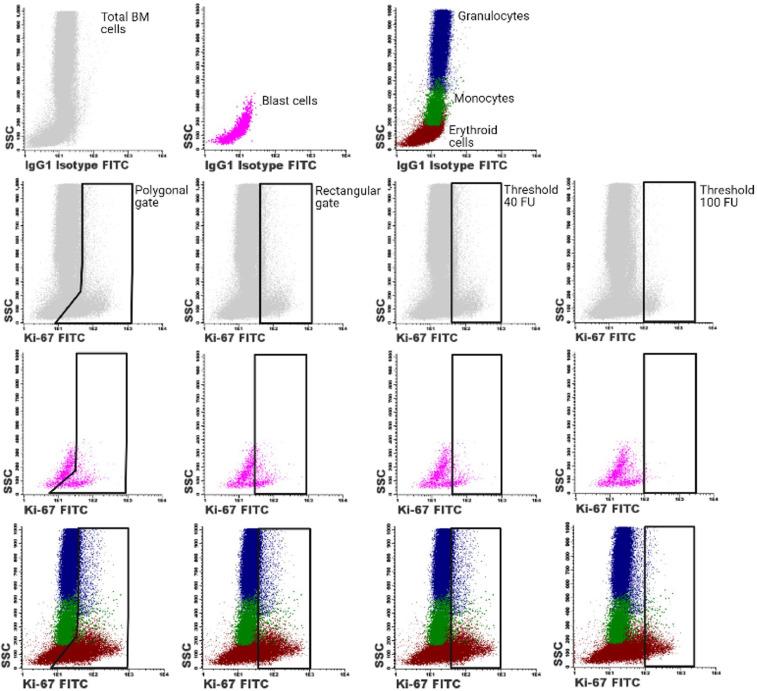
This Data in Brief article presents a novel flow cytometric assay used to acquire and process the data presented and discussed in the research paper by Mestrum et al., co-submitted to entitled: "Integration of the Ki-67 proliferation index into the Ogata score improves its diagnostic sensitivity for low-grade myelodysplastic syndromes." [1]. The dataset includes the gated fractions of the different myeloid populations in bone marrow (BM) aspirates (total BM cells, CD34 positive blast cells, erythroid cells, granulocytes and monocytes. The raw data is hosted in FlowRepository, while the analyzed data of 1) the fractions of the different myeloid cell populations and 2) the Ki-67 proliferation indices of these myeloid cell populations are provided in tabular form to allow comparison and reproduction of the data when such analyses are performed in a different setting. BM cells from aspirates of 50 myelodysplastic syndrome (MDS) patients and 20 non-clonal cytopenic controls were stained using specific antibody panels and proper fixation and permeabilization to determine the Ki-67 proliferation indices of the different myeloid cell populations. Data was acquired with the three laser, 10-color Navios™ Flow cytometer (Beckman Coulter, Marseille, France) with a blue diode Argon laser (488 nm, 22 mW), red diode Helium/Neon laser (638 nm, 25 mW) and violet air-cooled solid-state diode laser laser (405 nm, 50 mW). A minimum of 100,000 relevant events were acquired per sample, while we aimed at acquiring 500,000 events per sample. Gating was performed with the Infinicyt v2.0 software package (Cytognos SL, Salamanca, Spain). These data may guide the development and standardization of the flow cytometric analysis of the Ki-67 proliferation index (and other markers for cell behavior) for differentiation between non-clonal cytopenic patients and MDS patients. In addition, this assay may be used in myeloid malignancies for research and clinical purposes in other laboratories. This data can be used to encourage future research regarding stem-/progenitor cell resistance against anti-cancer therapies for myeloid malignancies, diagnostics of myeloid malignancies and prognosis of myeloid malignancies. Therefore, these data are of relevance to internist-hematologists, clinical chemists with sub-specialization of hematology and hemato-oncology oriented researchers.
这篇《数据简报》文章介绍了一种新型流式细胞术检测方法,用于获取和处理Mestrum等人共同提交的研究论文中呈现和讨论的数据,该论文标题为:“将Ki-67增殖指数纳入绪方评分可提高其对低级别骨髓增生异常综合征的诊断敏感性”[1]。数据集包括骨髓(BM)抽吸物中不同髓系细胞群的门控分数(总BM细胞、CD34阳性原始细胞、红系细胞、粒细胞和单核细胞)。原始数据存于FlowRepository中,而1)不同髓系细胞群的分数和2)这些髓系细胞群的Ki-67增殖指数的分析数据以表格形式提供,以便在不同环境下进行此类分析时能够比较和重现数据。使用特定抗体组合以及适当的固定和通透处理对50例骨髓增生异常综合征(MDS)患者和20例非克隆性血细胞减少症对照患者的抽吸物中的BM细胞进行染色,以确定不同髓系细胞群的Ki-67增殖指数。使用配备蓝色二极管氩离子激光(488 nm,22 mW)、红色二极管氦氖激光(638 nm,25 mW)和紫色风冷固态二极管激光(405 nm,50 mW)的三激光、10色Navios™流式细胞仪(贝克曼库尔特公司,法国马赛)采集数据。每个样本至少采集100,000个相关事件,同时我们的目标是每个样本采集500,000个事件。使用Infinicyt v2.0软件包(Cytognos SL,西班牙萨拉曼卡)进行门控。这些数据可能会指导Ki-67增殖指数(以及其他细胞行为标志物)流式细胞术分析的开发和标准化,以区分非克隆性血细胞减少症患者和MDS患者。此外,该检测方法可用于其他实验室的髓系恶性肿瘤的研究和临床目的。这些数据可用于鼓励未来关于髓系恶性肿瘤干细胞/祖细胞对抗癌治疗的抗性、髓系恶性肿瘤的诊断和髓系恶性肿瘤预后的研究。因此,这些数据对于内科血液学家、具有血液学亚专业的临床化学家以及血液肿瘤学方向的研究人员具有相关性。


 Zotero 插件