Centro de Investigación del Cáncer (Instituto de Biología Celular y Molecular del Cáncer, CSIC-USAL), IBSAL, Servicio de Citometría and Departamento de Medicina, Universidad de Salamanca, Salamanca, Spain.
PLoS One. 2012;7(8):e44321. doi: 10.1371/journal.pone.0044321. Epub 2012 Aug 31.
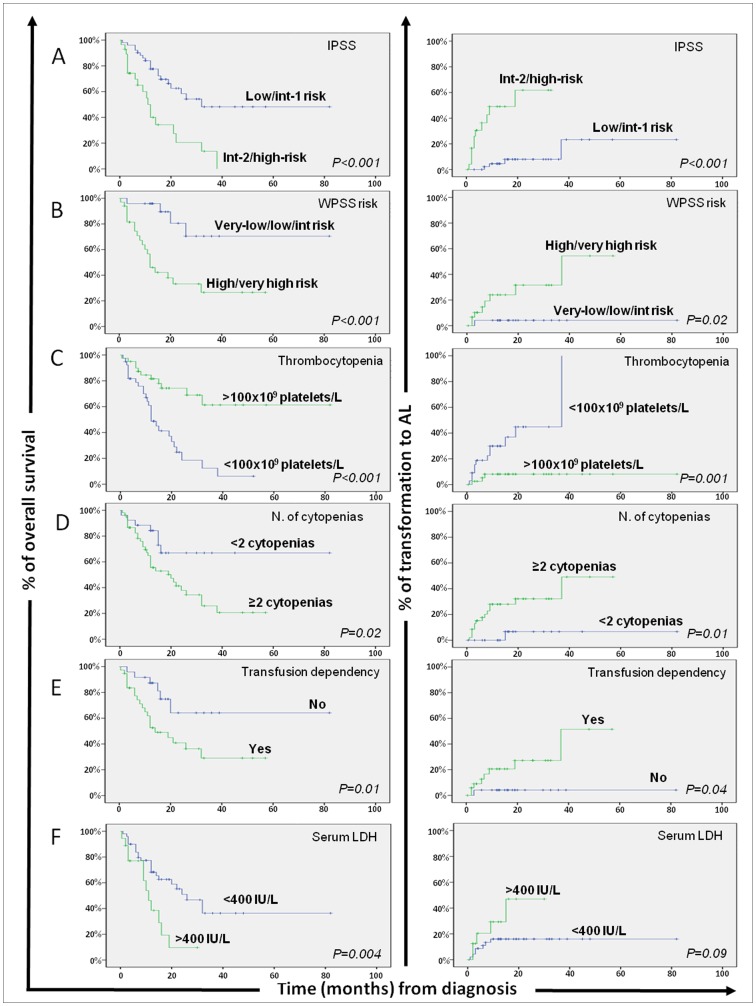
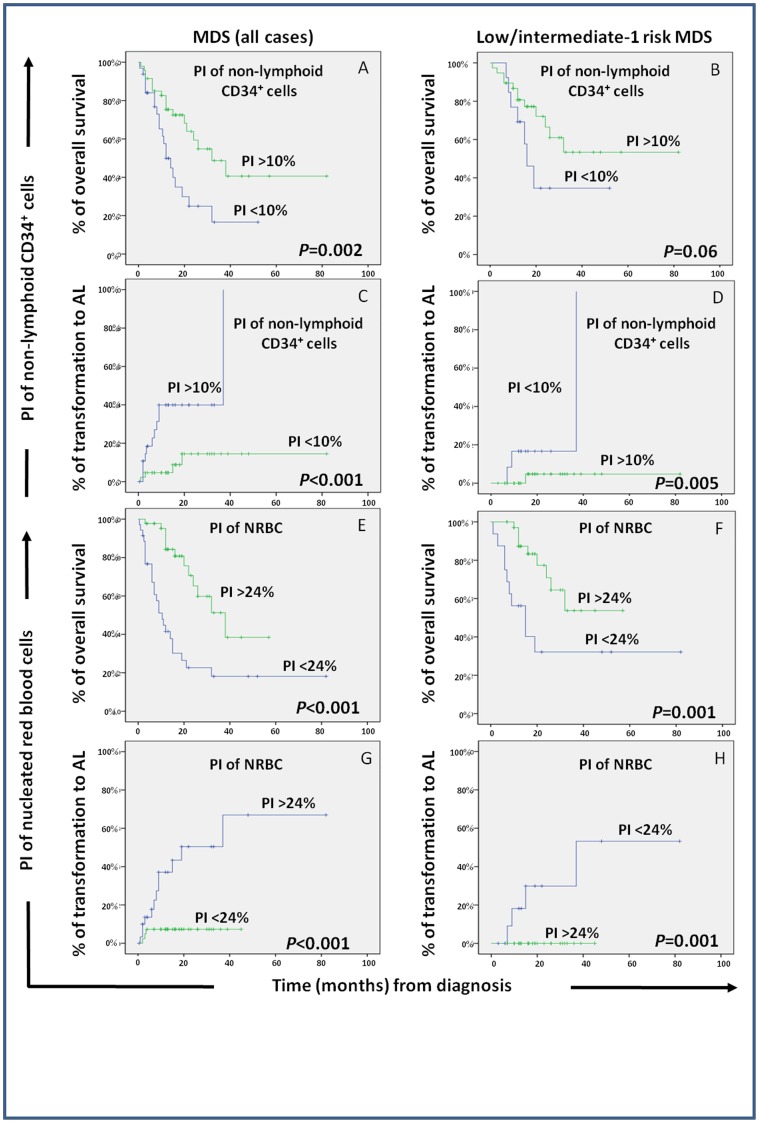
Myelodysplastic syndromes (MDS) are clonal stem cell disorders which frequently show a hypercellular dysplastic bone marrow (BM) associated with inefficient hematopoiesis and peripheral cytopenias due to increased apoptosis and maturation blockades. Currently, little is known about the role of cell proliferation in compensating for the BM failure syndrome and in determining patient outcome. Here, we analyzed the proliferation index (PI) of different compartments of BM hematopoietic cells in 106 MDS patients compared to both normal/reactive BM (n = 94) and acute myeloid leukemia (AML; n = 30 cases) using multiparameter flow cytometry. Our results show abnormally increased overall BM proliferation profiles in MDS which significantly differ between early/low-risk and advanced/high-risk cases. Early/low-risk patients showed increased proliferation of non-lymphoid CD34(+) precursors, maturing neutrophils and nucleated red blood cells (NRBC), while the PI of these compartments of BM precursors progressively fell below normal values towards AML levels in advanced/high-risk MDS. Decreased proliferation of non-lymphoid CD34(+) and NRBC precursors was significantly associated with adverse disease features, shorter overall survival (OS) and transformation to AML, both in the whole series and when low- and high-risk MDS patients were separately considered, the PI of NRBC emerging as the most powerful independent predictor for OS and progression to AML. In conclusion, assessment of the PI of NRBC, and potentially also of other compartments of BM precursors (e.g.: myeloid CD34(+) HPC), could significantly contribute to a better management of MDS.
骨髓增生异常综合征(MDS)是克隆性干细胞疾病,常表现为骨髓增生异常伴无效造血,外周血细胞减少,这是由于细胞凋亡增加和成熟阻滞所致。目前,人们对细胞增殖在补偿骨髓衰竭综合征和决定患者预后方面的作用知之甚少。在这里,我们使用多参数流式细胞术分析了 106 例 MDS 患者与正常/反应性骨髓(n=94)和急性髓系白血病(AML;n=30 例)的不同骨髓造血细胞区室的增殖指数(PI)。我们的结果显示,MDS 患者的整体骨髓增殖谱异常增加,早期/低危和晚期/高危病例之间存在显著差异。早期/低危患者的非淋巴系 CD34+前体、成熟中性粒细胞和有核红细胞(NRBC)增殖增加,而这些骨髓前体细胞区室的 PI 逐渐降至正常低值,并向 AML 水平下降。非淋巴系 CD34+和 NRBC 前体的增殖减少与不良疾病特征、总生存期(OS)缩短和向 AML 转化显著相关,这在整个系列中以及在低危和高危 MDS 患者分别考虑时均如此,NRBC 的 PI 成为 OS 和进展为 AML 的最有力独立预测因子。总之,NRBC 的 PI 评估,以及潜在的骨髓前体细胞其他区室(例如:髓系 CD34+HPC)的评估,可能会显著有助于 MDS 的更好管理。