Gynaecological Endocrinology and Reproductive Medicine, University Women's Hospital Inselspital, Friedbuehlstrasse 19, 3010, Bern, Switzerland.
Besins Healthcare Germany GmbH, Ullsteinhaus, Mariendorfer Damm 3, 12099, Berlin, Germany.
Arch Gynecol Obstet. 2022 Aug;306(2):513-521. doi: 10.1007/s00404-022-06457-9. Epub 2022 Mar 7.
The transition from the fertile phase of life to menopause is associated with numerous physical changes. Hormone replacement therapy (HRT), as the most effective and efficient form of drug treatment, involves the use of oestrogens and progestins with the aim of increasing health-related quality of life through symptom reduction, sleep improvement and affect enhancement.
The medical care situation and disease burden of menopausal women was investigated by means of a survey of 1000 women aged 45-60 years on the topics of quality of life, menopause and HRT and a quantitative, longitudinal healthcare study based on an anonymised and age- and sex-adjusted Statutory Health Insurance (SHI) routine data set with approximately four million anonymous insured persons per year.
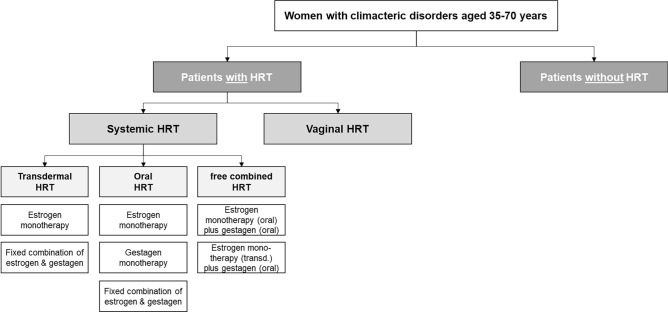
Out of more than half a million women aged 35-70 years, and with statutory health insurance, (n = 613,104), 14% (n = 82,785) had climacteric disorder documented as a first diagnosis in 2014. The proportion of women with the climacteric disorder, who were prescribed HRT on an outpatient basis, was 21%; according to the forsa survey, 50% of the women surveyed felt moderate to poorly/very poorly informed about treatment options.
Findings from the health insurance research conducted with different data sources (survey and SHI claims data) indicate the need for increasing awareness and providing an early and informative education on HRT and its risks and benefits.
从生育期向绝经期的过渡与许多身体变化有关。激素替代疗法(HRT)作为最有效和最有效的药物治疗形式,涉及使用雌激素和孕激素,旨在通过减轻症状、改善睡眠和改善情绪来提高与健康相关的生活质量。
通过对 1000 名年龄在 45-60 岁的妇女进行生活质量、绝经期和 HRT 主题的调查,以及一项基于匿名和年龄及性别调整的法定健康保险(SHI)常规数据的定量、纵向医疗保健研究,调查了绝经期妇女的医疗保健状况和疾病负担。该数据集中每年约有 400 万匿名参保人。
在 35-70 岁的超过 50 万名女性中,有 14%(n=82785)在 2014 年首次诊断为更年期障碍。在门诊接受 HRT 治疗的更年期障碍女性比例为 21%;根据 fors 调查,50%的接受调查的女性认为自己对治疗选择的了解程度为中等或较差/非常差。
不同数据源(调查和 SHI 索赔数据)进行的健康保险研究结果表明,需要提高对 HRT 及其风险和益处的认识,并提供早期和信息丰富的教育。