Nuffield Department of Primary Care Health Sciences, University of Oxford, Oxford, UK.
University of Oslo, Oslo, Norway.
Br J Gen Pract. 2022 Apr 28;72(718):e351-e360. doi: 10.3399/BJGP.2021.0658. Print 2022 May.
Fewer than 1% of UK general practice consultations occur by video.
To explain why video consultations are not more widely used in general practice.
Analysis of a sub-sample of data from three mixed-method case studies of remote consultation services in various UK settings from 2019-2021.
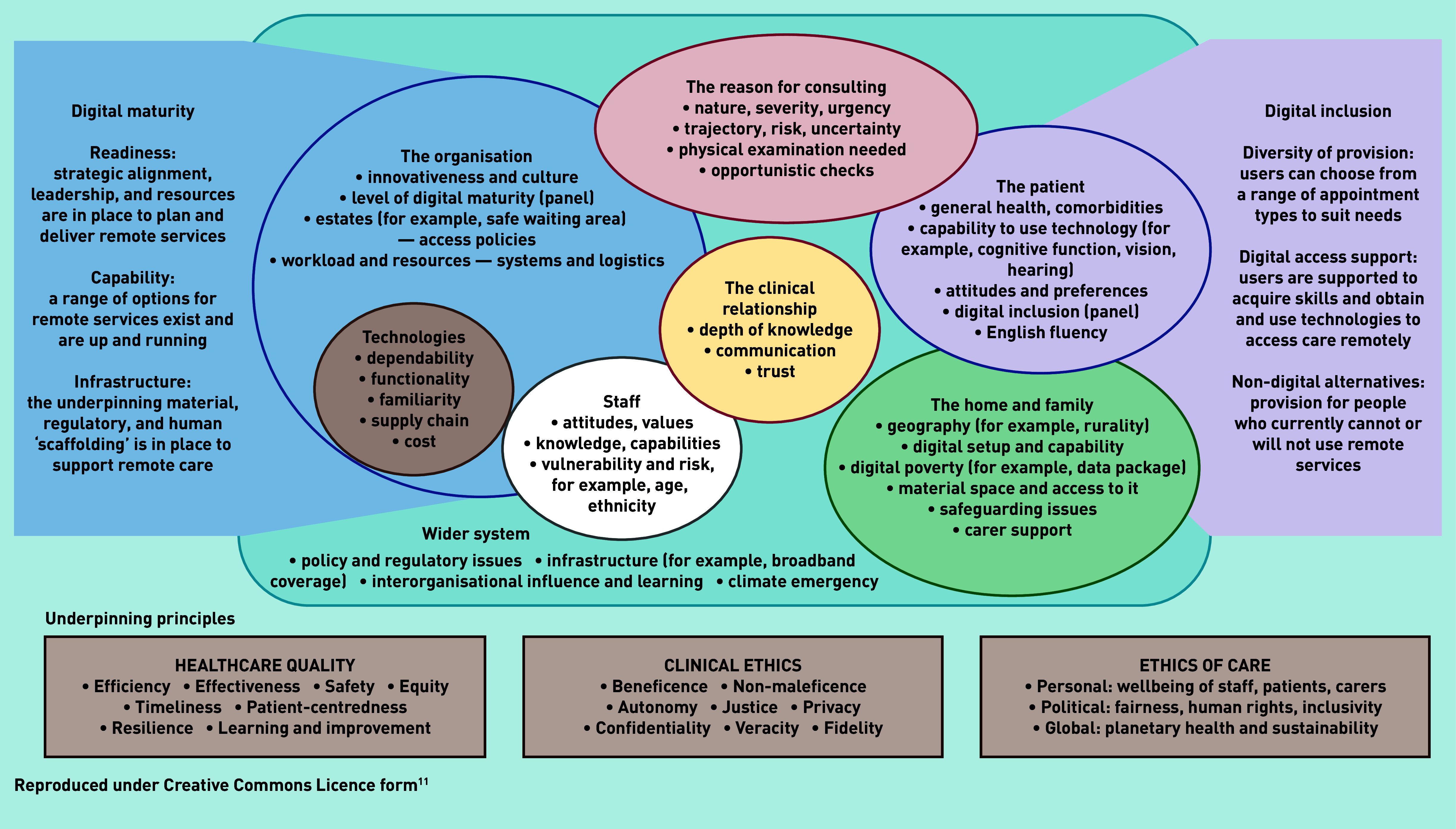
The dataset included interviews and focus groups with 121 participants from primary care (33 patients, 55 GPs, 11 other clinicians, nine managers, four support staff, four national policymakers, five technology industry). Data were transcribed, coded thematically, and then analysed using the Planning and Evaluating Remote Consultation Services (PERCS) framework.
With few exceptions, video consultations were either never adopted or soon abandoned in general practice despite a strong policy push, short-term removal of regulatory and financial barriers, and advances in functionality, dependability, and usability of video technologies (though some products remained 'fiddly' and unreliable). The relative advantage of video was perceived as minimal for most of the caseload of general practice, since many presenting problems could be sorted adequately and safely by telephone and in-person assessment was considered necessary for the remainder. Some patients found video appointments convenient, appropriate, and reassuring but others found a therapeutic presence was only achieved in person. Video sometimes added value for out-of-hours and nursing home consultations and statutory functions (for example, death certification).
Efforts to introduce video consultations in general practice should focus on situations where this modality has a clear relative advantage (for example, strong patient or clinician preference, remote localities, out-of-hours services, nursing homes).
在英国的全科医疗中,不到 1%的就诊是通过视频进行的。
解释为什么视频咨询在全科医疗中没有得到更广泛的应用。
对 2019-2021 年来自英国不同环境下远程咨询服务的三项混合方法案例研究的子样本数据进行分析。
数据集包括对来自初级保健的 121 名参与者(33 名患者、55 名全科医生、11 名其他临床医生、9 名管理人员、4 名支持人员、4 名国家政策制定者、5 名技术行业人员)的访谈和焦点小组。数据被转录、主题编码,然后使用远程咨询服务规划和评估(PERCS)框架进行分析。
除了少数例外,尽管政策大力推动、短期取消监管和财务障碍以及视频技术的功能、可靠性和可用性方面的进步,视频咨询在全科医疗中要么从未被采用,要么很快被放弃(尽管一些产品仍然“棘手”且不可靠)。对于全科医疗的大部分病例,视频咨询的相对优势被认为微不足道,因为许多就诊问题可以通过电话充分、安全地解决,对于其余的问题,面对面评估被认为是必要的。一些患者认为视频预约方便、合适且令人安心,但也有一些患者认为只有当面才能达到治疗效果。视频有时为非工作时间和疗养院咨询以及法定职能(例如,死亡证明)增加了价值。
在全科医疗中引入视频咨询的努力应集中在这种模式具有明显相对优势的情况下(例如,强烈的患者或临床医生偏好、偏远地区、非工作时间服务、疗养院)。