Centre for Clinical Microbiology, University College London, Royal Free Campus, London, UK.
Institute of Infection and Immunity, St George's, University of London, London, UK.
J Antimicrob Chemother. 2022 May 29;77(6):1685-1693. doi: 10.1093/jac/dkac070.
To develop a robust phenotypic antimicrobial susceptibility testing (AST) method with a correctly set breakpoint for pretomanid (Pa), the most recently approved anti-tuberculosis drug.
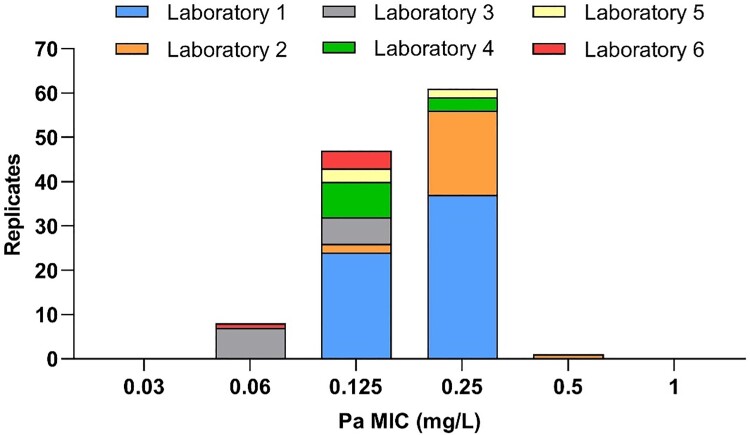
The Becton Dickinson Mycobacterial Growth Indicator Tube™ (MGIT) system was used at six laboratories to determine the MICs of a phylogenetically diverse collection of 356 Mycobacterium tuberculosis complex (MTBC) strains to establish the epidemiological cut-off value for pretomanid. MICs were correlated with WGS data to study the genetic basis of differences in the susceptibility to pretomanid.
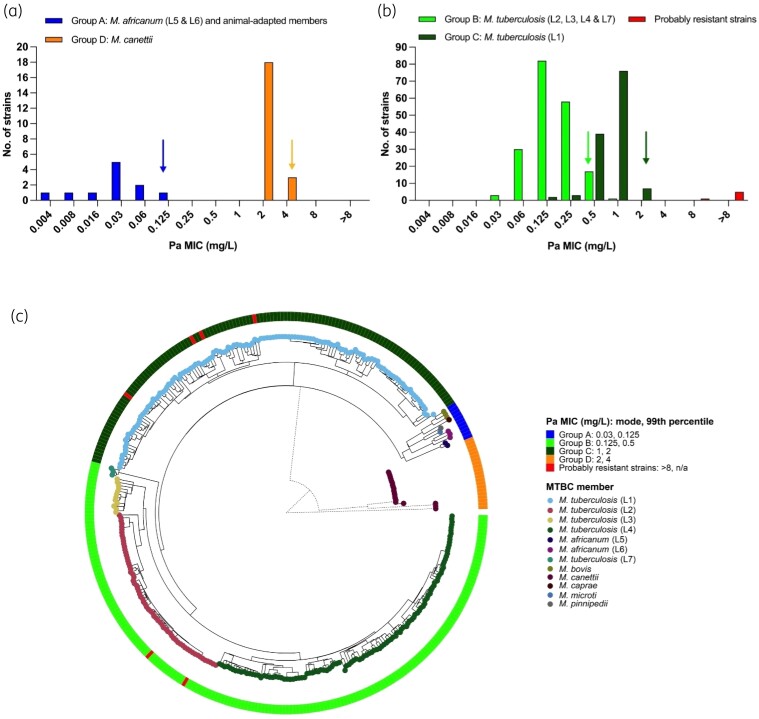
We observed ancient differences in the susceptibility to pretomanid among various members of MTBC. Most notably, lineage 1 of M. tuberculosis, which is estimated to account for 28% of tuberculosis cases globally, was less susceptible than lineages 2, 3, 4 and 7 of M. tuberculosis, resulting in a 99th percentile of 2 mg/L for lineage 1 compared with 0.5 mg/L for the remaining M. tuberculosis lineages. Moreover, we observed that higher MICs (≥8 mg/L), which probably confer resistance, had recently evolved independently in six different M. tuberculosis strains. Unlike the aforementioned ancient differences in susceptibility, these recent differences were likely caused by mutations in the known pretomanid resistance genes.
In light of these findings, the provisional critical concentration of 1 mg/L for MGIT set by EMA must be re-evaluated. More broadly, these findings underline the importance of considering the global diversity of MTBC during clinical development of drugs and when defining breakpoints for AST.
开发一种稳健的表型抗菌药物敏感性测试(AST)方法,并为新批准的抗结核药物帕托米那(Pa)正确设定折点。
六家实验室使用 Becton Dickinson 分枝杆菌生长指示剂管(MGIT)系统来确定 356 株结核分枝杆菌复合群(MTBC)菌株的药敏 MIC 值,以建立帕托米那的流行病学折点。MIC 与 WGS 数据相关联,以研究对帕托米那敏感性差异的遗传基础。
我们观察到 MTBC 各成员之间对帕托米那的敏感性存在古老差异。最值得注意的是,估计占全球结核病病例 28%的结核分枝杆菌 1 谱系比结核分枝杆菌 2、3、4 和 7 谱系的敏感性更低,导致 1 谱系的第 99 百分位为 2mg/L,而其余结核分枝杆菌谱系的第 99 百分位为 0.5mg/L。此外,我们观察到较高的 MIC(≥8mg/L),可能导致耐药性,最近在六个不同的结核分枝杆菌菌株中独立进化。与上述古老的敏感性差异不同,这些近期的差异可能是由已知的帕托米那耐药基因的突变引起的。
鉴于这些发现,EMA 设定的 1mg/L 临界浓度必须重新评估。更广泛地说,这些发现强调了在药物临床开发和 AST 折点定义时考虑 MTBC 全球多样性的重要性。