Department of Biomedical Sciences, Humanitas University, Milan, Italy.
Humanitas Clinical and Research Center, IRCCS, Milan, Italy.
Mov Disord. 2022 Jun;37(6):1202-1210. doi: 10.1002/mds.28987. Epub 2022 Mar 9.
To date, variants in the GBA gene represent the most frequent large-effect genetic factor associated with Parkinson's disease (PD). However, the reason why individuals with the same GBA variant may or may not develop neurodegeneration and PD is still unclear.
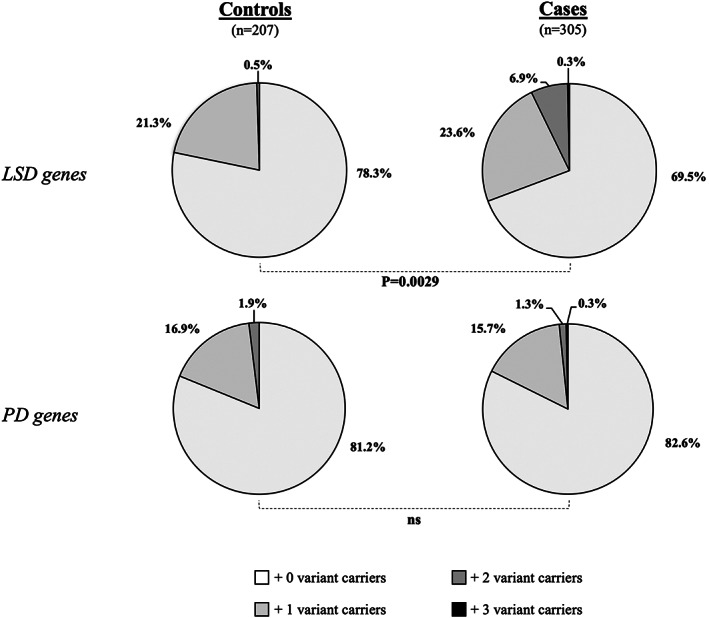
Therefore, we evaluated the contribution of rare variants in genes responsible for lysosomal storage disorders (LSDs) to GBA-PD risk, comparing the burden of deleterious variants in LSD genes in PD patients versus asymptomatic subjects, all carriers of deleterious variants in GBA.
We used a custom next-generation sequencing panel, including 50 LSD genes, to screen 305 patients and 207 controls (discovery cohort). Replication and meta-analysis were performed in two replication cohorts of GBA-variant carriers, of 250 patients and 287 controls, for whom exome or genome data were available.
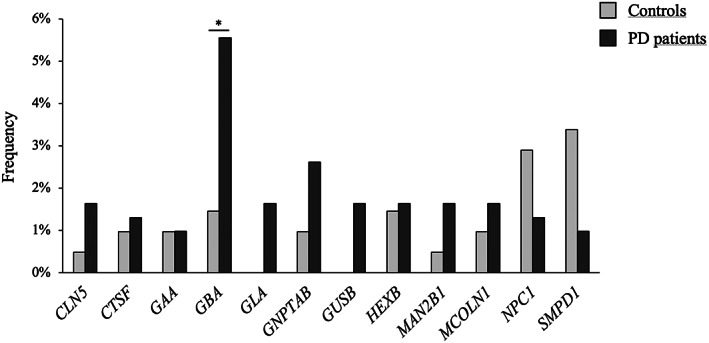
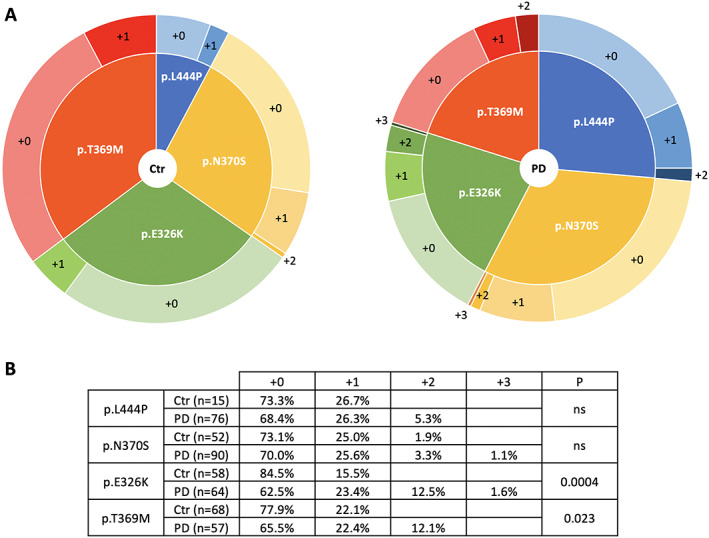
Statistical analysis in the discovery cohort revealed a significantly increased burden of deleterious variants in LSD genes in patients (P = 0.0029). Moreover, our analyses evidenced that the two strongest modifiers of GBA penetrance are a second variation in GBA (5.6% vs. 1.4%, P = 0.023) and variants in genes causing mucopolysaccharidoses (6.9% vs. 1%, P = 0.0020). These results were confirmed in the meta-analysis, where we observed pooled odds ratios of 1.42 (95% confidence interval [CI] = 1.10-1.83, P = 0.0063), 4.36 (95% CI = 2.02-9.45, P = 0.00019), and 1.83 (95% CI = 1.04-3.22, P = 0.038) for variants in LSD genes, GBA, and mucopolysaccharidosis genes, respectively.
The identification of genetic lesions in lysosomal genes increasing PD risk may have important implications in terms of patient stratification for future therapeutic trials. © 2022 The Authors. Movement Disorders published by Wiley Periodicals LLC on behalf of International Parkinson Movement Disorder Society.
迄今为止,GBA 基因中的变异是与帕金森病(PD)最相关的最常见的大效应遗传因素。然而,为什么具有相同 GBA 变异的个体可能会或可能不会发展为神经退行性变和 PD 仍然不清楚。
因此,我们评估了导致溶酶体贮积症(LSD)的基因中的稀有变异对 GBA-PD 风险的贡献,比较了 PD 患者与无症状受试者中 LSD 基因中有害变异的负担,所有这些患者和受试者均携带 GBA 中的有害变异。
我们使用了一个包含 50 个 LSD 基因的定制下一代测序面板,对 305 名患者和 207 名对照者(发现队列)进行了筛查。对于具有 GBA 变异携带者的两个复制队列(分别为 250 名患者和 287 名对照者),我们进行了复制和荟萃分析,这些队列具有外显子或基因组数据。
在发现队列中的统计分析显示,患者中 LSD 基因的有害变异负担明显增加(P=0.0029)。此外,我们的分析表明,GBA 外显率的两个最强修饰因子是 GBA 中的第二个变异(5.6%比 1.4%,P=0.023)和导致黏多糖贮积症的基因中的变异(6.9%比 1%,P=0.0020)。这些结果在荟萃分析中得到了证实,我们观察到 LSD 基因、GBA 和黏多糖贮积症基因中的变异的汇总比值比分别为 1.42(95%置信区间[CI]为 1.10-1.83,P=0.0063)、4.36(95% CI 为 2.02-9.45,P=0.00019)和 1.83(95% CI 为 1.04-3.22,P=0.038)。
鉴定增加 PD 风险的溶酶体基因中的遗传病变可能对未来治疗试验中的患者分层具有重要意义。