Department of Parasitology, Noguchi Memorial Institute for Medical Research, College of Health Sciences, University of Ghana, Accra, Ghana.
Department of Immunology Noguchi Memorial Institute for Medical Research, College of Health Sciences, University of Ghana, Accra, Ghana.
PLoS Negl Trop Dis. 2022 Mar 9;16(3):e0010115. doi: 10.1371/journal.pntd.0010115. eCollection 2022 Mar.
Evidence from recent studies in Schistosoma mansoni-endemic areas show an age-associated immunity that is positively correlated with IgE titres to Schistosoma mansoni-specific tegumental allergen-like protein 1 (SmTAL1). The structural homology between SmTAL1 and the S. haematobium-specific TAL1 (ShTAL1) has been verified, yet it remains unclear whether similar age- and immune-associated trends characterize ShTAL1. This community-based intervention study was conducted to assess whether ShTAL1IgE responses post-treatment with praziquantel (PZQ) might be associated with a reduced risk to re-infection with S. haematobium.
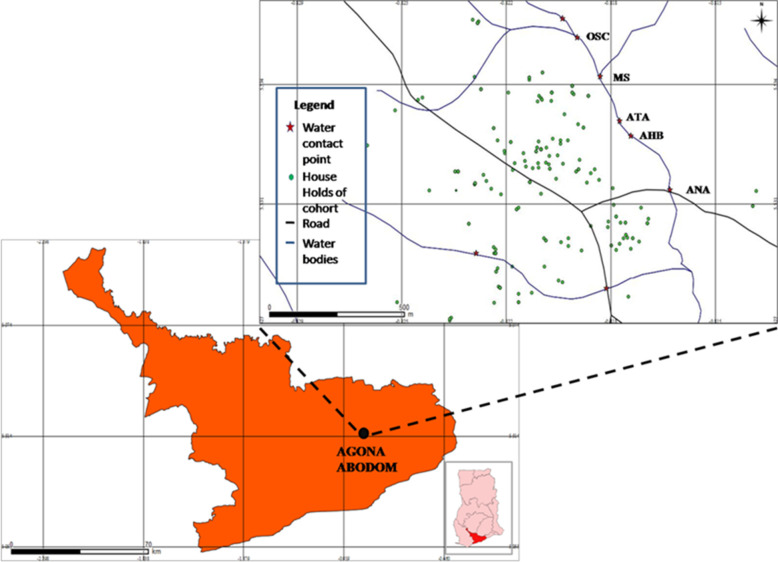
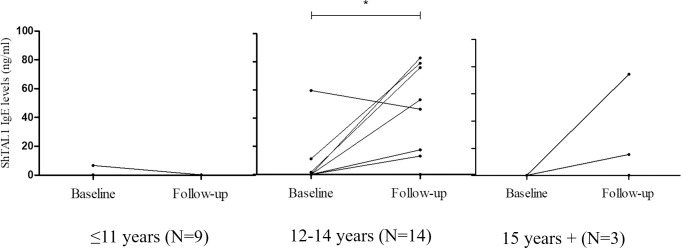
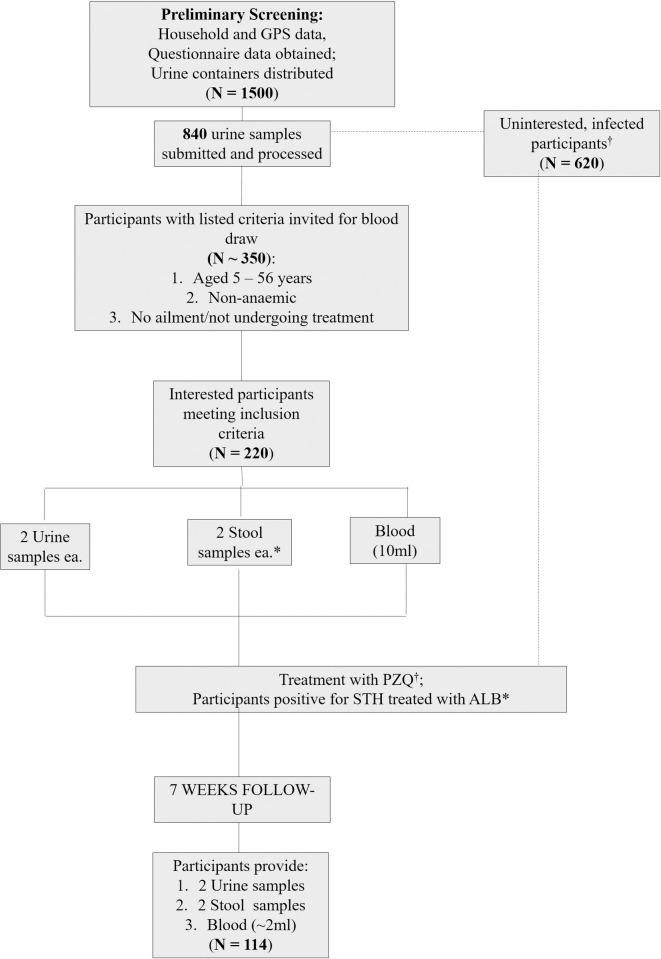
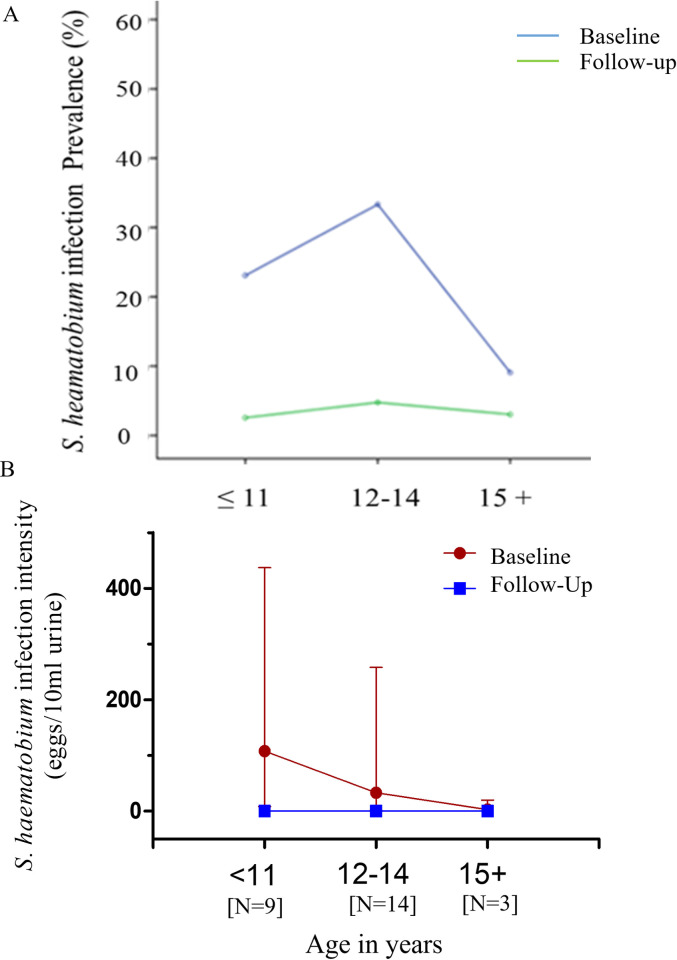
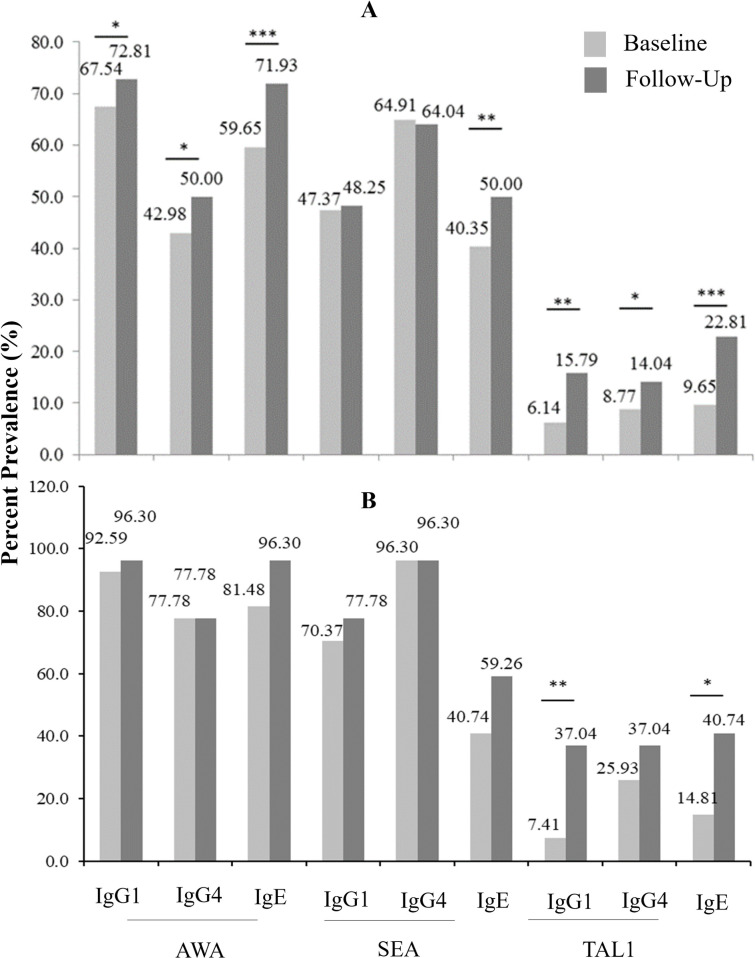
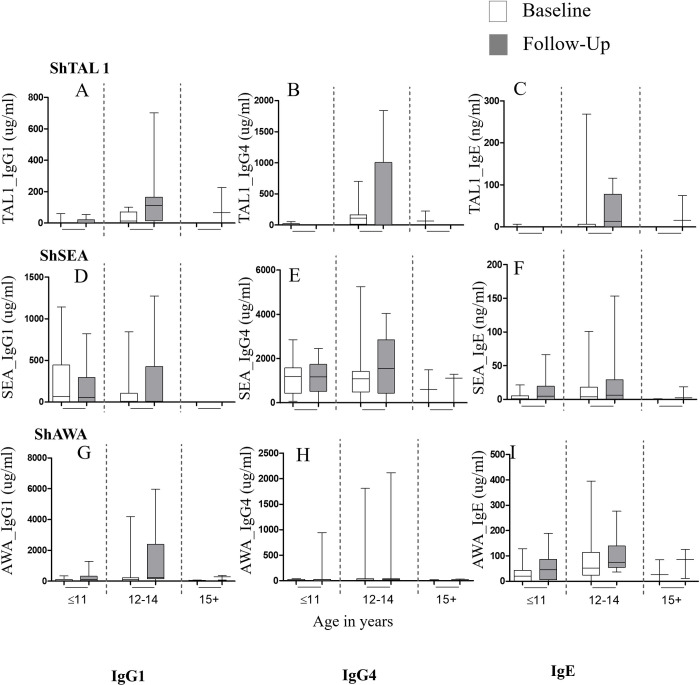
METHODOLOGY/PRINCIPAL FINDINGS: This study was conducted at Agona Abodom, Central Region, Ghana, and involved 114 participants aged 6 to 55 years. EDTA blood samples were collected at baseline and 7 weeks after PZQ treatment (Follow-up). Baseline and Follow-up titres of specific IgG1, IgG4, and IgE antibodies to the S. haematobium-specific adult worm antigen (ShAWA), the Sh-specific soluble egg antigen (ShSEA), and the Sh-specific tegumental-allergen-like 1 protein (ShTAL1) in plasma samples were measured using sandwich ELISA. Participants at both time points also provided stool and urine for helminth egg detection by microscopy. Prevalence of S. haematobium at baseline was 22.80%, and decreased to 3.50% at Follow-up. The egg reduction rate (ERR) was 99.87%. Overall plasma levels of ShTAL1-IgE increased 7 weeks post-PZQ treatment, and with increasing age; whiles S. haematobium infection prevalence and intensity decreased. For S. haematobium-infected participants who were egg-negative at Follow-up (N = 23), minimal median levels of ShTAL1-IgE were observed for all age groups prior to treatment, whilst median levels increased considerably among participants aged 12 years and older at Follow-up; and remained minimal among participants aged 11 years or less. In the univariate analysis, being aged 12 years or older implied an increased likelihood for ShTAL1-IgE positivity [12-14 years (cOR = 9.64, 95% CI = 2.09-44.51; p = 0.004); 15+ years (cOR = 14.26, 95% CI = 3.10-65.51; p = 0.001)], and this remained significant after adjusting for confounders [12-14 years (aOR = 22.34, 95% CI = 2.77-180.14; p = 0.004); ≥15 years (aOR = 51.82, 95% CI = 6.44-417.17; p < 0.001)]. Conversely, median ShTAL1-IgG4 titres were hardly detectible at Follow-up.
CONCLUSIONS/SIGNIFICANCE: These findings demonstrate that increased IgE levels to ShTAL1 7 weeks after PZQ treatment could be associated with a reduced risk to re-infection, and adds to the large body of evidence suggesting a protective role of the treatment-induced ShTAL1 antigen in schistosomiasis infections. It was also quite clear from this work that apart from being persistently S. haematobium-positive, elevated ShTAL1-IgG4 levels at Follow-up could be indicative of susceptibility to re-infection. These outcomes have important implications in vaccine development, and in shifting the paradigm in mass chemotherapy programmes from a 'one-size-fits-all' approach to more sub-group-/participant-specific strategies in endemic areas.
最近在曼氏血吸虫流行地区进行的研究表明,存在与年龄相关的免疫,这种免疫与曼氏血吸虫特异性表皮蛋白样 1(SmTAL1)的 IgE 滴度呈正相关。SmTAL1 与埃及血吸虫特异性 TAL1(ShTAL1)之间的结构同源性已经得到验证,但尚不清楚是否存在类似的与年龄和免疫相关的趋势来描述 ShTAL1。本社区干预研究旨在评估在使用吡喹酮(PZQ)治疗后,ShTAL1IgE 反应是否可能与减少再次感染埃及血吸虫的风险相关。
方法/主要发现:本研究在加纳中央地区的阿戈纳阿博多姆进行,涉及 114 名年龄在 6 至 55 岁的参与者。在基线和 PZQ 治疗后 7 周(随访)采集 EDTA 血样。使用夹心 ELISA 测量基线和随访时血浆样本中针对埃及血吸虫成虫抗原(ShAWA)、埃及血吸虫可溶性卵抗原(ShSEA)和埃及血吸虫表皮蛋白样 1 蛋白(ShTAL1)的特异性 IgG1、IgG4 和 IgE 抗体的滴度。在两个时间点,参与者还提供粪便和尿液样本,通过显微镜检测寄生虫卵。基线时埃及血吸虫的患病率为 22.80%,随访时降至 3.50%。卵减少率(ERR)为 99.87%。总体而言,在 PZQ 治疗后 7 周,ShTAL1-IgE 血浆水平增加,且随着年龄的增长而增加;而埃及血吸虫感染的患病率和强度降低。对于随访时(N = 23)粪便中无卵的埃及血吸虫感染者,所有年龄组在治疗前均观察到最低中位数 ShTAL1-IgE 水平,而在随访时 12 岁及以上的参与者中,中位数水平显著增加;而在 11 岁及以下的参与者中,中位数水平仍保持最低。在单变量分析中,12 岁及以上的年龄意味着 ShTAL1-IgE 阳性的可能性增加[12-14 岁(校正比值比[cOR] = 9.64,95%置信区间[CI] = 2.09-44.51;p = 0.004);15 岁及以上(cOR = 14.26,95%CI = 3.10-65.51;p = 0.001)],并且在调整混杂因素后仍然显著[12-14 岁(调整比值比[aOR] = 22.34,95%CI = 2.77-180.14;p = 0.004);15 岁及以上(aOR = 51.82,95%CI = 6.44-417.17;p < 0.001)]。相反,在随访时几乎检测不到中位数 ShTAL1-IgG4 滴度。
结论/意义:这些发现表明,在 PZQ 治疗后 7 周时,ShTAL1 的 IgE 水平增加可能与降低再感染风险相关,并为治疗诱导的 ShTAL1 抗原在血吸虫感染中具有保护作用的大量证据提供了补充。从这项工作中还可以清楚地看出,除了持续埃及血吸虫阳性外,随访时升高的 ShTAL1-IgG4 水平可能表明易再次感染。这些结果在疫苗开发和在流行地区将大规模化疗方案从“一刀切”的方法转变为更针对亚组/参与者的策略方面具有重要意义。