Department of Psychology, Ryerson University, Toronto, Ontario, Canada.
PLoS One. 2022 Mar 9;17(3):e0259312. doi: 10.1371/journal.pone.0259312. eCollection 2022.
Music and auditory beat stimulation (ABS) in the theta frequency range (4-7 Hz) are sound-based anxiety treatments that have been independently investigated in prior studies. Here, the anxiety-reducing potential of calm music combined with theta ABS was examined in a large sample of participants.
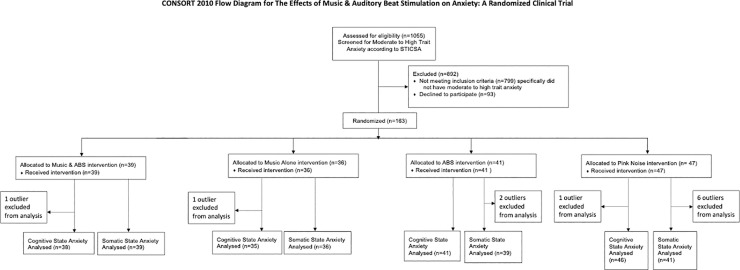
An open-label randomized controlled trial was conducted with participants taking anxiolytics (n = 163). Participants were randomly assigned using the Qualtrics randomizer algorithm, to a single session of sound-based treatment in one of four parallel arms: combined (music & ABS; n = 39), music-alone (n = 36), ABS-alone (n = 41), or pink noise (control; n = 47). Pre- and post-intervention somatic and cognitive state anxiety measures were collected along with trait anxiety, personality measures and musical preferences. The study was completed online using a custom application.
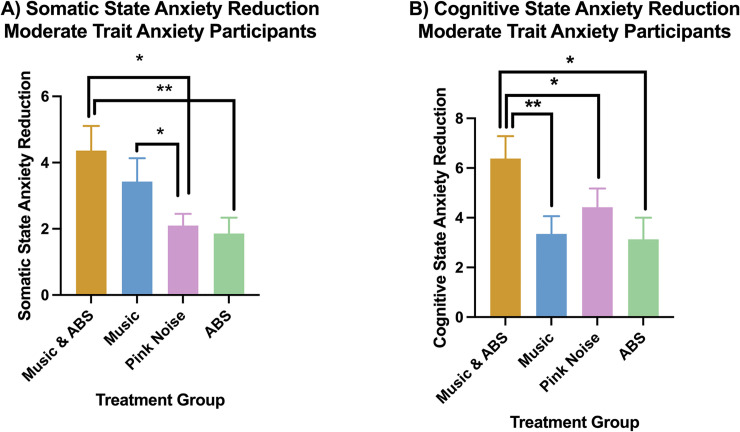
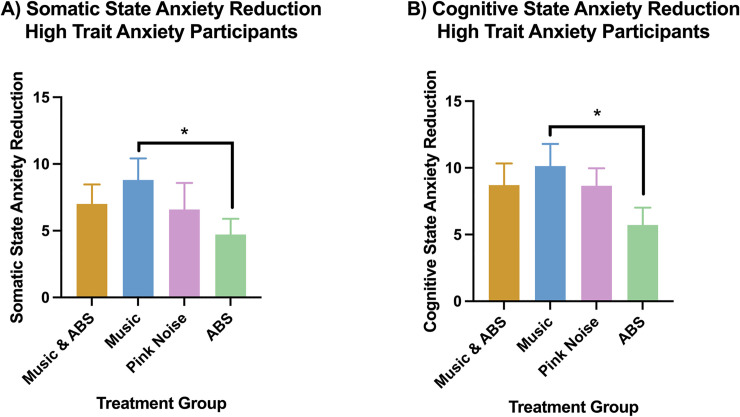
Based on trait anxiety scores participants were separated into moderate and high trait anxiety sub-groups. Among participants with moderate trait anxiety, we observed reductions in somatic anxiety that were greater in combined and music-alone conditions than in the pink noise condition; and reductions in cognitive state anxiety that were greater in the combined condition than in the music-alone, ABS-alone, and pink noise conditions. While we also observed reductions in somatic and cognitive state anxiety in participants with high trait anxiety, the conditions were not well differentiated.
Sound-based treatments are effective in reducing somatic and cognitive state anxiety. For participants with moderate trait anxiety, combined conditions were most efficacious.
音乐和听觉节拍刺激(ABS)在θ频带(4-7 Hz)是基于声音的焦虑治疗方法,在之前的研究中已经分别进行了研究。在这里,研究了镇静音乐与θ ABS 相结合对大量参与者的焦虑缓解潜力。
对服用抗焦虑药的参与者(n=163)进行了开放标签随机对照试验。使用 Qualtrics 随机算法对参与者进行随机分组,将他们分为四个平行组中的一个组,接受基于声音的单一疗程治疗:联合组(音乐和 ABS;n=39)、音乐组(n=36)、ABS 组(n=41)或粉红噪声(对照组;n=47)。在干预前后收集躯体和认知状态焦虑的测量值,以及特质焦虑、人格测量和音乐偏好。该研究使用定制应用程序在线完成。
根据特质焦虑评分,参与者被分为中度和高度特质焦虑亚组。在中度特质焦虑的参与者中,我们观察到联合组和音乐组的躯体焦虑降低程度大于粉红噪声组;在联合组的认知状态焦虑降低程度大于音乐组、ABS 组和粉红噪声组。虽然我们也观察到高度特质焦虑的参与者的躯体和认知状态焦虑降低,但这些条件并没有很好地区分。
基于声音的治疗方法可有效降低躯体和认知状态焦虑。对于中度特质焦虑的参与者,联合条件最有效。