Spinal Cord Injury Center, Balgrist University Hospital, University of Zurich, Forchstrasse 340, 8008, Zurich, Switzerland.
Department of Neurology, University Hospital Bern, Inselspital, University of Bern, Bern, Switzerland.
Sci Rep. 2022 Mar 9;12(1):4137. doi: 10.1038/s41598-022-07967-x.
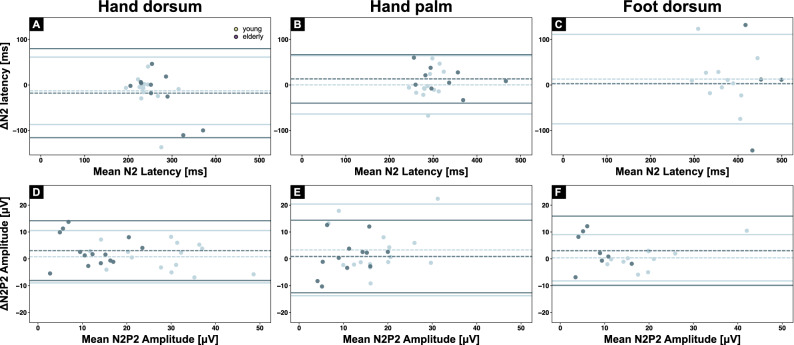
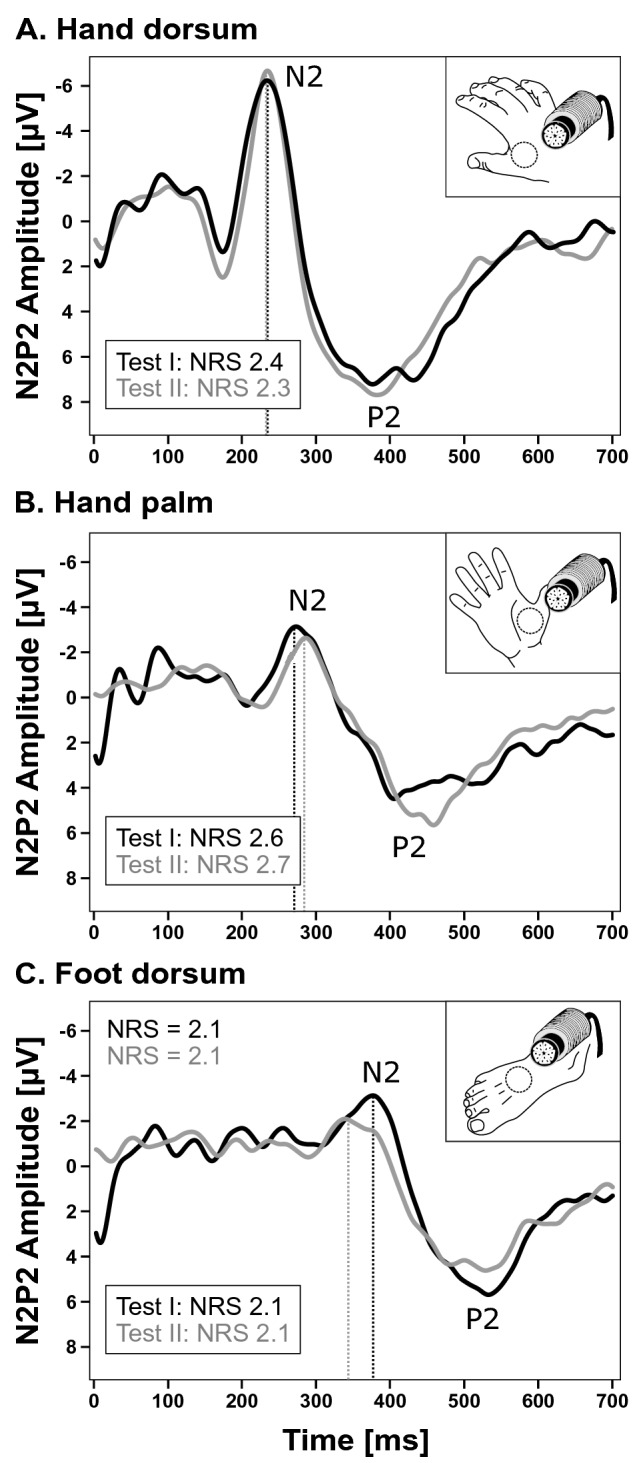
Cold-evoked potentials (CEPs) constitute a novel electrophysiological tool to assess cold-specific alterations in somatosensory function. As an important step towards the clinical implementation of CEPs as a diagnostic tool, we evaluated the feasibility and reliability of CEPs in response to rapid cooling of the skin (-300 °C/s) and different stimulation sites in young and elderly healthy individuals. Time-locked electroencephalographic responses were recorded from at vertex in fifteen young (20-40 years) and sixteen elderly (50-70 years), individuals in response to 15 rapid cold stimuli (-300 °C/s) applied to the skin of the hand dorsum, palm, and foot dorsum. High CEP proportions were shown for young individuals at all sites (hand dorsum/palm: 100% and foot: 79%) and elderly individuals after stimulation of the hand dorsum (81%) and palm (63%), but not the foot (44%). Depending on the age group and stimulation site, test-retest reliability was "poor" to "substantial" for N2P2 amplitudes and N2 latencies. Rapid cooling of the skin enables the recording of reliable CEPs in young individuals. In elderly individuals, CEP recordings were only robust after stimulation of the hand, but particularly challenging after stimulation of the foot. Further improvements in stimulation paradigms are warranted to introduce CEPs for clinical diagnostics.
冷激电位(CEPs)是一种评估体感功能中冷特异性改变的新型电生理工具。作为将 CEPs 作为诊断工具临床应用的重要步骤,我们评估了快速冷却皮肤(-300°C/s)和不同刺激部位时 CEPs 在年轻和老年健康个体中的可行性和可靠性。在十五名年轻个体(20-40 岁)和十六名老年个体(50-70 岁)的头顶记录了与快速冷刺激(-300°C/s)相关的锁定时间的脑电图反应,这些刺激应用于手部背侧、手掌和足部背侧的皮肤。在所有部位(手部背侧/手掌:100%和足部:79%)和手部背侧(81%)和手掌(63%)刺激的老年个体中,年轻个体显示出较高的 CEP 比例,但足部刺激(44%)除外。根据年龄组和刺激部位,N2P2 振幅和 N2 潜伏期的测试-重测可靠性为“差”到“中等”。皮肤的快速冷却使在年轻个体中记录可靠的 CEPs 成为可能。在老年个体中,CEPs 记录仅在手刺激后才稳健,但在足部刺激后特别具有挑战性。需要进一步改进刺激方案,以引入 CEPs 进行临床诊断。