Braaten Jacob A, Bergman Zachary R, Wothe Jillian K, Lofrano Arianna E, Matzek Luke J, Doucette Melissa, Saavedra-Romero Ramiro, Bohman John K, Prekker Matthew E, Lusczek Elizabeth R, Brunsvold Melissa E
University of Minnesota, Medical School, Minneapolis, MN.
Department of Surgery, University of Minnesota, Minneapolis, MN.
Crit Care Explor. 2022 Mar 4;4(3):e0655. doi: 10.1097/CCE.0000000000000655. eCollection 2022 Mar.
Determine the factors associated with mortality in venovenous extracorporeal membrane oxygenation (V-V ECMO) patients with COVID-19 infection and provide an updated report of clinical outcomes for patients treated with V-V ECMO for COVID-19 in Minnesota.
Multicenter prospective observational study.
The four adult Extracorporeal Life Support Organization-certified Centers of Excellence in Minnesota.
A total of 100 patients treated with V-V ECMO for COVID-19-associated acute respiratory distress syndrome (ARDS) from March 2020 to May 2021.
Not applicable.
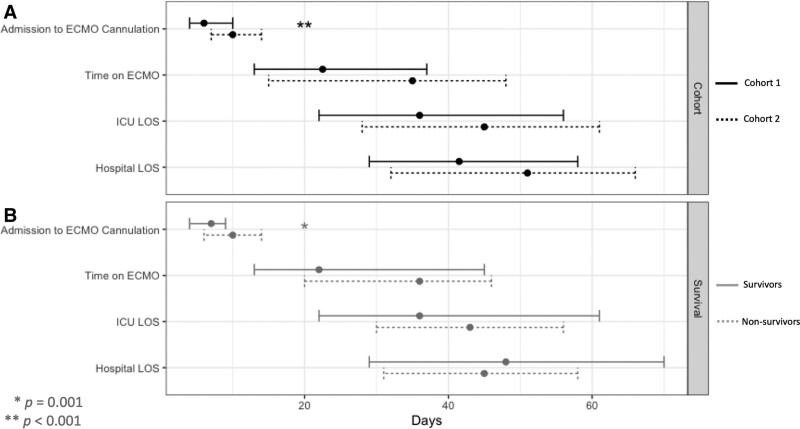
The primary outcome was 60-day survival for patients treated with V-V ECMO for COVID-19. Outcomes of patients treated from November 2020 to May 2021(cohort 2) were compared with data from a previous cohort of patients, collected from March 2020 to October 2020 (cohort 1). The data from both cohorts were merged into a single dataset (Combined Cohort). Survival on V-V ECMO due to COVID-19-associated ARDS significantly decreased after October 2020 (63% vs 41%; = 0.026). The median interval from hospital admission to V-V ECMO cannulation was significantly associated with 60-day mortality (10 d [6-14 d] in nonsurvivors vs 7 d [4-9 d] in survivors; = 0.001) in the Combined Cohort and was also significantly longer in cohort 2 than cohort 1 (10 d [7-14 d] vs 6 d [4-10 d]; < 0.001). In the Combined Cohort, the 60-day survival for patients who did not receive steroids was 86% ( = 12) versus 45% ( = 39) for patients who received at least one dose of steroids ( = 0.005).
There was a significant increase in mortality for patients treated with V-V ECMO for COVID-19-associated ARDS in cohort 2 compared with cohort 1. Further research is required to determine the cause of the worsening trend in mortality.
确定新型冠状病毒肺炎(COVID-19)感染的静脉-静脉体外膜肺氧合(V-V ECMO)患者的死亡相关因素,并提供明尼苏达州接受V-V ECMO治疗的COVID-19患者临床结局的最新报告。
多中心前瞻性观察性研究。
明尼苏达州四个获得体外生命支持组织认证的成人卓越中心。
2020年3月至2021年5月期间共100例因COVID-19相关急性呼吸窘迫综合征(ARDS)接受V-V ECMO治疗的患者。
不适用。
主要结局是接受V-V ECMO治疗的COVID-19患者的60天生存率。将2020年11月至2021年5月治疗的患者(队列2)的结局与先前一组患者(2020年3月至2020年10月收集,队列1)的数据进行比较。两个队列的数据合并为一个数据集(合并队列)。2020年10月后,因COVID-19相关ARDS接受V-V ECMO治疗的患者的生存率显著下降(63%对41%;P = 0.026)。在合并队列中,从入院到进行V-V ECMO插管的中位间隔与60天死亡率显著相关(非幸存者为10天[6-14天],幸存者为7天[4-9天];P = 0.001),且队列2中的该间隔也显著长于队列1(10天[7-14天]对6天[4-10天];P < 0.001)。在合并队列中,未接受类固醇治疗的患者60天生存率为86%(n = 12),而接受至少一剂类固醇治疗的患者为45%(n = 39)(P = 0.005)。
与队列1相比,队列2中因COVID-19相关ARDS接受V-V ECMO治疗的患者死亡率显著增加。需要进一步研究以确定死亡率恶化趋势背后的原因。