
乳腺癌中的主动靶向纳米药物:从临床前研究到临床应用
Actively Targeted Nanomedicines in Breast Cancer: From Pre-Clinal Investigation to Clinic.
作者信息
Fraguas-Sánchez Ana Isabel, Lozza Irene, Torres-Suárez Ana Isabel
机构信息
Department of Pharmaceutics and Food Technology, Faculty of Pharmacy, Complutense University of Madrid, 28040 Madrid, Spain.
Institute of Industrial Pharmacy, Faculty of Pharmacy, Complutense University of Madrid, 28040 Madrid, Spain.
出版信息
Cancers (Basel). 2022 Feb 25;14(5):1198. doi: 10.3390/cancers14051198.
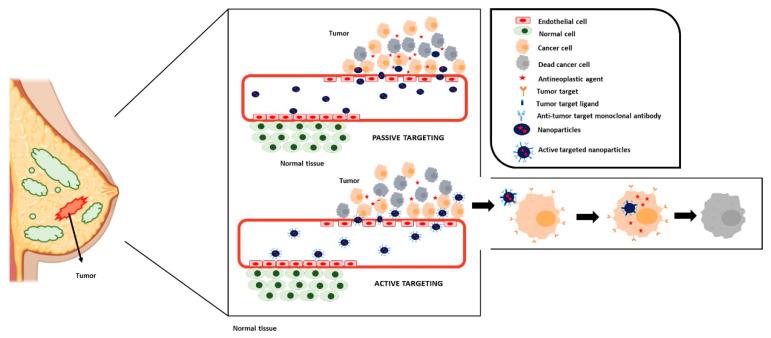
Breast cancer is one of the most frequently diagnosed tumors and the second leading cause of cancer death in women worldwide. The use of nanosystems specifically targeted to tumor cells (active targeting) can be an excellent therapeutic tool to improve and optimize current chemotherapy for this type of neoplasm, since they make it possible to reduce the toxicity and, in some cases, increase the efficacy of antineoplastic drugs. Currently, there are 14 nanomedicines that have reached the clinic for the treatment of breast cancer, 4 of which are already approved (Kadcyla, Enhertu, Trodelvy, and Abraxane). Most of these nanomedicines are antibody-drug conjugates. In the case of HER-2-positive breast cancer, these conjugates (Kadcyla, Enhertu, Trastuzumab-duocarmycin, RC48, and HT19-MMAF) target HER-2 receptors, and incorporate maytansinoid, deruxtecan, duocarmicyn, or auristatins as antineoplastics. In TNBC these conjugates (Trodelvy, Glembatumumab-Vedotin, Ladiratuzumab-vedotin, Cofetuzumab-pelidotin, and PF-06647263) are directed against various targets, in particular Trop-2 glycoprotein, NMB glycoprotein, Zinc transporter LIV-1, and Ephrin receptor-4, to achieve this selective accumulation, and include campthotecins, calicheamins, or auristatins as drugs. Apart from the antibody-drug conjugates, there are other active targeted nanosystems that have reached the clinic for the treatment of these tumors such as Abraxane and Nab-rapamicyn (albumin nanoparticles entrapping placlitaxel and rapamycin respectively) and various liposomes (MM-302, C225-ILS-Dox, and MM-310) loaded with doxorubicin or docetaxel and coated with ligands targeted to Ephrin A2, EPGF, or HER-2 receptors. In this work, all these active targeted nanomedicines are discussed, analyzing their advantages and disadvantages over conventional chemotherapy as well as the challenges involved in their lab to clinical translation. In addition, examples of formulations developed and evaluated at the preclinical level are also discussed.
乳腺癌是全球女性中最常被诊断出的肿瘤之一,也是癌症死亡的第二大主要原因。使用专门靶向肿瘤细胞的纳米系统(主动靶向)可能是一种出色的治疗工具,可改善和优化针对这类肿瘤的现有化疗方法,因为它们能够降低毒性,并且在某些情况下提高抗肿瘤药物的疗效。目前,有14种纳米药物已进入治疗乳腺癌的临床阶段,其中4种已获批准(赫赛莱、德曲妥珠单抗、戈沙妥珠单抗和艾日布林)。这些纳米药物大多是抗体药物偶联物。在HER-2阳性乳腺癌的情况下,这些偶联物(赫赛莱、德曲妥珠单抗、曲妥珠单抗-多卡米星、RC48和HT19-MMAF)靶向HER-2受体,并结合美登素、德卢替康、多卡米星或奥瑞他汀作为抗肿瘤药物。在三阴性乳腺癌中,这些偶联物(戈沙妥珠单抗、吉妥木单抗-维朵汀、拉地妥珠单抗-维朵汀、考非妥珠单抗-佩利多汀和PF-06647263)针对各种靶点,特别是 Trop-2糖蛋白、NMB糖蛋白、锌转运蛋白LIV-1和 Ephrin受体-4,以实现这种选择性积累,并包括喜树碱、刺孢霉素或奥瑞他汀作为药物。除了抗体药物偶联物外,还有其他已进入治疗这些肿瘤临床阶段的主动靶向纳米系统,如艾日布林和纳布-雷帕霉素(分别包裹紫杉醇和雷帕霉素的白蛋白纳米颗粒)以及各种负载阿霉素或多西他赛并包被靶向 Ephrin A2、表皮生长因子或HER-2受体配体的脂质体(MM-302、C225-ILS-阿霉素和MM-310)。在这项工作中,将讨论所有这些主动靶向纳米药物,分析它们相对于传统化疗的优缺点以及从实验室到临床转化过程中涉及的挑战。此外,还将讨论在临床前阶段开发和评估的制剂实例。



 Zotero 插件