Mambetsariev Isa, Arvanitis Leonidas, Fricke Jeremy, Pharaon Rebecca, Baroz Angel R, Afkhami Michelle, Koczywas Marianna, Massarelli Erminia, Salgia Ravi
Department of Medical Oncology & Therapeutics Research, City of Hope, Duarte, CA 91010, USA.
Department of Pathology, City of Hope, Duarte, CA 91010, USA.
J Clin Med. 2022 Mar 5;11(5):1429. doi: 10.3390/jcm11051429.
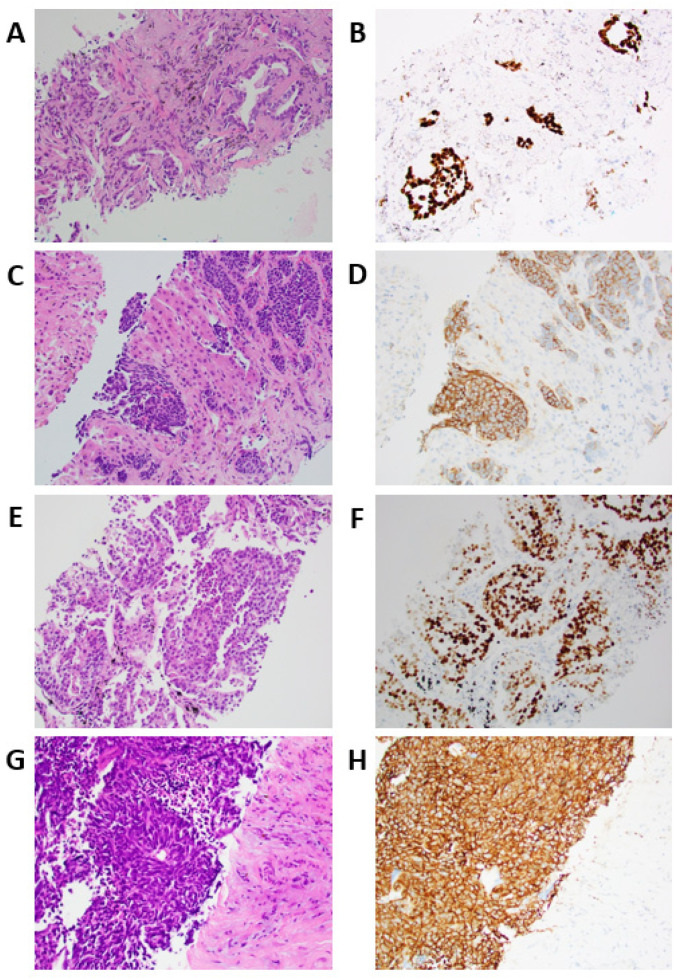
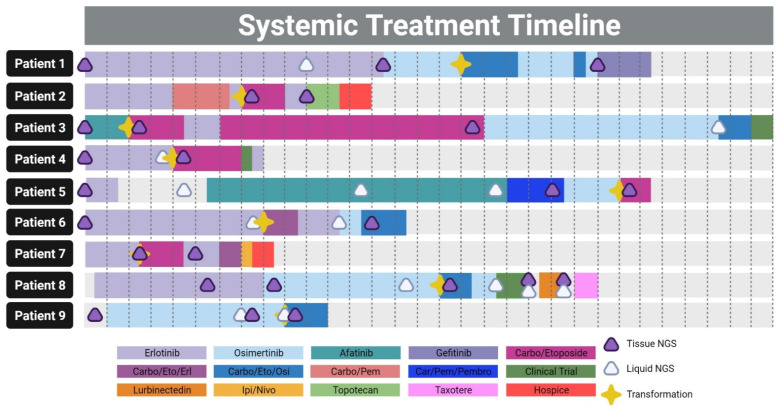
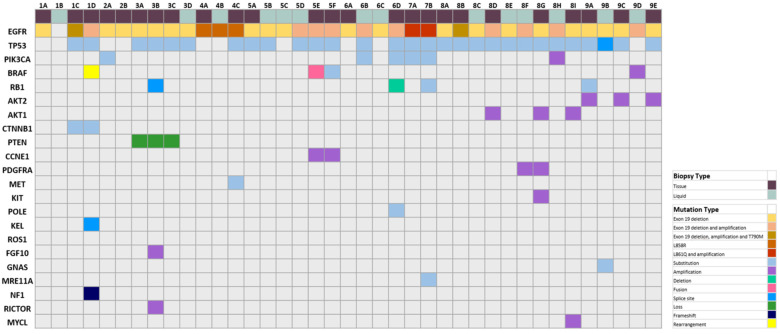
EGFR-mutated lung adenocarcinoma patients who received tyrosine kinase inhibitors (TKIs) may initially respond to therapy, but over time, resistance eventually occurs. In a small population (5-10%), these patients can have a histological transformation to SCLC. Nine patients with EGFR-mutated lung adenocarcinoma who transformed to SCLC were evaluated at City of Hope. Patient clinical and pathology data, including multiple next-generation sequencing (NGS) results, clinical therapies, histology, and outcomes, were collected across multiple time points. Descriptive statistics were utilized to visualize and interpret the clinical therapeutic timeline and molecular transformation profiles for these patients. All patients received at least one line of EGFR TKI therapies prior to small cell lung cancer transformation, including erlotinib, afatinib, and osimertinib. Two patients also received chemotherapy prior to transformation (one with immunotherapy). The median months to small cell lung cancer transformation was 16 months, ranging from 4-49 months. The median overall survival (OS) was 29 months from diagnosis, with the minimum of 16 months and maximum of 62 months. The majority of patients had EGFR exon 19 deletion ( = 7, 77.8%), and no patients had a change of original oncogenic EGFR mutation over the different time points. Though a TP53 mutation was detected in eight patients (88.9%) either at the first biopsy or the subsequent biopsies, an RB1 alteration was only detected in one patient at presentation, and three patients upon subsequent biopsies ( = 4, 44.4%). Each patient had a unique molecular profile in the subsequent molecular testing post-transformation, but BRAF alterations occurred frequently, including BRAF rearrangement ( = 1), fusion ( = 1), and amplification ( = 1). Our results showed that EGFR-mutated lung adenocarcinoma to SCLC transformation patients have a unique histological, molecular, and clinical profile over multiple time points, with further heterogeneity that is not currently reported in the literature, and we suggest more work is required to better understand the molecular heterogeneity and clinical outcomes over time for this EGFR TKI resistance subtype.
接受酪氨酸激酶抑制剂(TKIs)治疗的表皮生长因子受体(EGFR)突变型肺腺癌患者最初可能对治疗有反应,但随着时间推移,最终会出现耐药。在一小部分患者(5%-10%)中,这些患者会发生组织学转变为小细胞肺癌(SCLC)。希望之城对9例EGFR突变型肺腺癌转变为SCLC的患者进行了评估。在多个时间点收集了患者的临床和病理数据,包括多次二代测序(NGS)结果、临床治疗、组织学和预后情况。利用描述性统计来可视化和解读这些患者的临床治疗时间线和分子转变图谱。所有患者在小细胞肺癌转变前至少接受过一线EGFR TKI治疗,包括厄洛替尼、阿法替尼和奥希替尼。2例患者在转变前还接受过化疗(1例接受过免疫治疗)。转变为小细胞肺癌的中位时间为16个月,范围为4-49个月。从诊断开始计算的中位总生存期(OS)为29个月,最短为16个月,最长为62个月。大多数患者存在EGFR外显子19缺失(n = 7,77.8%),且在不同时间点没有患者发生原始致癌EGFR突变的改变。虽然在首次活检或后续活检中8例患者(88.9%)检测到TP53突变,但仅1例患者在初诊时检测到RB1改变,3例患者在后续活检时检测到RB1改变(n = 4,44.4%)。每个患者在转变后的后续分子检测中都有独特的分子图谱,但BRAF改变频繁发生,包括BRAF重排(n = 1)、融合(n = 1)和扩增(n = 1)。我们的结果表明,EGFR突变型肺腺癌转变为SCLC的患者在多个时间点具有独特的组织学、分子和临床特征,具有目前文献中尚未报道的进一步异质性,我们建议需要开展更多工作以更好地了解这种EGFR TKI耐药亚型随时间变化的分子异质性和临床结局。