Boukezzi Larbi, Rondot Sébastien, Jbara Omar, Ghoneim Sherif S M, Boubakeur Ahmed, Abdelwahab Saad A Mohamed
Materials Science and Informatics Laboratory, MSIL, University of Djelfa, Djelfa 17000, Algeria.
Laboratoire Matériaux et Ingénierie Mécanique, UFR Sciences, Université de Reims Champagne Ardenne, BP1039, 51687 Reims, France.
Materials (Basel). 2022 Mar 4;15(5):1918. doi: 10.3390/ma15051918.
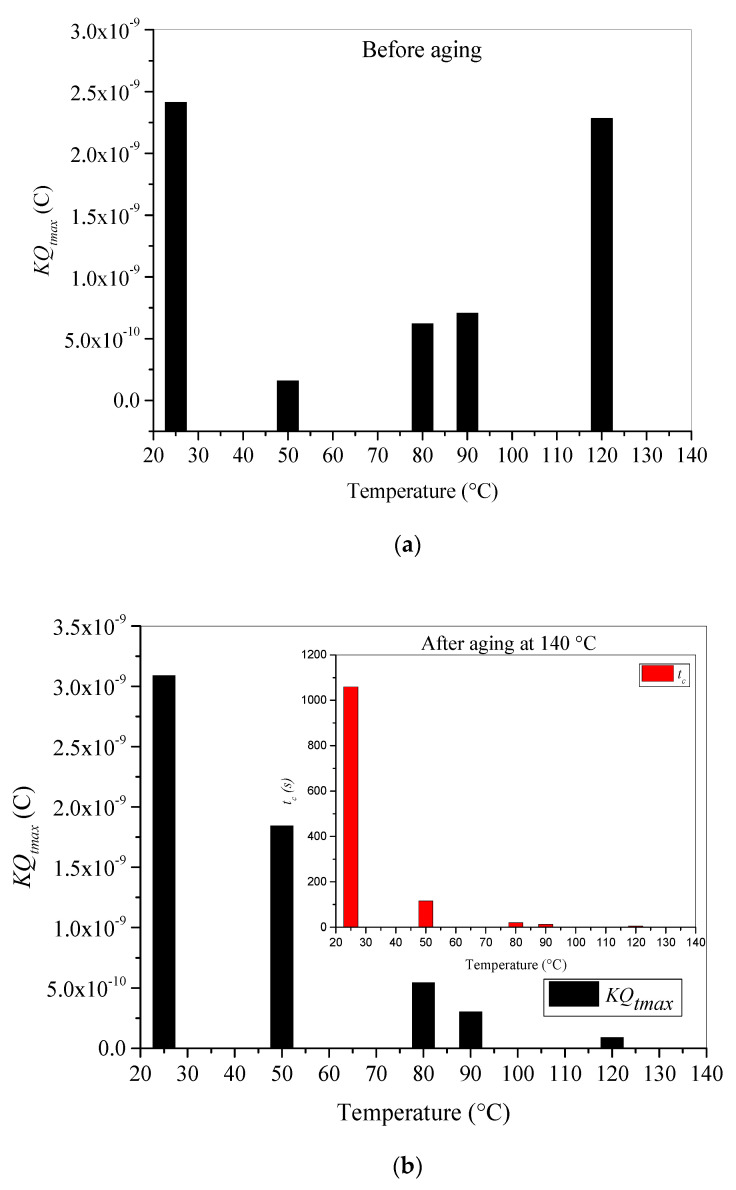
The effect of isothermal conditions on the trapping/detrapping process of charges in e-beam irradiated thermally aged XLPE insulation in scanning electron microscopy (SEM) has been investigated. Different isothermal conditions ranging from room temperature to 120 °C are applied on both unaged and aged XLPE samples (2 mm thick) by a suitable arrangement associated with SEM. For each applied test temperature, leakage, and influence currents have been measured simultaneously during and after e-beam irradiation. Experimental results show a big difference between the fresh and aged material regarding trapping and detrapping behavior. It has been pointed out that in the unaged material deep traps govern the process, whereas the shallow traps take part in the aged one. Almost all obtained results reveal that the trapped charge decreases and then increases as the temperature increases for the unaged sample. A deflection temperature corresponding to a minimum is observed at 50 °C. However, for the aged material, the maximum trapped charge decreases continuously with increasing temperature, and the material seems to trap fewer charges under e-beam irradiation at high temperature. Furthermore, thermal aging leads to the occurrence of detrapping process at high temperatures even under e-beam irradiation, which explains the decrease with time evolution of trapped charge during this period. The recorded leakage current increases with increasing temperature for both cases with pronounced values for aged material. The effect of temperature and thermal aging on electrostatic influence factor () and total secondary electron emission yield () were also studied.
研究了等温条件对扫描电子显微镜(SEM)中电子束辐照热老化交联聚乙烯(XLPE)绝缘材料中电荷俘获/去俘获过程的影响。通过与SEM相关的合适装置,对未老化和老化的XLPE样品(2毫米厚)施加从室温到120°C的不同等温条件。对于每个施加的测试温度,在电子束辐照期间和之后同时测量泄漏电流和影响电流。实验结果表明,新鲜材料和老化材料在俘获和去俘获行为方面存在很大差异。已经指出,在未老化材料中,深陷阱控制着过程,而浅陷阱参与老化材料中的过程。几乎所有获得的结果都表明,对于未老化样品,俘获电荷随温度升高先减少后增加。在50°C观察到对应于最小值的偏转温度。然而,对于老化材料,最大俘获电荷随温度升高而持续降低,并且在高温下电子束辐照时材料似乎俘获的电荷更少。此外,热老化导致即使在电子束辐照下高温时也会发生去俘获过程,这解释了在此期间俘获电荷随时间演变而减少的现象。对于两种情况,记录的泄漏电流均随温度升高而增加,老化材料的值更为明显。还研究了温度和热老化对静电影响因子()和总二次电子发射产率()的影响。