Integrated Research and Treatment Center-Center for Sepsis Control and Care (CSCC), Jena University Hospital, Am Klinikum 1, 07747, Jena, Germany.
Department of Anaesthesiology and Intensive Care Medicine, Jena University Hospital, Am Klinikum 1, 07747, Jena, Germany.
Sci Rep. 2022 Mar 10;12(1):3925. doi: 10.1038/s41598-022-07915-9.
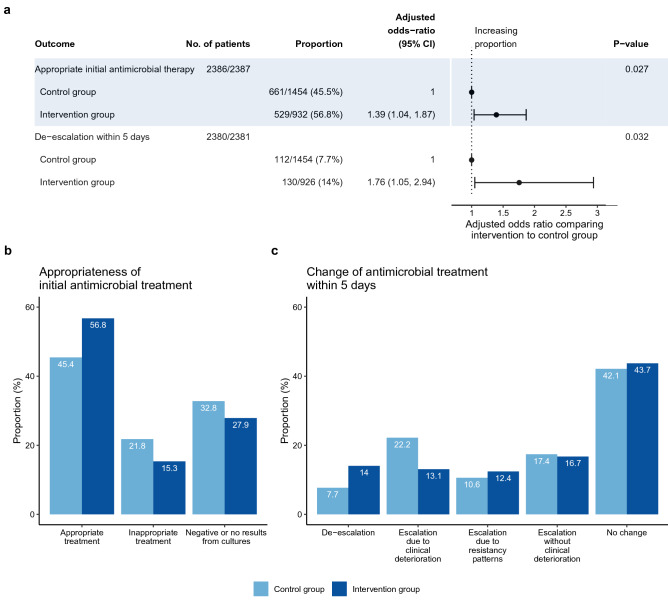
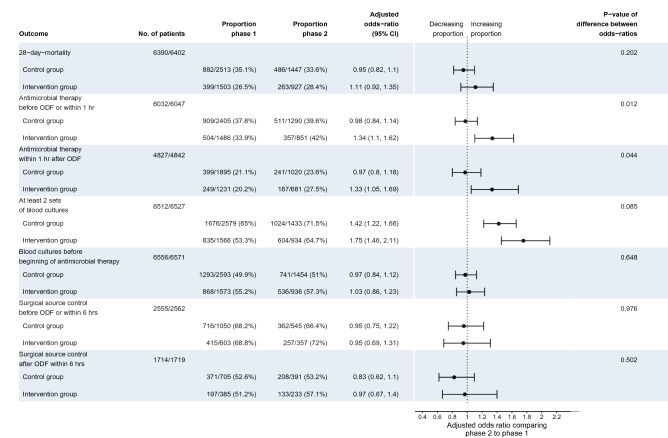
Sepsis is a major reason for preventable hospital deaths. A cluster-randomized controlled trial on an educational intervention did not show improvements of sepsis management or outcome. We now aimed to test an improved implementation strategy in a second intervention phase in which new intervention hospitals (former controls) received a multifaceted educational intervention, while controls (former intervention hospitals) only received feedback of quality indicators. Changes in outcomes from the first to the second intervention phase were compared between groups using hierarchical generalized linear models controlling for possible confounders. During the two phases, 19 control hospitals included 4050 patients with sepsis and 21 intervention hospitals included 2526 patients. 28-day mortality did not show significant changes between study phases in both groups. The proportion of patients receiving antimicrobial therapy within one hour increased in intervention hospitals, but not in control hospitals. Taking at least two sets of blood cultures increased significantly in both groups. During phase 2, intervention hospitals showed higher proportion of adequate initial antimicrobial therapy and de-escalation within 5 days. A survey among involved clinicians indicated lacking resources for quality improvement. Therefore, quality improvement programs should include all elements of sepsis guidelines and provide hospitals with sufficient resources for quality improvement.Trial registration: ClinicalTrials.gov, NCT01187134. Registered 23 August 2010, https://www.clinicaltrials.gov/ct2/show/study/NCT01187134 .
脓毒症是可预防医院死亡的主要原因。一项关于教育干预的整群随机对照试验并未显示出脓毒症管理或结局的改善。我们现在旨在在第二个干预阶段测试一种改进的实施策略,在该阶段中,新的干预医院(以前的对照组)接受了多方面的教育干预,而对照组(以前的干预医院)仅收到了质量指标的反馈。使用分层广义线性模型,在控制可能的混杂因素的情况下,比较了两个阶段之间从第一阶段到第二阶段的结果变化。在两个阶段中,19 家对照医院包括 4050 名脓毒症患者,21 家干预医院包括 2526 名患者。在两个组中,28 天死亡率在研究阶段之间均未显示出显著变化。在干预医院中,接受抗菌治疗的患者比例在一个小时内有所增加,但在对照组中没有增加。两组患者的至少两套血培养均显著增加。在第二阶段,干预医院表现出更高比例的初始适当抗菌治疗和 5 天内的降级。一项针对参与临床医生的调查表明,缺乏质量改进的资源。因此,质量改进计划应包括脓毒症指南的所有要素,并为医院提供足够的资源进行质量改进。试验注册:ClinicalTrials.gov,NCT01187134。注册于 2010 年 8 月 23 日,https://www.clinicaltrials.gov/ct2/show/study/NCT01187134。