Stroke and Ageing Research, Department of Medicine, School of Clinical Sciences at Monash Health, Monash University, Clayton, VIC, Australia.
Cardiovascular Research Group, School of Population and Global Health, The University of Western Australia, Perth, WA, Australia.
Curr Neurol Neurosci Rep. 2022 Mar;22(3):151-160. doi: 10.1007/s11910-022-01180-z. Epub 2022 Mar 11.
To critically appraise literature on recent advances and methods using "big data" to evaluate stroke outcomes and associated factors.
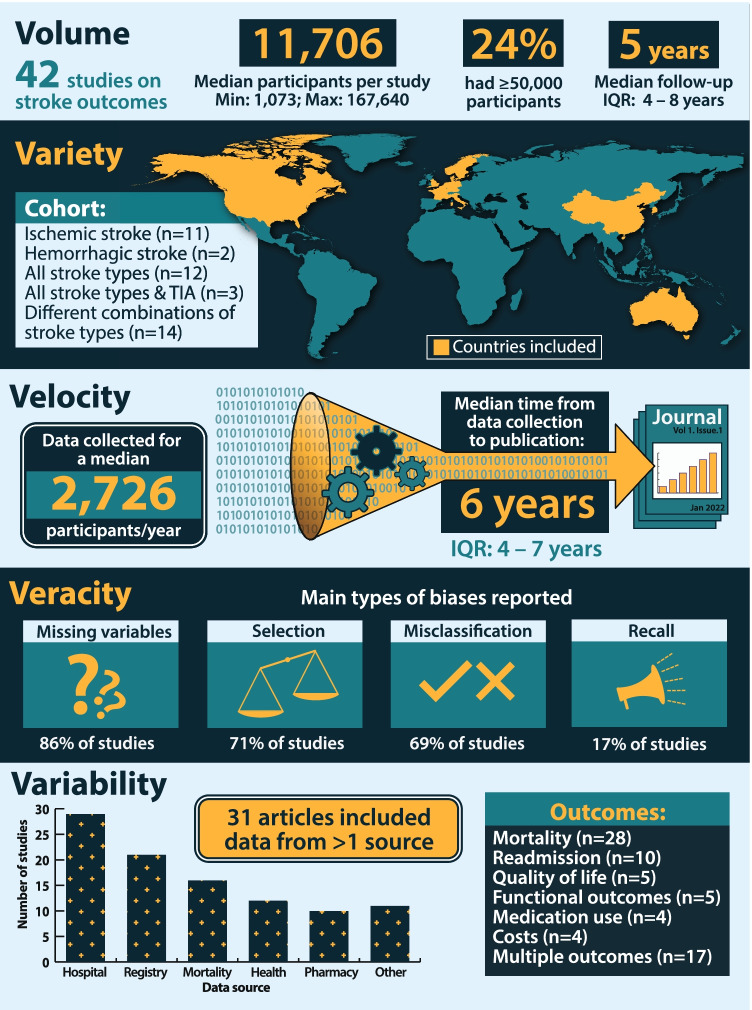
Recent big data studies provided new evidence on the incidence of stroke outcomes, and important emerging predictors of these outcomes. Main highlights included the identification of COVID-19 infection and exposure to a low-dose particulate matter as emerging predictors of mortality post-stroke. Demographic (age, sex) and geographical (rural vs. urban) disparities in outcomes were also identified. There was a surge in methodological (e.g., machine learning and validation) studies aimed at maximizing the efficiency of big data for improving the prediction of stroke outcomes. However, considerable delays remain between data generation and publication. Big data are driving rapid innovations in research of stroke outcomes, generating novel evidence for bridging practice gaps. Opportunity exists to harness big data to drive real-time improvements in stroke outcomes.
批判性评价利用“大数据”评估中风结果及相关因素的最新进展和方法的文献。
最近的大数据研究为中风结果的发生率提供了新的证据,并为这些结果的重要新兴预测因素提供了新的证据。主要亮点包括确定 COVID-19 感染和接触低剂量颗粒物是中风后死亡率的新预测因素。结果还存在人口统计学(年龄、性别)和地理(农村与城市)差异。旨在最大限度地提高大数据效率以改善中风结果预测的方法学(例如,机器学习和验证)研究也大量涌现。然而,在数据生成和发布之间仍然存在相当大的延迟。大数据正在推动中风结果研究的快速创新,为弥合实践差距提供新的证据。有机会利用大数据实时改善中风结果。