Department of Oral Health Sciences, Faculty of Dentistry, University of British Columbia, Vancouver, BC, Canada.
Department of Oral Medicine and Oral Diagnosis, School of Dentistry and Dental Research Institute, Seoul National University, Seoul, Korea.
J Oral Rehabil. 2022 Jun;49(6):633-643. doi: 10.1111/joor.13316. Epub 2022 Apr 1.
Oxygen saturation indices show a strong correlation with long-term health outcomes. Nonetheless, evidence on the relationship between reduction in respiratory events and increase in oxygenation levels following oral appliance (OA) treatment is scarce.
To verify the relationship between reduction in the apnoea-hypopnoea index (AHI) and oxygen saturation levels following OA treatment, we have conducted an evaluation of polysomnography (PSG) and clinical parameters associated with the improvement of oxygen desaturation.
OSA patients (n = 48) who received an OA and had pre- and post-treatment PSG were classified into three responder groups according to the change in AHI and min O post-treatment: responder (decrease in AHI of ≥50% but increase in min O level of <4% or decrease); responder (increase in min O level of ≥4% but decrease in AHI <50% or increase) and responder (decrease in AHI of ≥50% and increase in min O level of ≥4%). Various demographic and PSG variables were statistically compared among groups.
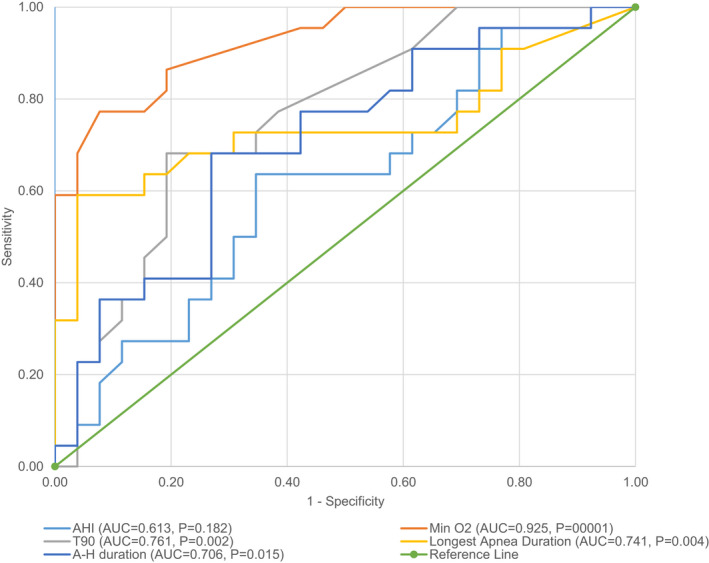
There were 26 (54.17%) responder , 9 (18.75%) responder and 13 (27.08%) responder . Pre-treatment min O was significantly lower in responder . A higher pre-treatment min O showed a significant correlation with a smaller amount of change in mean O (r = -.486) and min O (r = -.764) with treatment. Pre-treatment min O showed the strongest ability to predict those who would show a ≥4% min O increase following treatment.
Certain patients do not show sufficient decrease in hypoxaemia in spite of the improvement in AHI. Pre-treatment min O should be considered in OA treatment planning regarding its close relation to improvements in oxygenation levels with treatment.
氧饱和度指数与长期健康结果有很强的相关性。然而,关于口腔矫治器(OA)治疗后呼吸事件减少与氧合水平升高之间的关系的证据很少。
通过评估与氧减饱和度改善相关的多导睡眠图(PSG)和临床参数,验证 OA 治疗后呼吸暂停低通气指数(AHI)降低与氧饱和度水平之间的关系。
对接受 OA 治疗并进行了治疗前后 PSG 的 OSA 患者(n=48)根据治疗后 AHI 和最低氧饱和度(min O)的变化进行分类:应答者(AHI 降低≥50%但 min O 升高<4%或降低;应答者(min O 升高≥4%但 AHI 降低<50%或增加)和应答者(AHI 降低≥50%且 min O 升高≥4%)。对各组间各种人口统计学和 PSG 变量进行了统计学比较。
有 26 例(54.17%)为应答者,9 例(18.75%)为应答者,13 例(27.08%)为应答者。应答者的 min O 在治疗前明显较低。较高的 min O 治疗前与治疗后平均 O(r=-.486)和 min O(r=-.764)变化量显著相关。治疗前的 min O 与治疗后 min O 升高≥4%的预测能力最强。
尽管 AHI 有所改善,但某些患者的低氧血症仍未得到充分改善。在 OA 治疗计划中应考虑治疗前的 min O,因为它与治疗后氧合水平的改善密切相关。