Second Division, Department of Internal Medicine, Hamamatsu University School of Medicine, 1-20-1 Handayama Higashiku, Hamamatsu, 431-3192, Japan.
Department of Respiratory Medicine, Seirei Hamamatsu General Hospital, 2-12-12 Sumiyoshi, Naka Ward, Hamamatsu, 430-8558, Japan.
Respir Res. 2022 Mar 11;23(1):57. doi: 10.1186/s12931-022-01978-y.
Patients with rheumatoid arthritis-associated interstitial lung disease (RA-ILD), like those with idiopathic pulmonary fibrosis (IPF), might develop an unexpected acute exacerbation (AE)-a rapidly progressing and deadly respiratory decline. Although AE incidence and risk factors in RA-ILD patients are known, their post-AE clinical course remains unknown owing to the rarity of AE-RA-ILD. This multicentre retrospective study evaluated post-AE mortality and prognostic variables in AE-RA-ILD patients and created a mortality prediction model for AE-RA-ILD.
This research comprised 58 patients with AE-RA-ILD and 96 with AE-IPF (a control disease). Multivariate Cox regression analysis was performed to identify prognostic variables. A prediction model was created with recursive partitioning (decision tree).
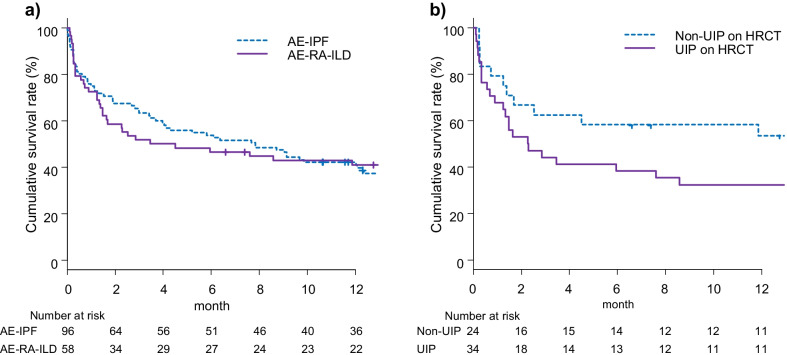
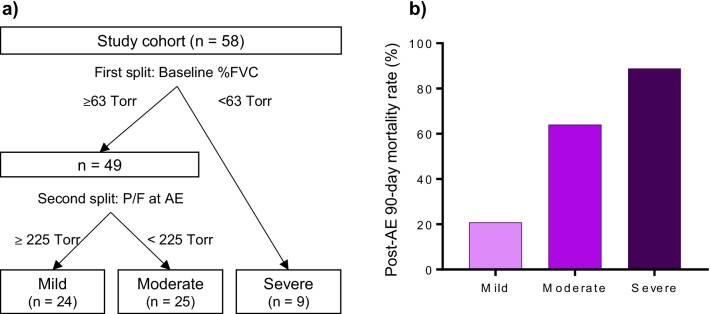
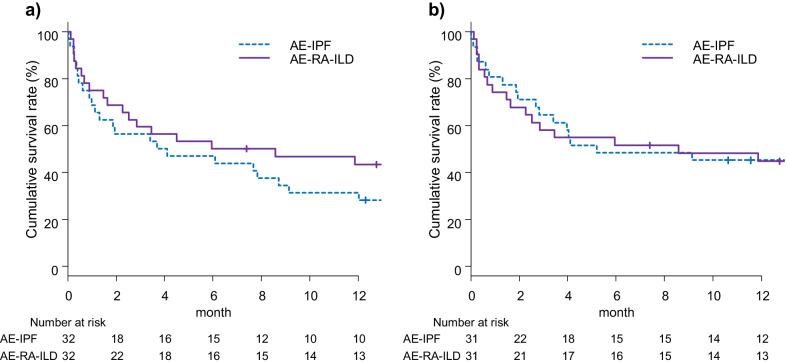
The post-AE 90-day mortality rate in the overall AE-RA-ILD group was 48.3%; percent predicted forced vital capacity within 12 months before AE onset (baseline %FVC) and PaO/FiO ratio at AE onset (P/F at AE) were independent predictors of mortality. Post-AE 90-day mortality rates were 40.6% and 43.8%, respectively, in AE-RA-ILD and AE-IPF patients propensity score-matched for age, sex, baseline %FVC and P/F at AE (P = 1.0000). In AE-RA-ILD patients, C-indices of baseline %FVC and P/F at AE to predict post-AE 90-day mortality were 0.604 and 0.623, respectively. A decision tree model based on these prognostic factors classified AE-RA-ILD patients into mild, moderate and severe groups (post-AE 90-day mortality rates: 20.8%, 64.0% and 88.9%, respectively; P = 0.0002); the C-index improved to 0.775.
Post-AE mortality was high in AE-RA-ILD patients similar to AE-IPF patients. The discovered prognostic factors and our mortality prediction model may aid in the management of AE-RA-ILD patients.
类风湿关节炎相关间质性肺疾病(RA-ILD)患者与特发性肺纤维化(IPF)患者一样,可能会出现意料之外的急性加重(AE)——一种快速进展且致命的呼吸下降。虽然已知 RA-ILD 患者的 AE 发生率和危险因素,但由于 AE-RA-ILD 的罕见性,其 AE 后的临床过程仍不清楚。这项多中心回顾性研究评估了 AE-RA-ILD 患者的 AE 后死亡率和预后变量,并为 AE-RA-ILD 患者创建了一个死亡率预测模型。
这项研究包括 58 例 AE-RA-ILD 患者和 96 例 AE-IPF(对照疾病)患者。采用多变量 Cox 回归分析确定预后变量。采用递归分区(决策树)创建预测模型。
总体 AE-RA-ILD 组 AE 后 90 天的死亡率为 48.3%;AE 发病前 12 个月的预计用力肺活量百分比(基线%FVC)和 AE 发病时的 PaO/FiO 比值(AE 时的 P/F)是死亡率的独立预测因素。AE-RA-ILD 和 AE-IPF 患者在年龄、性别、基线%FVC 和 AE 时的 P/F 进行倾向评分匹配后,AE 后 90 天的死亡率分别为 40.6%和 43.8%(P=1.0000)。在 AE-RA-ILD 患者中,基线%FVC 和 AE 时的 P/F 预测 AE 后 90 天死亡率的 C 指数分别为 0.604 和 0.623。基于这些预后因素的决策树模型将 AE-RA-ILD 患者分为轻度、中度和重度组(AE 后 90 天的死亡率分别为 20.8%、64.0%和 88.9%;P=0.0002);C 指数提高至 0.775。
AE-RA-ILD 患者的 AE 后死亡率与 AE-IPF 患者相似较高。发现的预后因素和我们的死亡率预测模型可能有助于 AE-RA-ILD 患者的管理。