Wake Forest School of Medicine, Winston-Salem, North Carolina, USA.
Department of Biobehavioral Health Sciences, University of Pennsylvania School of Nursing, Philadelphia, Pennsylvania, USA.
Obesity (Silver Spring). 2022 Jun;30(6):1268-1278. doi: 10.1002/oby.23429. Epub 2022 May 6.
This study aimed to measure the impact of the COVID-19 pandemic on self-reported life experiences in older adults with diabetes and obesity.
Participants were surveyed in 2020 regarding negative and positive impacts of the pandemic across domains of personal, social, and physical experiences. A cumulative negative risk index (a count of all reported negative impacts of 46 items) and a positive risk index (5 items) were characterized in relation to age, sex, race/ethnicity, BMI, and multimorbidity.
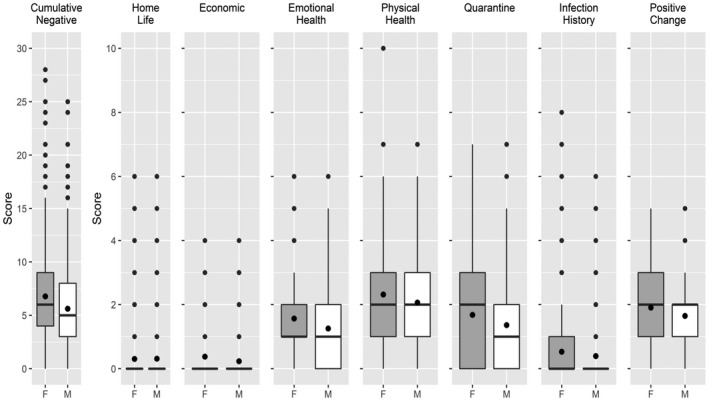
Response rate was high (2950/3193, 92%), average age was 76 years, 63% were women, and 39% were from underrepresented populations. Women reported more negative impacts than men (6.8 vs. 5.6; p < 0.001 [of 46 items]) as did persons with a greater multimorbidity index (p < 0.001). Participants reporting African American/Black race reported fewer negative impacts than White participants. Women also reported more positive impacts than men (1.9 vs. 1.6; p < 0.001 [of 5 items]).
Older adults with diabetes and obesity reported more positive impacts of the pandemic than negative impacts, relative to the number of positive (or negative) items presented. Some subgroups experienced greater negative impacts (e.g., for women, a greater multimorbidity index). Efforts to reestablish personal, social, and physical health after the pandemic could target certain groups.
本研究旨在衡量 COVID-19 大流行对患有糖尿病和肥胖症的老年患者自我报告生活体验的影响。
2020 年,参与者接受了关于大流行对个人、社会和身体体验各领域的负面影响和积极影响的调查。根据年龄、性别、种族/民族、BMI 和多种合并症,对 46 项报告的负面影响进行了累积负面风险指数(所有报告的负面影响的计数)和积极风险指数(5 项)的特征描述。
回应率很高(3193 名参与者中有 2950 名,占 92%),平均年龄为 76 岁,63%为女性,39%来自代表性不足的人群。女性报告的负面影响多于男性(6.8 比 5.6;p < 0.001[46 项中的一项]),且合并症指数较高的患者(p < 0.001)报告的负面影响也较多。报告为非裔美国人/黑人的参与者报告的负面影响少于白人参与者。女性报告的积极影响也多于男性(1.9 比 1.6;p < 0.001[5 项中的一项])。
与呈现的积极(或负面)项目数量相比,患有糖尿病和肥胖症的老年患者报告的大流行的积极影响多于负面影响。某些亚组经历了更大的负面影响(例如,对于女性而言,合并症指数较高)。在大流行后重新建立个人、社会和身体健康的努力可以针对某些群体。