Tan Jiuqing, Meng Fangqi, Zhang Baobao, Deng Qingwen, Jiao Boyu, Peng Lizhi, Ding Ying, Ruan Jingwen, Zeng Jingchun, Pei Wenya, Lin Guohua
The First Affiliated Hospital, Guangzhou University of Chinese Medicine, 16 Airport Road, Guangzhou 510405, Guangdong, China.
The First Affiliated Hospital, Sun Yat-sen University, 58 Zhongshan 2nd Road, Guangzhou 510080, Guangdong, China.
Evid Based Complement Alternat Med. 2022 Mar 4;2022:8040555. doi: 10.1155/2022/8040555. eCollection 2022.
Previous studies have shown that electroacupuncture (EA) has a positive effect on motor and sensory function in patients with spinal cord injury (SCI). This review evaluated the effectiveness of EA for improvement in activities of daily living in patients with SCI.
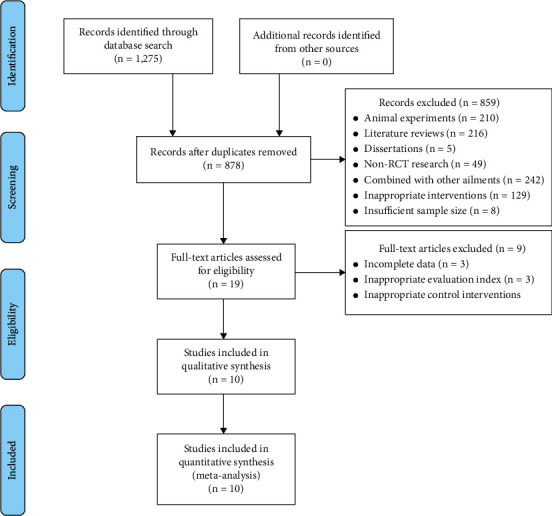
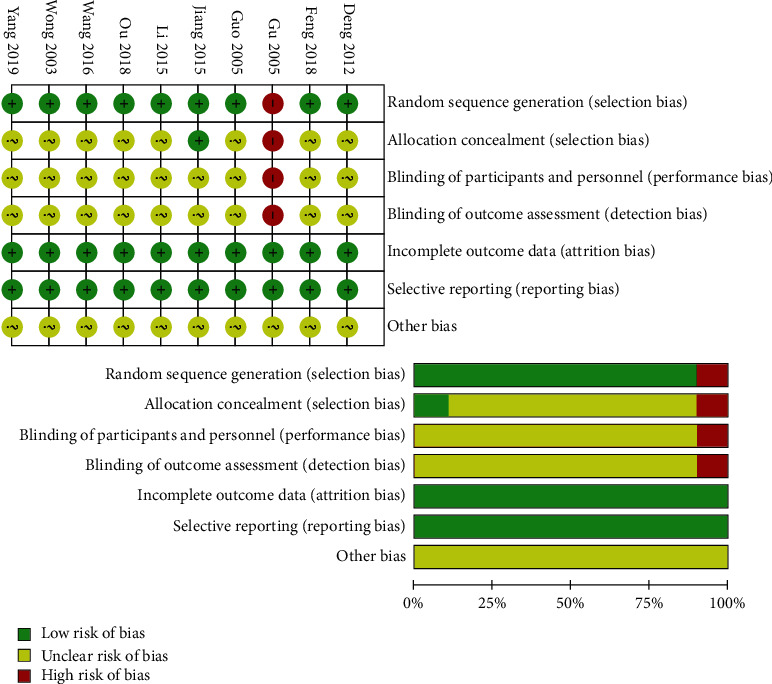
We searched the Cochrane Library, PubMed, Web of Science, CNKI, WanFang Data, and VIP databases using a search strategy according to the guidelines of the Cochrane Handbook for Systematic Review of Interventions up to 30th September 2020. Only randomized controlled trials (RCTs) of EA in patients with SCI were included. We analyzed the data using RevMan (version 5.3) and graded the quality of evidence using GRADE profiler 3.6.1.
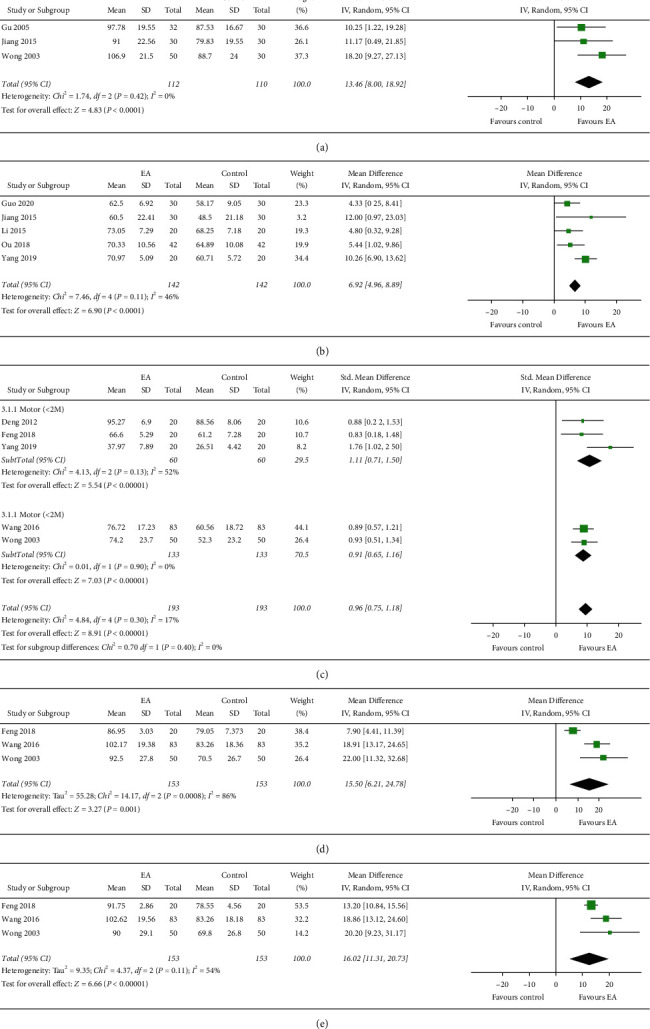
This meta-analysis included 10 RCTs with 712 patients. Three studies revealed that the functional independence measure score for SCI patients in the EA group was higher than that in the control group (mean difference [MD] = 13.46, 95% CI: 8.00 to 18.92, < 0.00001). Five studies showed that the modified Barthel index in the EA group was higher than that in the control group (MD = 6.92, 95% CI: 4.96 to 8.89, < 0.00001). Five studies showed that the American Spinal Injury Association-motor score (ASIA-motor score) in the EA group was higher than that in the control group (standard MD = 0.96, 95% CI: 0.75 to 1.18, < 0.00001). Three studies reported the ASIA-tactile and pain scores and also reported that the scores in the EA group were higher than those in the control group, with high homogeneity (tactile I = 86%, = 0.0008; pain I = 54%, = 0.11). The quality of evidence for the use of EA for improvement in motor and sensory function in SCIs was moderate according to the GRADE system.
This review suggested that EA improves activities of daily living and motor function in patients with SCI, with a moderate level of evidence.
既往研究表明,电针(EA)对脊髓损伤(SCI)患者的运动和感觉功能有积极影响。本综述评估了电针改善SCI患者日常生活活动能力的有效性。
我们按照《Cochrane系统评价干预措施手册》指南制定的检索策略,检索了Cochrane图书馆、PubMed、Web of Science、中国知网、万方数据和维普数据库,检索截至2020年9月30日。仅纳入SCI患者电针治疗的随机对照试验(RCT)。我们使用RevMan(5.3版)分析数据,并使用GRADE profiler 3.6.1对证据质量进行分级。
本荟萃分析纳入了10项RCT,共712例患者。三项研究显示,电针组SCI患者的功能独立性测量评分高于对照组(平均差值[MD]=13.46,95%CI:8.00至18.92,P<0.00001)。五项研究表明,电针组改良Barthel指数高于对照组(MD=6.92,95%CI:4.96至8.89,P<0.00001)。五项研究显示,电针组美国脊髓损伤协会运动评分(ASIA运动评分)高于对照组(标准化MD=0.96,95%CI:0.75至1.18,P<0.00001)。三项研究报告了ASIA触觉和疼痛评分,也报告了电针组的评分高于对照组,同质性较高(触觉I=86%,P=0.0008;疼痛I=54%,P=0.11)。根据GRADE系统,电针改善SCI患者运动和感觉功能的证据质量为中等。
本综述表明,电针可改善SCI患者的日常生活活动能力和运动功能,证据水平为中等。