Laboratory of Allergic Diseases, National Institute of Allergy and Infectious Diseases (NIAID), National Institutes of Health (NIH), Bethesda, MD, United States.
Front Immunol. 2022 Feb 24;13:818039. doi: 10.3389/fimmu.2022.818039. eCollection 2022.
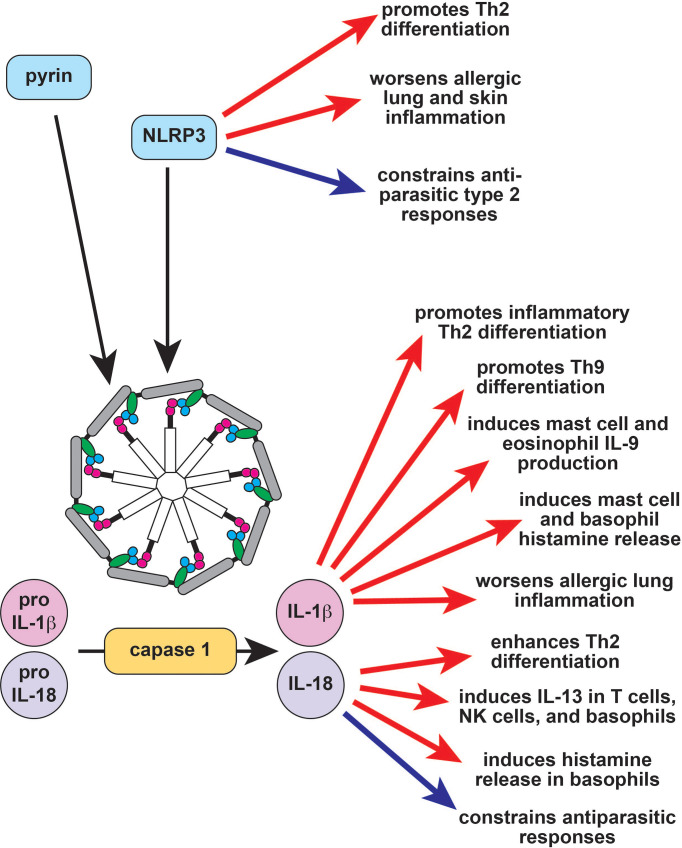
Autoinflammatory diseases are a group of clinical syndromes characterized by constitutive overactivation of innate immune pathways. This results in increased production of or responses to monocyte- and neutrophil-derived cytokines such as interleukin-1β (IL-1β), Tumor Necrosis Factor-α (TNF-α), and Type 1 interferon (IFN). By contrast, clinical allergy is caused by dysregulated type 2 immunity, which is characterized by expansion of T helper 2 (Th2) cells and eosinophils, as well as overproduction of the associated cytokines IL-4, IL-5, IL-9, and IL-13. Traditionally, type 2 immune cells and autoinflammatory effectors were thought to counter-regulate each other. However, an expanding body of evidence suggests that, in some contexts, autoinflammatory pathways and cytokines may potentiate type 2 immune responses. Conversely, type 2 immune cells and cytokines can regulate autoinflammatory responses in complex and context-dependent manners. Here, we introduce the concepts of autoinflammation and type 2 immunity. We proceed to review the mechanisms by which autoinflammatory and type 2 immune responses can modulate each other. Finally, we discuss the epidemiology of type 2 immunity and clinical allergy in several monogenic and complex autoinflammatory diseases. In the future, these interactions between type 2 immunity and autoinflammation may help to expand the spectrum of autoinflammation and to guide the management of patients with various autoinflammatory and allergic diseases.
自身炎症性疾病是一组以固有免疫途径持续过度激活为特征的临床综合征。这导致单核细胞和中性粒细胞衍生的细胞因子(如白细胞介素-1β(IL-1β)、肿瘤坏死因子-α(TNF-α)和 1 型干扰素(IFN))的产生或反应增加。相比之下,临床过敏是由 2 型免疫失调引起的,其特征是 T 辅助 2(Th2)细胞和嗜酸性粒细胞的扩张,以及相关细胞因子 IL-4、IL-5、IL-9 和 IL-13 的过度产生。传统上,2 型免疫细胞和自身炎症效应物被认为相互拮抗。然而,越来越多的证据表明,在某些情况下,自身炎症途径和细胞因子可能增强 2 型免疫反应。相反,2 型免疫细胞和细胞因子可以以复杂且依赖于上下文的方式调节自身炎症反应。在这里,我们介绍自身炎症和 2 型免疫的概念。我们接着回顾了自身炎症和 2 型免疫反应相互调节的机制。最后,我们讨论了几种单基因和复杂自身炎症性疾病中 2 型免疫和临床过敏的流行病学。在未来,2 型免疫和自身炎症之间的这些相互作用可能有助于扩大自身炎症的范围,并指导各种自身炎症和过敏性疾病患者的管理。