Zhang Wei, Wang Shiqun, Xing Yu, Wang Hongyi, Fu Binsha, Long Mingjia, Cao Juan
Department of Neonatology, Hainan Women and Children's Medical Center, Haikou, China.
Department of Pediatrics, Qionghai Hospital of Traditional Chinese Medicine, Qionghai, China.
Transl Pediatr. 2022 Feb;11(2):229-238. doi: 10.21037/tp-21-624.
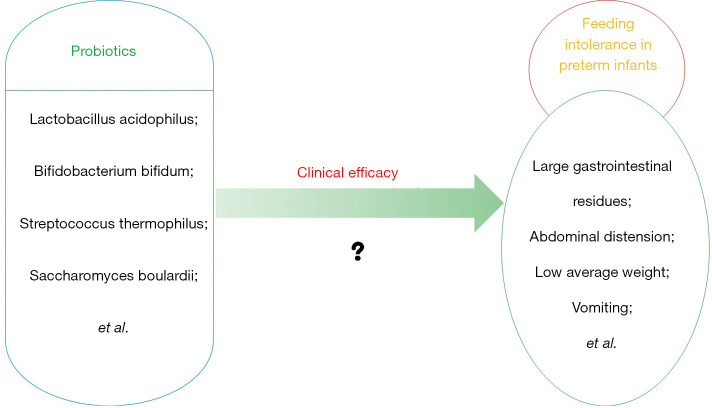
The physiological organ system of premature infants is still very immature, so it is easy to result feeding intolerance. Therefore, effective probiotic supplementation plays a very important role and clinical research significance in promoting the growth and development of preterm infants, improving the quality of life and improving the occurrence of feeding intolerance. To explore the clinical effect of probiotics on feeding intolerance (FI) in preterm infants by meta-analysis.
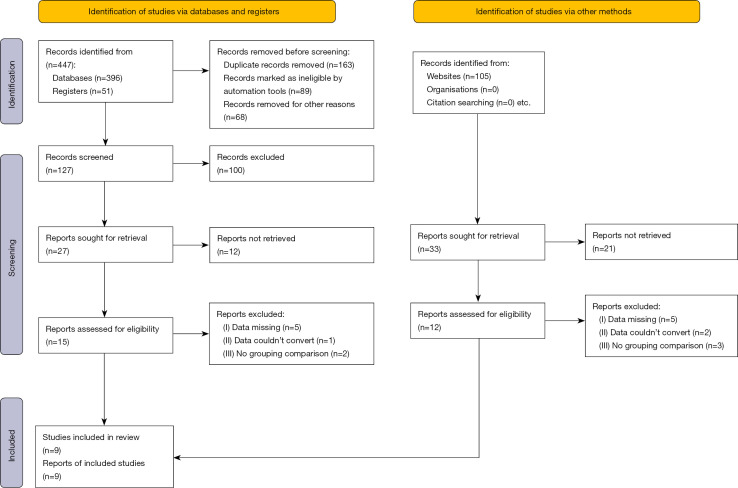
The PubMed, Web of Science, EMBASE and MEDLINE literature databases were searched for relevant literature. The literature related to the clinical effect of probiotics on FI in preterm infants was published from January 2002 to January 2021. RevMan 5.3 was used to calculate the reinforcement mean difference (MD) and evaluate the publication bias.
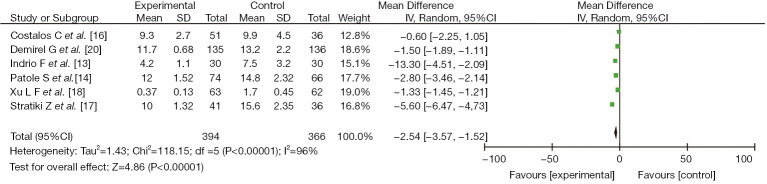
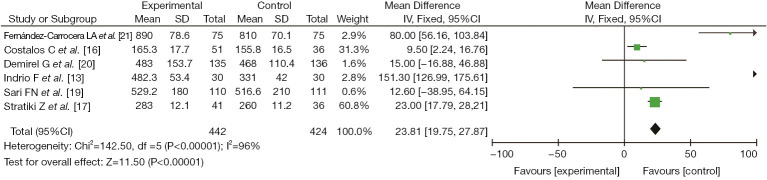
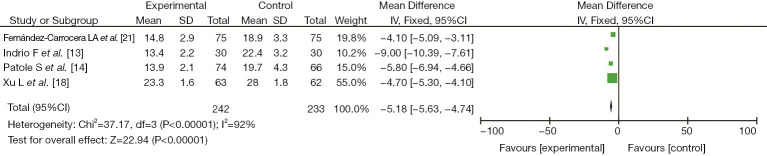
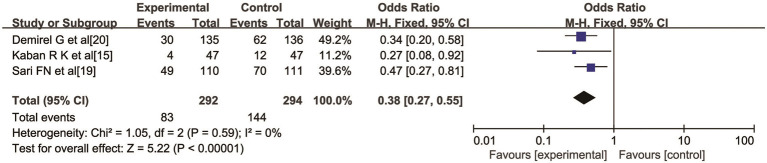
Nine articles were included, involving a total of 1,244 preterm infants with FI. Through the sensitivity analysis of each excluded study, the results showed no significant differences. Compared with patients in the control group, the probiotics group had significant improvements (P<0.1) in the total intestinal feeding time (MD =-2.54, 95% CI: -3.57, -1.52, P<0.00001), weight gain (MD =23.81, 95% CI: 19.75, 27.81, P<0.00001), maximum enteral feeding (MD =6.41, 95% CI: 1.94, 10.88, P=0.005), hospital stay (MD =-5.18, 95% CI: -5.63, -4.74, P<0.00001), incidence of FI [odds rate (OR) =0.38, 95% CI: 0.27, 0.55, P<0.00001] and improvement in the gastrointestinal tract (OR =2.34, 95% CI: 1.07, 5.14, P=0.03).
Our study shows that the use of probiotics can promote the early growth of preterm infants and effectively improve the occurrence of FI in preterm infants.
早产儿的生理器官系统仍非常不成熟,因此容易导致喂养不耐受。因此,有效的益生菌补充在促进早产儿生长发育、提高生活质量以及改善喂养不耐受的发生方面具有非常重要的作用和临床研究意义。通过荟萃分析探讨益生菌对早产儿喂养不耐受(FI)的临床效果。
检索PubMed、Web of Science、EMBASE和MEDLINE文献数据库中的相关文献。检索2002年1月至2021年1月发表的有关益生菌对早产儿FI临床效果的文献。使用RevMan 5.3计算强化平均差(MD)并评估发表偏倚。
纳入9篇文章,共涉及1244例患有FI的早产儿。通过对每项排除研究的敏感性分析,结果显示无显著差异。与对照组患者相比,益生菌组在总肠道喂养时间(MD = -2.54,95%CI:-3.57,-1.52,P < 0.00001)、体重增加(MD = 23.81,95%CI:19.75,27.81,P < 0.00001)、最大肠内喂养量(MD = 6.41,95%CI:1.94,10.88,P = 0.005)、住院时间(MD = -5.18,95%CI:-5.63,-4.74,P < 0.00001)、FI发生率[比值比(OR)= 0.38,95%CI:0.27,0.55,P < 0.00001]以及胃肠道改善情况(OR = 2.34,95%CI:1.07,5.14,P = 0.03)方面均有显著改善。
我们的研究表明,使用益生菌可促进早产儿的早期生长,并有效改善早产儿FI的发生情况。