Centre for Addiction and Mental Health, Institute of Mental Health and Policy Research, Toronto, Canada.
Dalla Lana School of Public Health, University of Toronto, Toronto, Canada.
BMC Med Res Methodol. 2022 Mar 13;22(1):67. doi: 10.1186/s12874-022-01556-2.
Inconsistent responding is a type of invalid responding, which occurs on self-report surveys and threatens the reliability and validity of study results. This secondary analysis evaluated the utility of identifying inconsistent responses as a real-time, direct method to improve quality during data collection for an Internet-based RCT.
The cannabis subscale of the Alcohol, Smoking and Substance Involvement Screening Test (ASSIST) was administered as part of eligibility screening for the RCT. Following the consent procedure, the cannabis subscale was repeated during the baseline interview. Responses were automatically compared and individuals with inconsistent responses were screened out.
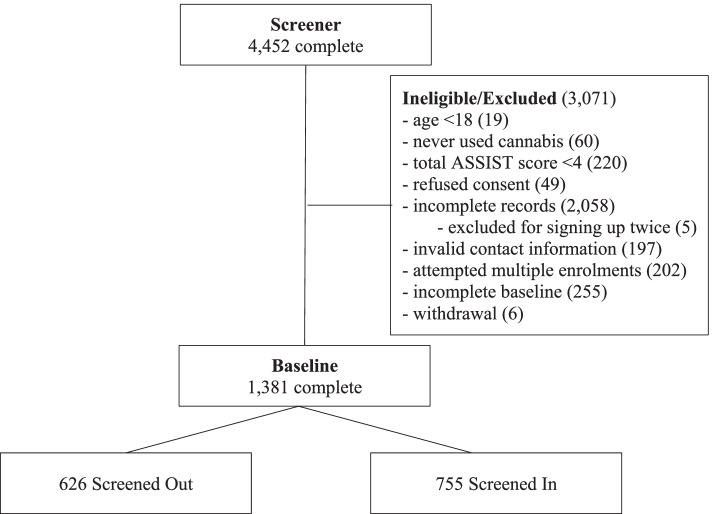
Nearly half of those initially eligible for the RCT were subsequently screened out for data quality issues (n = 626, 45.3%). Between-group bivariate analysis found that those screened out (OUT) were significantly older (OUT = 39.5 years (SD = 13.9), IN = 35.7 years (SD = 12.9), p < .001), more had annual incomes less than $20,000CND (OUT = 58.3%, IN = 53.0%, p = .047), used cannabis less often in the past 30 days (OUT = 23.3 days (SD = 9.7), IN = 24.8 days (SD = 11.3), p < .006), and had lower total ASSIST scores at screener (OUT = 19.3 (SD = 8.0), IN = 23.8 (SD = 10.4), p < .001) and baseline (OUT = 17.5 (SD = 7.9), IN = 23.3 (SD = 10.3), p < .001) compared to participants who were screened in to the RCT.
Inconsistent responding may occur at high rates in Internet research and direct methods to identify invalid responses are needed. Comparing responses for consistency can be programmed in Internet surveys to automatically screen participants during recruitment and reduce the need for post-hoc data cleaning.
不一致回答是一种无效回答,发生在自我报告调查中,威胁研究结果的可靠性和有效性。本二次分析评估了识别不一致回答作为一种实时、直接的方法来提高基于互联网 RCT 数据收集质量的效用。
酒精、吸烟和物质参与筛查测试(ASSIST)的大麻子量表作为 RCT 入选标准的一部分进行管理。在同意程序后,在基线访谈期间重复大麻子量表。自动比较响应,筛选出不一致响应的个体。
近一半最初符合 RCT 入选标准的人因数据质量问题而被筛选(n=626,45.3%)。组间双变量分析发现,筛选出的人(OUT)年龄明显较大(OUT=39.5 岁(SD=13.9),IN=35.7 岁(SD=12.9),p<.001),年收入低于 20000 加元的人更多(OUT=58.3%,IN=53.0%,p=0.047),过去 30 天内使用大麻的频率较低(OUT=23.3 天(SD=9.7),IN=24.8 天(SD=11.3),p<.006),且在筛选时的 ASSIST 总分较低(OUT=19.3(SD=8.0),IN=23.8(SD=10.4),p<.001)和基线时(OUT=17.5(SD=7.9),IN=23.3(SD=10.3),p<.001)与入选 RCT 的参与者相比。
互联网研究中可能会出现不一致回答的高发生率,需要直接识别无效回答的方法。比较响应的一致性可以在互联网调查中编程,以便在招募期间自动筛选参与者,并减少事后数据清理的需要。