Badali Sabrina, Rawson Katherine A, Dunlosky John
Department of Psychological Sciences, Kent State University, P.O. Box 5190, Kent, OH 44242-0001 USA.
Educ Psychol Rev. 2022;34(3):1651-1677. doi: 10.1007/s10648-022-09665-6. Epub 2022 Mar 5.
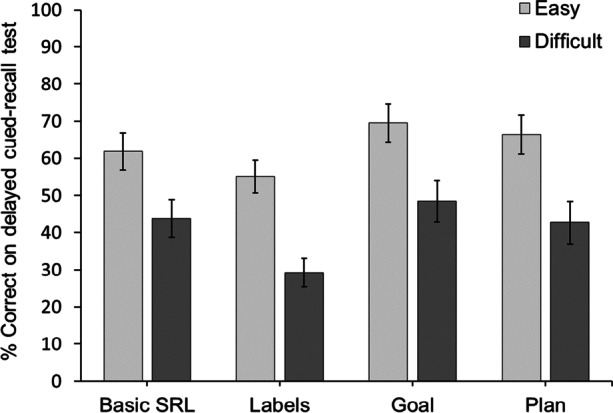
Retrieval practice is beneficial for both easy-to-learn and difficult-to-learn materials, but scant research has examined students' use of self-testing for items of varying difficulty. In two experiments, we investigated whether students differentially regulate their use of self-testing for easy and difficult items and assessed the effectiveness of students' self-regulated choices. Undergraduate participants learned normatively easy and normatively difficult Lithuanian-English word pair translations. After an initial study trial, participants in the self-regulated learning groups chose whether they wanted to restudy an item, take a practice test, or remove an item from further practice. Participants chose to test items repeatedly while learning but dropped both easy and difficult items after reaching a criterion of about one correct recall per item. Consequently, final test performance 2 days later was lower for difficult items versus easy items, and performance was lower in the self-regulated learning group than in an experimenter-controlled comparison group (in Experiment 1). In Experiment 2, we tested hypotheses for participants reached a similar number of correct recalls for both easy and difficult items. Three new groups included different scaffolds aimed at minimizing potential barriers to effective regulation. These scaffolds did not change participants' learning choices, and as a result, performance on difficult items was still lower than on easy items. Importantly, participants planned to continue practicing items beyond one correct recall and believed that an optimal student should practice difficult items more than easy items, but they did not execute this plan during the learning task.
检索练习对易于学习和难以学习的材料都有益,但很少有研究考察学生对不同难度项目的自我测试使用情况。在两项实验中,我们调查了学生是否对简单和困难项目的自我测试使用进行差异化调节,并评估了学生自我调节选择的有效性。本科参与者学习了规范上简单和规范上困难的立陶宛语 - 英语单词对翻译。在初步学习试验后,自我调节学习组的参与者选择他们是想重新学习一个项目、进行一次练习测试,还是将一个项目从进一步练习中移除。参与者在学习时选择反复测试项目,但在达到每个项目约一次正确回忆的标准后,放弃了简单和困难的项目。因此,两天后的最终测试中,困难项目的表现低于简单项目,并且在自我调节学习组中的表现低于实验者控制的比较组(实验1)。在实验2中,我们针对简单和困难项目达到相似正确回忆次数的参与者测试了假设。三个新组包括不同的支架,旨在最小化有效调节的潜在障碍。这些支架没有改变参与者的学习选择,结果,困难项目的表现仍然低于简单项目。重要的是,参与者计划在一次正确回忆之后继续练习项目,并认为一个优秀的学生应该比简单项目更多地练习困难项目,但他们在学习任务中没有执行这个计划。