Solé-Padullés Cristina, Macià Dídac, Andersson Micael, Stiernstedt Mikael, Pudas Sara, Düzel Sandra, Zsoldos Enikő, Ebmeier Klaus P, Binnewies Julia, Drevon Christian A, Brandmaier Andreas M, Mowinckel Athanasia M, Fjell Anders M, Madsen Kathrine Skak, Baaré William F C, Lindenberger Ulman, Nyberg Lars, Walhovd Kristine B, Bartrés-Faz David
Department of Medicine, Faculty of Medicine and Health Sciences, Institute of Neurosciences, University of Barcelona, Barcelona, Spain.
ISGlobal, Hospital Clínic - University of Barcelona, Barcelona, Spain.
Front Aging Neurosci. 2022 Feb 23;14:795764. doi: 10.3389/fnagi.2022.795764. eCollection 2022.
Loneliness is most prevalent during adolescence and late life and has been associated with mental health disorders as well as with cognitive decline during aging. Associations between longitudinal measures of loneliness and verbal episodic memory and brain structure should thus be investigated.
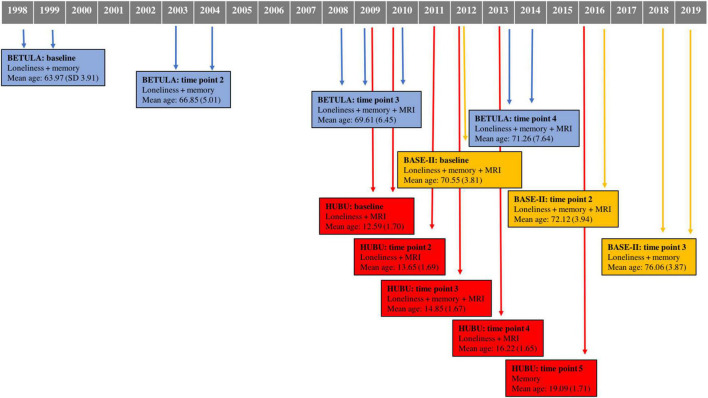
We sought to determine associations between loneliness and verbal episodic memory as well as loneliness and hippocampal volume trajectories across three longitudinal cohorts within the Lifebrain Consortium, including children, adolescents ( = 69, age range 10-15 at baseline examination) and older adults ( = 1468 over 60). We also explored putative loneliness correlates of cortical thinning across the entire cortical mantle.
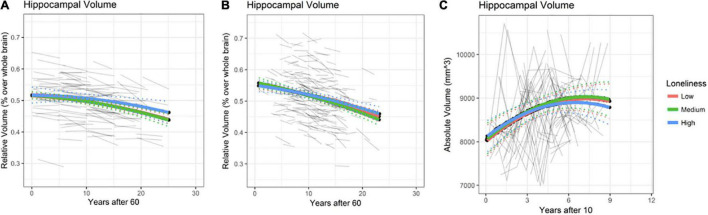
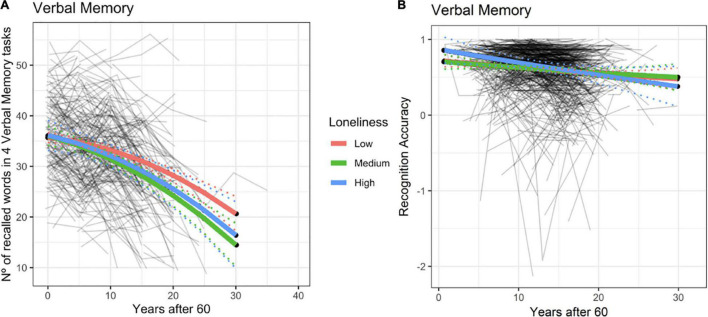
Loneliness was associated with worsening of verbal episodic memory in one cohort of older adults. Specifically, reporting medium to high levels of loneliness over time was related to significantly increased memory loss at follow-up examinations. The significance of the loneliness-memory change association was lost when eight participants were excluded after having developed dementia in any of the subsequent follow-up assessments. No significant structural brain correlates of loneliness were found, neither hippocampal volume change nor cortical thinning.
In the present longitudinal European multicenter study, the association between loneliness and episodic memory was mainly driven by individuals exhibiting progressive cognitive decline, which reinforces previous findings associating loneliness with cognitive impairment and dementia.
孤独感在青春期和晚年最为普遍,并且与心理健康障碍以及衰老过程中的认知衰退有关。因此,应该研究孤独感的纵向测量与言语情景记忆和脑结构之间的关联。
我们试图确定在Lifebrain联盟的三个纵向队列中,孤独感与言语情景记忆之间的关联,以及孤独感与海马体体积轨迹之间的关联,这三个队列包括儿童、青少年(n = 69,基线检查时年龄范围为10 - 15岁)和老年人(n = 1468,年龄超过60岁)。我们还探讨了整个皮质层皮质变薄与孤独感之间可能存在的关联。
在一组老年人中,孤独感与言语情景记忆的恶化有关。具体而言,随着时间的推移报告中度至高度孤独感与随访检查中记忆力显著下降有关。在后续任何一次随访评估中出现痴呆后排除8名参与者后,孤独感与记忆力变化之间的关联的显著性消失。未发现孤独感与脑结构之间存在显著关联,无论是海马体体积变化还是皮质变薄。
在本项纵向欧洲多中心研究中,孤独感与情景记忆之间的关联主要由表现出进行性认知衰退的个体驱动,这强化了先前将孤独感与认知障碍和痴呆联系起来的研究结果。