Li Ziwei, An Mengjie, Hong Dashuang, Chang Doudou, Wang Kaiyong, Fan Hua
Agricultural College, Shihezi University, Shihezi, China.
Front Plant Sci. 2022 Feb 23;13:820540. doi: 10.3389/fpls.2022.820540. eCollection 2022.
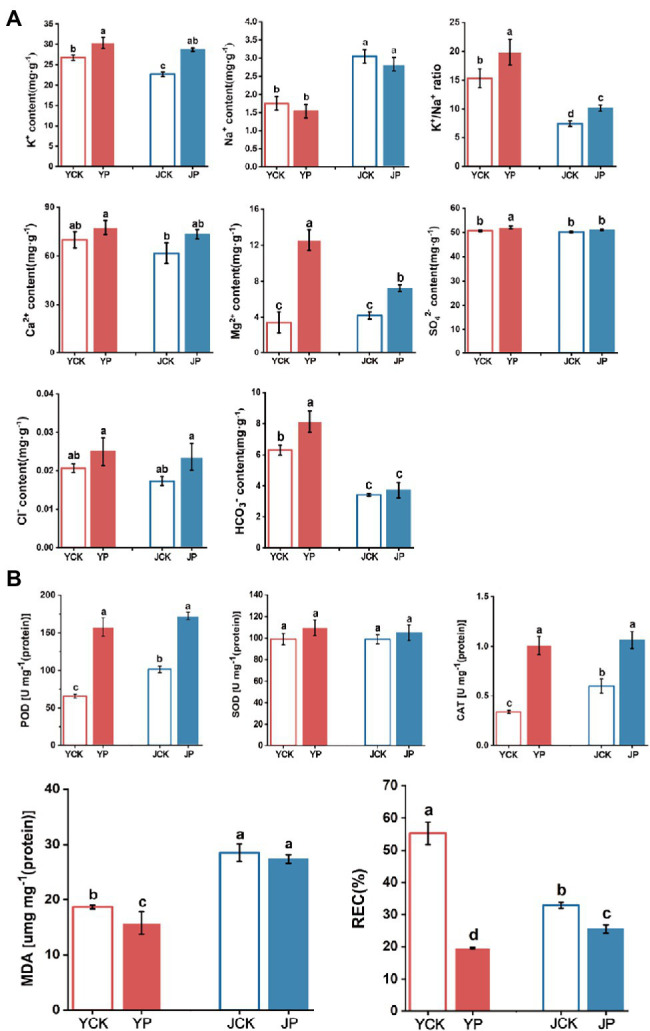
Oilseed rape not only has the function of improve saline and alkaline soils, but also alleviate the local feed shortage. However, medium- and high-degree soil salinization and alkalinization always inhibit the growth of oilseed rape. Studies have shown that compound material can improve the tolerance to saline and alkaline stress of crops, but the difference in the regulation mechanism of compound material on oilseed rape in saline and alkaline soils is not clear. This study explored the difference through determining the leaf ion contents, physiological indexes, transcriptomics, and metabolomics of oilseed rape in salinized soil (NaCl 8 g kg) and alkalinized soil (NaCO 8 g kg) at full flowering stage, respectively after the application of compound material. The results showed that in salinized and alkalinized soil, the compound material upregulated the genes related to the regulation of potassium ion transport, and changed the amino acid metabolic pathway, which reduced the contents of Na, malondialdehyde (MDA), and relative conductivity (REC) in leaves, and increased the contents of K and Mg and the activities of superoxide dismutase (SOD), peroxidase (POD), and catalase (CAT). However, there were differences in the regulation mechanism of compound material in salinized and alkalinized soil. In salinized soil, the compound material improved the tolerance of oilseed rape to saline stress by upregulating transcription factors mannose-1-phosphate guanylyltransferase () and Glutamine--fructose-6-phosphate transaminase () and downregulating phosphomannomutase () to change nucleotide metabolism pathway and lipid metabolism pathway. In alkalized soil, the compound material improved the tolerance of oilseed rape to alkaline stress by upregulating transcription factors Phenylalanine ammonia lyase () to change the biosynthesis pathway of other secondary metabolites. Therefore, the compound material can improve the tolerance of oilseed rape to saline and alkaline stress by regulating the genetic adaptability and apparent plasticity, but the mechanisms were different. This study provides a practical method for the ecological environment restoration and the development of animal husbandry.
油菜不仅具有改良盐碱地的作用,还能缓解当地饲料短缺问题。然而,中高度土壤盐碱化总是会抑制油菜的生长。研究表明,复合材料可以提高作物对盐碱胁迫的耐受性,但复合材料对盐碱土壤中油菜的调控机制差异尚不清楚。本研究通过分别测定在施用复合材料后盛花期盐碱化土壤(NaCl 8 g/kg)和碱化土壤(Na₂CO₃ 8 g/kg)中油菜的叶片离子含量、生理指标、转录组学和代谢组学,探索了其中的差异。结果表明,在盐碱化和碱化土壤中,复合材料上调了与钾离子转运调控相关的基因,改变了氨基酸代谢途径,降低了叶片中Na、丙二醛(MDA)和相对电导率(REC)的含量,增加了K和Mg的含量以及超氧化物歧化酶(SOD)、过氧化物酶(POD)和过氧化氢酶(CAT)的活性。然而,复合材料在盐碱化和碱化土壤中的调控机制存在差异。在盐碱化土壤中,复合材料通过上调转录因子甘露糖-1-磷酸鸟苷转移酶( )和谷氨酰胺-果糖-6-磷酸转氨酶( )以及下调磷酸甘露糖变位酶( )来改变核苷酸代谢途径和脂质代谢途径,从而提高油菜对盐胁迫的耐受性。在碱化土壤中,复合材料通过上调转录因子苯丙氨酸解氨酶( )来改变其他次生代谢物的生物合成途径,从而提高油菜对碱胁迫的耐受性。因此,复合材料可以通过调节遗传适应性和表观可塑性来提高油菜对盐碱胁迫的耐受性,但机制不同。本研究为生态环境恢复和畜牧业发展提供了一种实用方法。