Division of Diabetes Endocrinology Medicine, Fujieda Municipal General Hospital, Fujieda, Japan.
Division of Respiratory Internal Medicine, Fujieda Municipal General Hospital, Fujieda, Japan.
J Diabetes Investig. 2022 Aug;13(8):1366-1373. doi: 10.1111/jdi.13792. Epub 2022 Mar 24.
AIMS/INTRODUCTION: Diabetes and sarcopenia have a two-way relationship with each other with advanced age. Additionally, malnutrition is correlated with a higher risk of sarcopenia in elderly patients. This study evaluated the association between sarcopenia and geriatric nutritional risk index (GNRI) in elderly patients with type 2 diabetes mellitus.
Patients with type 2 diabetes mellitus aged ≥60 years were recruited from June 2018 to August 2020. This study analyzed 234 patients, who completed a physical performance test required for the diagnosis of sarcopenia. To investigate the effect of GNRI on sarcopenia, logistic regression analyses was used.
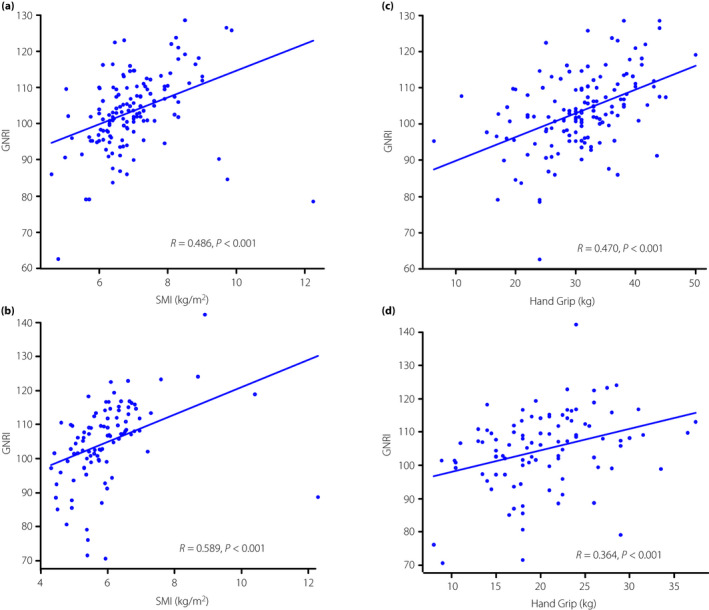
Patients with sarcopenia were significantly older with a lower body mass index (BMI) and GNRI compared with normal patients. The GNRI showed a positive correlation with the skeletal muscle index (SMI) and handgrip strength (SMI: R = 0.486, P < 0.001 for male; R = 0.589, P < 0.001 for female, handgrip strength: R = 0.470, P < 0.001 for male, R = 0.364, P < 0.001 for female). In the multivariate logistic regression model, a higher GNRI was associated with a lower risk of sarcopenia in older men and women with diabetes (adjusted odds ratio [OR], 0.892; 95% confidence interval [CI], 0.839-0.948 for male; adjusted OR, 0.928; 95% CI, 0.876-0.982 for female). One year of diabetes treatment improved the GNRI in the sarcopenia group with type 2 diabetes mellitus.
A low GNRI was associated with an increased risk of sarcopenia in elderly patients with type 2 diabetes mellitus. Treatment with glucose-lowering drugs improved the GNRI in the sarcopenia group.
目的/引言:糖尿病和肌肉减少症随着年龄的增长呈双向关系。此外,营养不良与老年患者发生肌肉减少症的风险增加相关。本研究评估了老年 2 型糖尿病患者肌肉减少症与老年营养风险指数(GNRI)之间的关系。
本研究纳入了 2018 年 6 月至 2020 年 8 月期间年龄≥60 岁的 2 型糖尿病患者。本研究分析了 234 名完成了诊断肌肉减少症所需的身体表现测试的患者。为了研究 GNRI 对肌肉减少症的影响,采用了逻辑回归分析。
与正常患者相比,患有肌肉减少症的患者年龄明显更大,体重指数(BMI)和 GNRI 更低。GNRI 与骨骼肌指数(SMI)和握力呈正相关(男性:SMI:R=0.486,P<0.001;女性:SMI:R=0.589,P<0.001;握力:R=0.470,P<0.001;女性:R=0.364,P<0.001)。在多变量逻辑回归模型中,较高的 GNRI 与糖尿病老年男性和女性发生肌肉减少症的风险降低相关(调整后的优势比[OR],0.892;95%置信区间[CI],0.839-0.948 男性;调整后的 OR,0.928;95%CI,0.876-0.982 女性)。在患有 2 型糖尿病的肌肉减少症组中,1 年的糖尿病治疗可改善 GNRI。
低 GNRI 与老年 2 型糖尿病患者发生肌肉减少症的风险增加相关。降低血糖的药物治疗可改善肌肉减少症组的 GNRI。