School of Psychology, Deakin University, Australia; Department of Psychology, University of Oregon, USA.
Department of Psychology, University of Oregon, USA.
Neuroimage Clin. 2022;34:102986. doi: 10.1016/j.nicl.2022.102986. Epub 2022 Mar 9.
Adolescents in foster care may exhibit differential patterns of brain functioning that contribute to their pervasive socioemotional challenges. However, there has been limited investigation of implicated neural processes, particularly in the social domain. Thus, the current study investigated neural responses to exclusionary and inclusionary peer interactions in adolescents in foster-care.
Participants comprised adolescents aged 11-18 years in foster care (N = 69) and a community sample (N = 69). They completed an fMRI adaptation of Cyberball, a virtual ball-throwing paradigm, that included periods of exclusion and over-inclusion. To investigate neural sensitivity to peer social experiences, we quantified neural responses that scaled with consecutive inclusionary and exclusionary interactions (using parametric modulators).
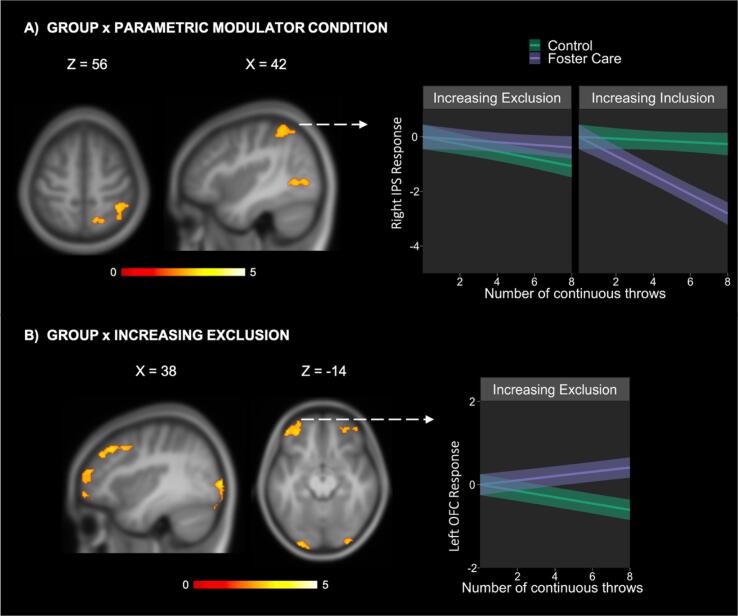
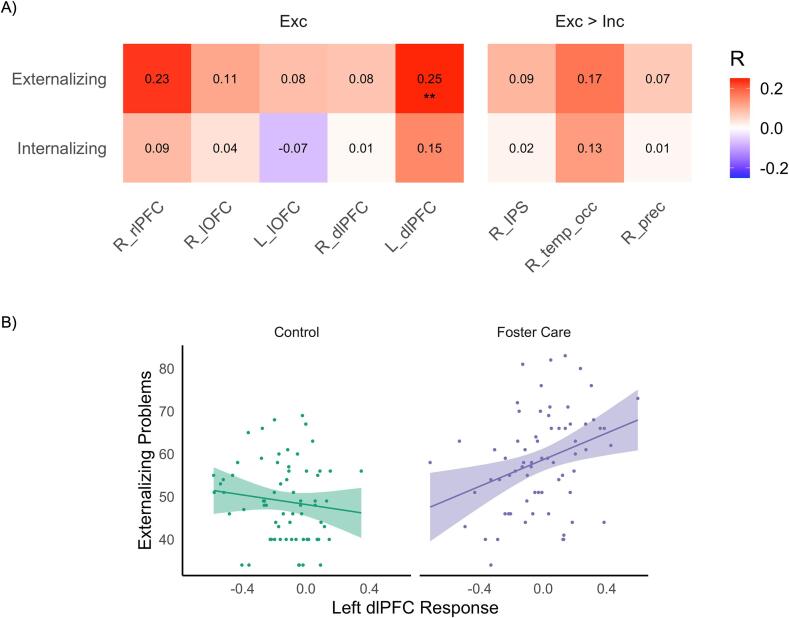
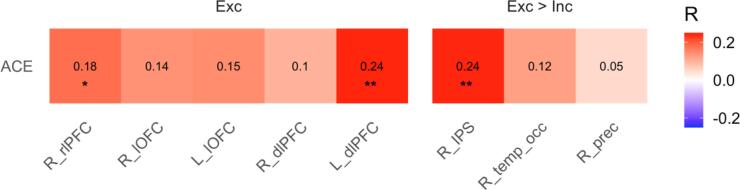
Relative to the community sample, adolescents in foster care exhibited increasing response to consecutive exclusionary events in lateral prefrontal regions and decreasing response to consecutive inclusionary events in the intraparietal sulcus and temporo-occipital cortex. Further, exploratory analyses revealed that dorsolateral prefrontal activation to exclusion was related to externalizing problems, particularly in the foster care sample.
Findings highlight greater neural sensitivity to exclusionary, and lesser sensitivity to inclusionary, peer interactions in adolescents in foster care. Engagement of prefrontal clusters may reflect greater salience and emotion regulatory processes during exclusion, while parietal and temporal clusters may reflect reduced attention and behavioural engagement during inclusion. Thus foster care involvement is associated with broad changes in neural responses during peer interactions, and further these potentially relate to externalizing problems that have been identified in this vulnerable population.
寄养中的青少年可能表现出不同的大脑功能模式,这导致他们普遍存在社会情感挑战。然而,涉及的神经过程,特别是在社会领域,研究有限。因此,本研究调查了寄养青少年在排除和包容同伴互动时的神经反应。
参与者包括寄养中的 11-18 岁青少年(N=69)和社区样本(N=69)。他们完成了 Cyberball 的 fMRI 改编版,这是一种虚拟的投球范式,包括排除和过度包容期。为了研究对同伴社会经验的神经敏感性,我们量化了与连续包容和排斥互动相关的神经反应(使用参数调制器)。
与社区样本相比,寄养中的青少年在外侧前额叶区域对连续排斥事件的反应增加,而在顶内沟和颞枕叶皮质对连续包容事件的反应减少。此外,探索性分析表明,对排斥的背外侧前额叶激活与外化问题有关,特别是在寄养样本中。
研究结果强调了寄养中的青少年对排斥性同伴互动的神经敏感性增加,对包容性同伴互动的敏感性降低。前额叶簇的参与可能反映了在排斥期间更大的显着性和情绪调节过程,而顶叶和颞叶簇可能反映了在包容期间注意力和行为参与的减少。因此,寄养参与与同伴互动期间的广泛神经反应变化有关,并且这些变化可能与已在这一脆弱群体中确定的外化问题有关。