Ju Lingsha, Yang Jiaojiao, Zhu Tingting, Liu Panmiao, Yang Jianjun
Department of Anesthesiology, Pain and Perioperative Medicine, The First Affiliated Hospital of Zhengzhou University, Zhengzhou, Henan, China.
Department of Anesthesiology, Zhongda Hospital, School of Medicine, Southeast University, Nanjing, Jiangsu, China.
BMC Psychiatry. 2022 Mar 15;22(1):182. doi: 10.1186/s12888-022-03838-x.
Preclinical studies have indicated that the ketamine metabolite (2R,6R)-hydroxynorketamine (HNK) is a rapid-acting antidepressant drug with limited dissociation properties and low abuse potential. However, its effects and molecular mechanisms remain unclear. In this work, we examined the involvement of brain-derived neurotrophic factor (BDNF), tropomyosin receptor kinase B (TrkB) and Narp in the antidepressant-like actions of (2R,6R)-HNK in a chronic restraint stress (CRS) mouse model.
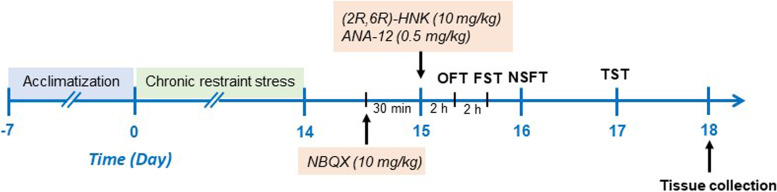
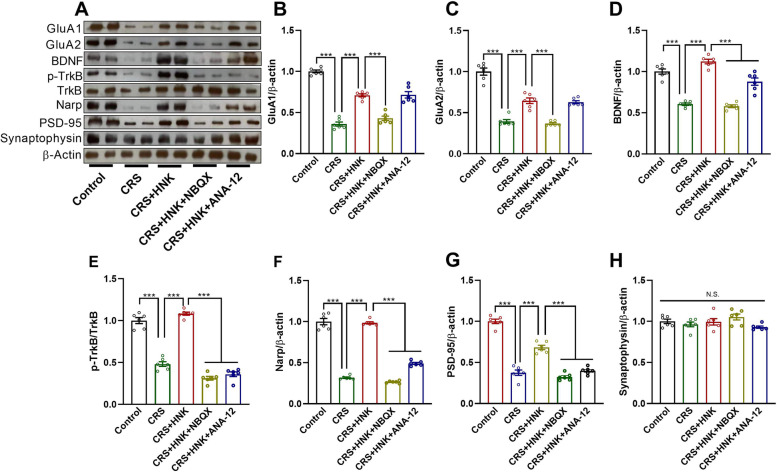
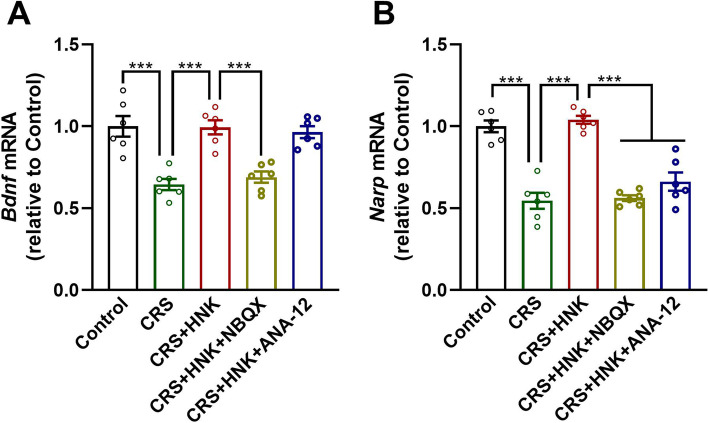
C57BL/6 male mice were subjected to CRS for 8 h per day for 14 consecutive days. Open field, forced swimming, novelty suppressed feeding, and tail suspension tests were performed after administering (2R,6R)-HNK (10 mg/kg), a combination of (2R,6R)-HNK and NBQX (an alpha-amino-3-hydroxy-5-methyl-4-isoxazole propionic acid (AMPA) receptor antagonist; 10 mg/kg), or a combination of (2R,6R)-HNK and ANA-12 (a TrkB receptor antagonist; 0.5 mg/kg). The mRNA levels of Bdnf and Narp in the hippocampus were determined by quantitative reverse transcription-PCR (qRT-PCR). Western blotting was used to determine the hippocampal protein levels of GluA1, GluA2, BDNF, Narp, PSD95, and synaptophysin, as well as the p-TrkB/TrkB protein ratio.
(2R,6R)-HNK had rapid antidepressant-like effects in CRS mice. Furthermore, (2R,6R)-HNK significantly ameliorated CRS-induced downregulation of GluA1, GluA2, BDNF, Narp, PSD95, and the p-TrkB/TrkB protein ratio in the hippocampus. The effects of (2R,6R)-HNK were blocked by combinations with NBQX or ANA-12.
BDNF-TrkB signaling-mediated upregulation of Narp in the hippocampus may play a key role in the antidepressant-like effect of (2R,6R)-HNK in the CRS model of depression.
临床前研究表明,氯胺酮代谢物(2R,6R)-羟基去甲氯胺酮(HNK)是一种起效迅速的抗抑郁药物,具有有限的解离特性和低滥用潜力。然而,其作用及分子机制仍不清楚。在本研究中,我们在慢性束缚应激(CRS)小鼠模型中研究了脑源性神经营养因子(BDNF)、原肌球蛋白受体激酶B(TrkB)和神经元五聚体蛋白(Narp)在(2R,6R)-HNK抗抑郁样作用中的参与情况。
C57BL/6雄性小鼠连续14天每天接受8小时的CRS。在给予(2R,6R)-HNK(10mg/kg)、(2R,6R)-HNK与NBQX(一种α-氨基-3-羟基-5-甲基-4-异恶唑丙酸(AMPA)受体拮抗剂;10mg/kg)的组合或(2R,6R)-HNK与ANA-12(一种TrkB受体拮抗剂;0.5mg/kg)的组合后,进行旷场试验、强迫游泳试验、新奇性抑制摄食试验和悬尾试验。通过定量逆转录PCR(qRT-PCR)测定海马中Bdnf和Narp的mRNA水平。蛋白质免疫印迹法用于测定海马中GluA1、GluA2、BDNF、Narp、PSD95和突触素的蛋白水平,以及p-TrkB/TrkB蛋白比率。
(2R,6R)-HNK对CRS小鼠具有快速的抗抑郁样作用。此外,(2R,6R)-HNK显著改善了CRS诱导的海马中GluA1、GluA2、BDNF、Narp、PSD95和p-TrkB/TrkB蛋白比率的下调。(2R,6R)-HNK的作用被与NBQX或ANA-12的组合所阻断。
BDNF-TrkB信号介导的海马中Narp上调可能在(2R,6R)-HNK在抑郁症CRS模型中的抗抑郁样作用中起关键作用。