Experimental and Clinical Research Center, Max Delbrueck Center for Molecular Medicine and Charité-Universitätsmedizin Berlin, Corporate Member of Freie Universität Berlin, Humboldt-Universität zu Berlin, Berlin Institute of Health, Berlin, Germany.
Boehringer Ingelheim Pharma GmbH & Co., KG, Biberach, Germany.
J Am Soc Nephrol. 2022 May;33(5):936-947. doi: 10.1681/ASN.2021081112. Epub 2022 Mar 15.
The ANCA autoantigens proteinase 3 (PR3) and myeloperoxidase (MPO) are exclusively expressed by neutrophils and monocytes. ANCA-mediated activation of these cells is the key driver of the vascular injury process in ANCA-associated vasculitis (AAV), and neutrophil serine proteases (NSPs) are disease mediators. Cathepsin C (CatC) from zymogens activates the proteolytic function of NSPs, including PR3. Lack of NSP zymogen activation results in neutrophils with strongly reduced NSP proteins.
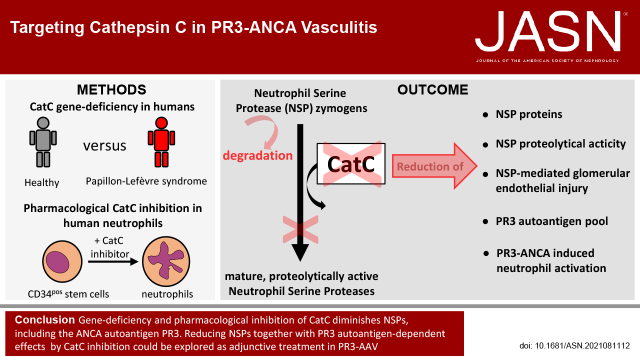
To explore AAV-relevant consequences of blocking NSP zymogen activation by CatC, we used myeloid cells from patients with Papillon-Lefèvre syndrome, a genetic deficiency of CatC, to assess NSPs and NSP-mediated endothelial cell injury. We also examined pharmacologic CatC inhibition in neutrophil-differentiated human hematopoietic stem cells, primary human umbilical vein cells, and primary glomerular microvascular endothelial cells.
Patients with Papillon-Lefèvre syndrome showed strongly reduced NSPs in neutrophils and monocytes. Neutrophils from these patients produced a negative PR3-ANCA test, presented less PR3 on the surface of viable and apoptotic cells, and caused significantly less damage in human umbilical vein cells. These findings were recapitulated in human stem cells, in which a highly specific CatC inhibitor, but not prednisolone, reduced NSPs without affecting neutrophil differentiation, reduced membrane PR3, and diminished neutrophil activation upon PR3-ANCA but not MPO-ANCA stimulation. Compared with healthy controls, neutrophils from patients with Papillon-Lefèvre syndrome transferred less proteolytically active NSPs to glomerular microvascular endothelial cells, the cell type targeted in ANCA-induced necrotizing crescentic glomerulonephritis. Finally, both genetic CatC deficiency and pharmacologic inhibition, but not prednisolone, reduced neutrophil-induced glomerular microvascular endothelial cell damage.
These findings may offer encouragement for clinical studies of adjunctive CatC inhibitor in patients with PR3-AAV.
中性粒细胞和单核细胞特异性表达抗中性粒细胞胞浆抗体(ANCA)自身抗原蛋白酶 3(PR3)和髓过氧化物酶(MPO)。ANCA 介导的这些细胞的激活是抗中性粒细胞胞浆抗体相关性血管炎(AAV)血管损伤过程的关键驱动因素,中性粒细胞丝氨酸蛋白酶(NSPs)是疾病的介质。组织蛋白酶 C(CatC)从酶原激活 NSP 的蛋白水解功能,包括 PR3。缺乏 NSP 酶原激活导致中性粒细胞 NSP 蛋白明显减少。
为了探索通过 CatC 阻断 NSP 酶原激活对 AAV 的相关影响,我们使用 Papillon-Lefèvre 综合征患者的髓样细胞,即 CatC 的遗传缺陷,来评估 NSPs 和 NSP 介导的内皮细胞损伤。我们还检查了在中性粒细胞分化的人类造血干细胞、原代人脐静脉细胞和原代肾小球微血管内皮细胞中,药物抑制 CatC 的作用。
Papillon-Lefèvre 综合征患者的中性粒细胞和单核细胞中 NSPs 明显减少。这些患者的中性粒细胞产生阴性的 PR3-ANCA 试验,活细胞和凋亡细胞表面的 PR3 减少,对人脐静脉细胞的损伤明显减少。这些发现在人类干细胞中得到了再现,在这些细胞中,一种高度特异性的 CatC 抑制剂,但不是泼尼松龙,减少了 NSPs,而不影响中性粒细胞分化,减少了膜 PR3,并减少了 PR3-ANCA 但不是 MPO-ANCA 刺激后的中性粒细胞激活。与健康对照组相比,Papillon-Lefèvre 综合征患者的中性粒细胞向肾小球微血管内皮细胞传递的具有蛋白水解活性的 NSPs 减少,这是 ANCA 诱导的坏死性新月体肾小球肾炎的靶细胞类型。最后,遗传 CatC 缺陷和药物抑制,而不是泼尼松龙,都减少了中性粒细胞诱导的肾小球微血管内皮细胞损伤。
这些发现可能为 PR3-AAV 患者联合使用 CatC 抑制剂的临床研究提供了鼓励。