Instituto de Biotecnologia, Universidade de Caxias do Sul, Caxias do Sul, RS, Brasil.
Hospital Geral, Universidade de Caxias do Sul, Caxias do Sul, RS, Brasil.
Braz J Med Biol Res. 2022 Mar 11;55:e11857. doi: 10.1590/1414-431X2021e11857. eCollection 2022.
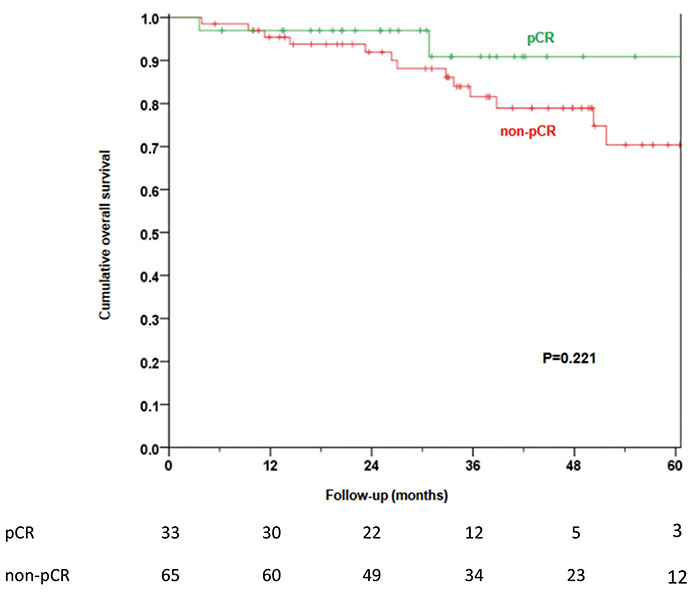
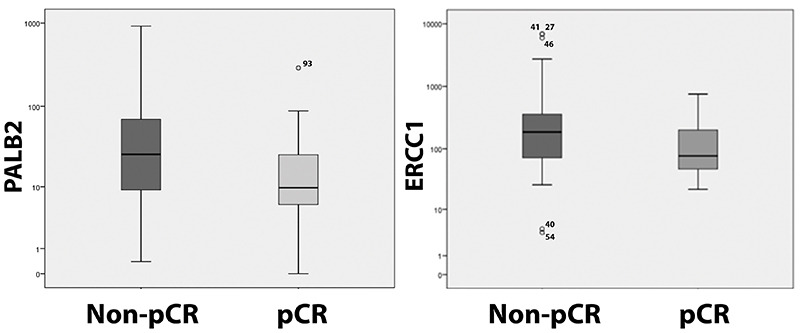
Genome-wide analysis using microarrays has revolutionized breast cancer (BC) research. A substantial body of evidence supports the clinical utility of the 21-gene assay (Oncotype DX) and 70-gene assay (MammaPrint) to predict BC recurrence and the magnitude of benefit from chemotherapy. However, there is currently no genetic tool able to predict chemosensitivity and chemoresistance to neoadjuvant chemotherapy (NACT) during BC treatment. In this study, we explored the predictive value of DNA repair gene expression in the neoadjuvant setting. We selected 98 patients with BC treated with NACT. We assessed DNA repair expression in 98 formalin-fixed, paraffin-embedded core biopsy fragments used at diagnosis and in 32 formalin-fixed, paraffin-embedded post-NACT residual tumors using quantitative reverse transcription-polymerase chain reaction. The following genes were selected: BRCA1, PALB2, RAD51C, BRCA2, ATM, FANCA, MSH2, XPA, ERCC1, PARP1, and SNM1. Of 98 patients, 33 (33.7%) achieved pathologic complete response (pCR). The DNA expression of 2 genes assessed in pre-NACT biopsies (PALB2 and ERCC1) was lower in pCR than in non-pCR patients (P=0.005 and P=0.009, respectively). There was no correlation between molecular subtype and expression of DNA repair genes. The genes BRCA2 (P=0.009), ATM (P=0.004), FANCA (P=0.001), and PARP1 (P=0.011) showed a lower expression in post-NACT residual tumor samples (n=32) than in pre-NACT biopsy samples (n=98). The expression of 2 genes (PALB2 and ERCC1) was lower in pCR patients. These alterations in DNA repair could be considered suitable targets for cancer therapy.
基于微阵列的全基因组分析已经彻底改变了乳腺癌(BC)的研究。大量证据支持 21 基因检测(Oncotype DX)和 70 基因检测(MammaPrint)在预测 BC 复发和化疗获益程度方面的临床实用性。然而,目前还没有能够预测新辅助化疗(NACT)期间 BC 治疗的化疗敏感性和耐药性的遗传工具。在这项研究中,我们探讨了 DNA 修复基因表达在新辅助环境中的预测价值。我们选择了 98 例接受 NACT 治疗的 BC 患者。我们使用定量逆转录聚合酶链反应评估了 98 例福尔马林固定、石蜡包埋的核心活检标本在诊断时和 32 例福尔马林固定、石蜡包埋的 NACT 后残留肿瘤中的 DNA 修复表达。选择了以下基因:BRCA1、PALB2、RAD51C、BRCA2、ATM、FANCA、MSH2、XPA、ERCC1、PARP1 和 SNM1。在 98 例患者中,33 例(33.7%)达到病理完全缓解(pCR)。在 pCR 患者中,2 个在 NACT 前活检中评估的基因(PALB2 和 ERCC1)的 DNA 表达低于非 pCR 患者(P=0.005 和 P=0.009)。分子亚型与 DNA 修复基因的表达之间没有相关性。基因 BRCA2(P=0.009)、ATM(P=0.004)、FANCA(P=0.001)和 PARP1(P=0.011)在 32 例 NACT 后残留肿瘤样本(n=32)中的表达低于 98 例 NACT 前活检样本(n=98)。2 个基因(PALB2 和 ERCC1)在 pCR 患者中的表达较低。这些 DNA 修复的改变可以被认为是癌症治疗的合适靶点。