State Key Laboratory of Bioorganic and Natural Products Chemistry, Center for Excellence in Molecular Synthesis, Shanghai Institute of Organic Chemistry, University of Chinese Academy of Sciences, Chinese Academy of Sciences, Shanghai 200032, China.
Laboratory of Bacterial Pathogenesis, Institutes of Medical Sciences, Shanghai Jiao Tong University School of Medicine, Shanghai 200032, China.
Proc Natl Acad Sci U S A. 2022 Mar 22;119(12):e2116776119. doi: 10.1073/pnas.2116776119. Epub 2022 Mar 16.
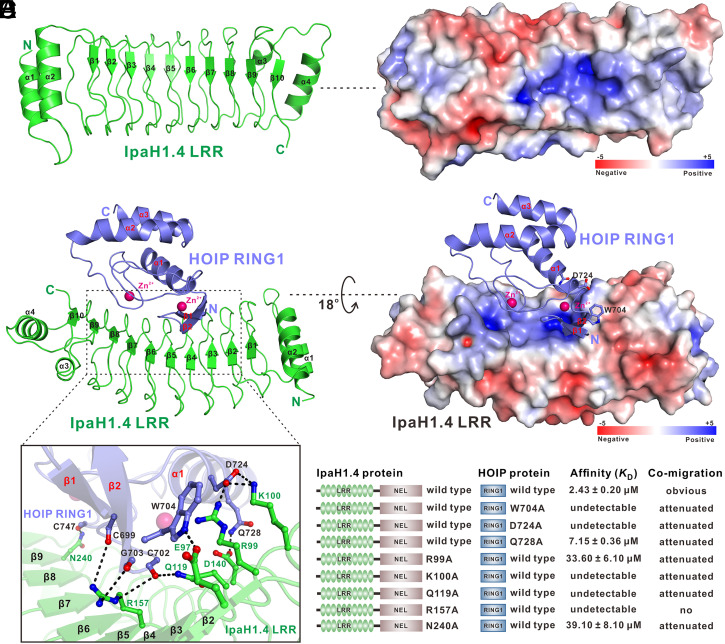
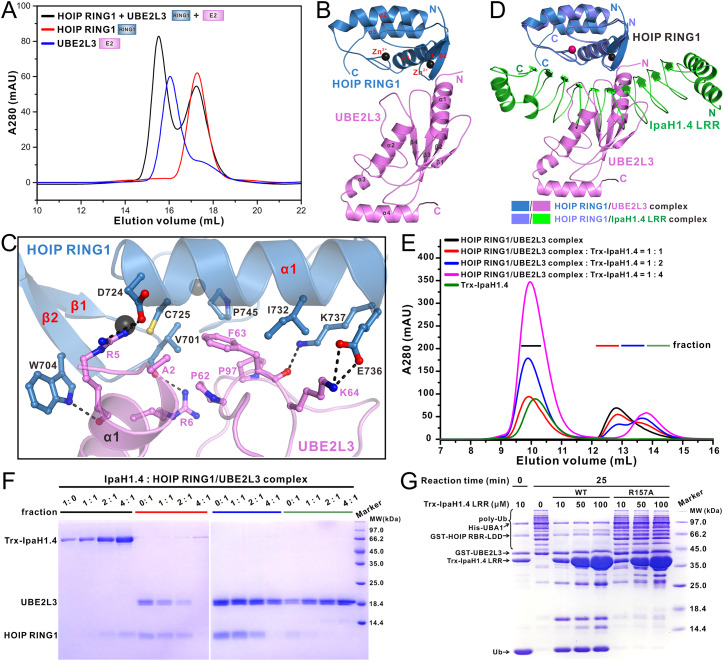
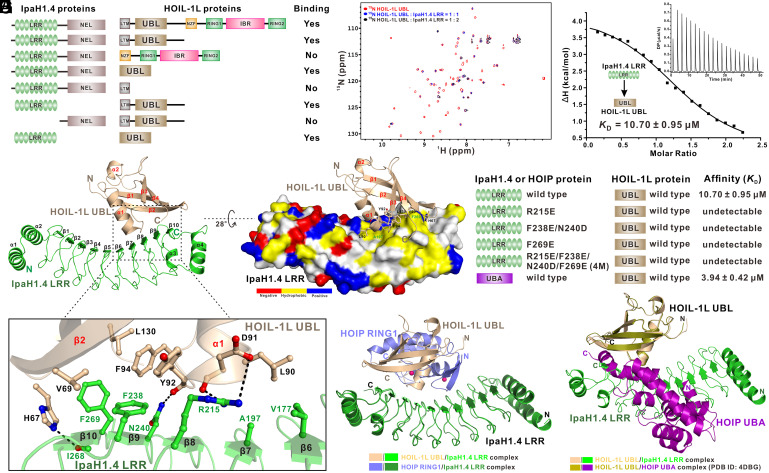
Shigella flexneri, a gram-negative bacterium, is the major culprit of bacterial shigellosis and causes a large number of human infection cases and deaths worldwide annually. For evading the host immune response during infection, S. flexneri secrets two highly similar E3 ligases, IpaH1.4 and IpaH2.5, to subvert the linear ubiquitin chain assembly complex (LUBAC) of host cells, which is composed of HOIP, HOIL-1L, and SHARPIN. However, the detailed molecular mechanism underpinning the subversion of the LUBAC by IpaH1.4/2.5 remains elusive. Here, we demonstrated that IpaH1.4 can specifically recognize HOIP and HOIL-1L through its leucine-rich repeat (LRR) domain by binding to the HOIP RING1 domain and HOIL-1L ubiquitin-like (UBL) domain, respectively. The determined crystal structures of IpaH1.4 LRR/HOIP RING1, IpaH1.4 LRR/HOIL-1L UBL, and HOIP RING1/UBE2L3 complexes not only elucidate the binding mechanisms of IpaH1.4 with HOIP and HOIL-1L but also unveil that the recognition of HOIP by IpaH1.4 can inhibit the E2 binding of HOIP. Furthermore, we demonstrated that the interaction of IpaH1.4 LRR with HOIP RING1 or HOIL-1L UBL is essential for the ubiquitination of HOIP or HOIL-1L in vitro as well as the suppression of NF-κB activation by IpaH1.4 in cells. In summary, our work elucidated that in addition to inducing the proteasomal degradation of LUBAC, IpaH1.4 can also inhibit the E3 activity of LUBAC by blocking its E2 loading and/or disturbing its stability, thereby providing a paradigm showing how a bacterial E3 ligase adopts multiple tactics to subvert the key LUBAC of host cells.
福氏志贺菌是一种革兰氏阴性菌,是细菌性痢疾的主要病原体,每年在全球范围内导致大量人类感染和死亡。为了在感染过程中逃避宿主免疫反应,福氏志贺菌秘密分泌两种高度相似的 E3 连接酶,IpaH1.4 和 IpaH2.5,来颠覆宿主细胞的线性泛素链组装复合物(LUBAC),该复合物由 HOIP、HOIL-1L 和 SHARPIN 组成。然而,IpaH1.4/2.5 颠覆 LUBAC 的详细分子机制仍不清楚。在这里,我们证明 IpaH1.4 通过其富含亮氨酸的重复(LRR)结构域特异性识别 HOIP 和 HOIL-1L,分别与 HOIP 的 RING1 结构域和 HOIL-1L 的泛素样(UBL)结构域结合。IpaH1.4 LRR/HOIP RING1、IpaH1.4 LRR/HOIL-1L UBL 和 HOIP RING1/UBE2L3 复合物的晶体结构不仅阐明了 IpaH1.4 与 HOIP 和 HOIL-1L 的结合机制,还揭示了 IpaH1.4 对 HOIP 的识别可以抑制 HOIP 的 E2 结合。此外,我们证明了 IpaH1.4 LRR 与 HOIP RING1 或 HOIL-1L UBL 的相互作用对于 HOIP 或 HOIL-1L 的体外泛素化以及 IpaH1.4 在细胞中抑制 NF-κB 激活是必不可少的。总之,我们的工作阐明了除了诱导 LUBAC 的蛋白酶体降解外,IpaH1.4 还可以通过阻断其 E2 加载和/或干扰其稳定性来抑制 LUBAC 的 E3 活性,从而提供了一个范例,展示了一种细菌 E3 连接酶如何采用多种策略来颠覆宿主细胞的关键 LUBAC。