West German Cancer Center Essen, Department of Medical Oncology, University Hospital Essen, Essen, Germany.
German Cancer Consortium (DKTK), partner site University Hospital Essen, Essen, Germany.
Clin Cancer Res. 2022 Jul 15;28(14):3002-3010. doi: 10.1158/1078-0432.CCR-21-3872.
Enhanced MAPK pathway signaling and cell-cycle checkpoint dysregulation are frequent in NRAS-mutant melanoma and, as such, the regimen of the MEK inhibitor binimetinib and the selective CDK4/6 inhibitor ribociclib is a rational combination.
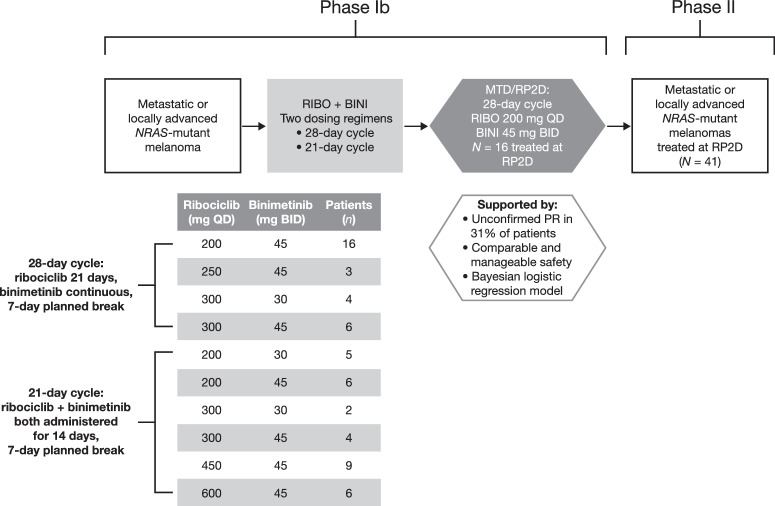
This is a phase Ib/II, open-label study of ribociclib + binimetinib in patients with NRAS-mutant melanoma (NCT01781572). Primary objectives were to estimate the MTD/recommended phase II dose (RP2D) of the combination (phase Ib) and to characterize combination antitumor activity at the RP2D (phase II). Tumor genomic characterization and pharmacokinetics/pharmacodynamics were also evaluated.
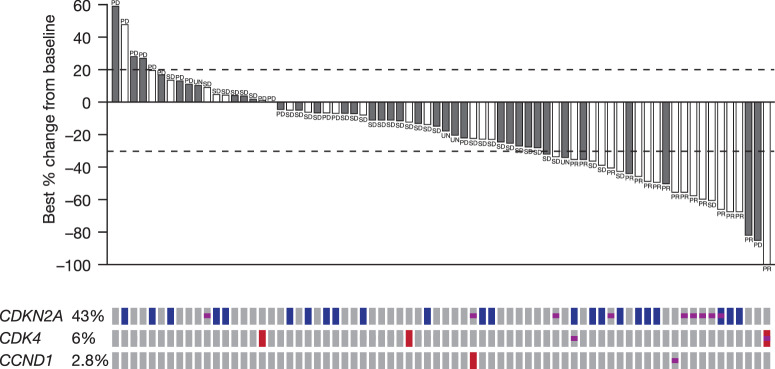
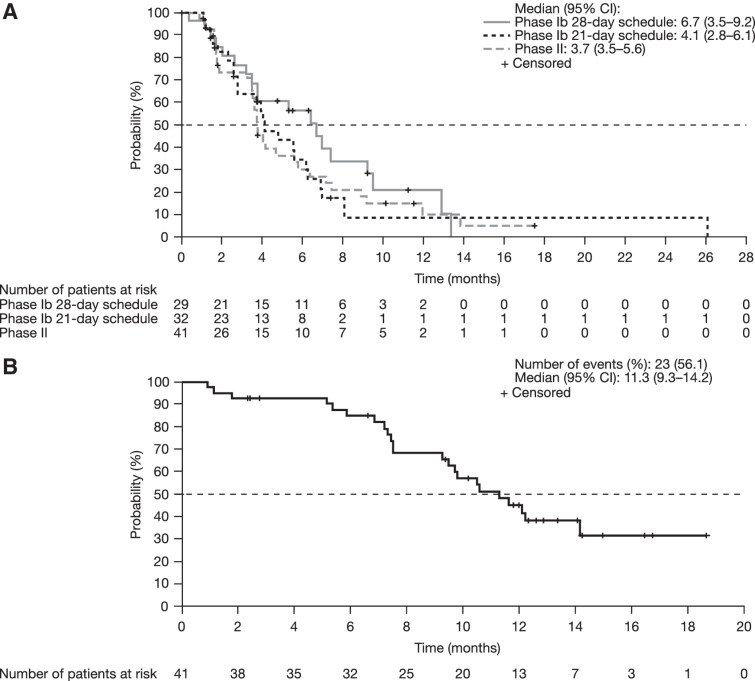
Ten patients (16.4%) experienced dose-limiting toxicities in cycle 1 of phase Ib. Overall response rate in the phase II cohort (n = 41) for the selected RP2D (binimetinib 45 mg twice daily + ribociclib 200 mg once daily, 21 days on/7 days off) was 19.5% [8/41; 95% confidence interval (CI), 8.8-34.9]. The response rate was 32.5% (13/40; 95% CI, 20.1-48.0) in patients with NRAS mutation with concurrent alterations of CDKN2A, CDK4, or CCND1. Median progression-free survival was 3.7 months (95% CI, 3.5-5.6) and median overall survival was 11.3 months (95% CI, 9.3-14.2) for all patients. Common treatment-related toxicities included creatine phosphokinase elevation, rash, edema, anemia, nausea, diarrhea, and fatigue. Pharmacokinetics and safety were consistent with single-agent data, supporting a lack of drug-drug interaction.
Ribociclib + binimetinib can be safely administered and is clinically active in patients with NRAS-mutant melanoma. Co-mutations of cell-cycle genes may define a population with greater likelihood of treatment benefit. See related commentary by Moschos, p. 2977.
NRAS 突变型黑色素瘤中常出现增强的 MAPK 通路信号和细胞周期检查点失调,因此,MEK 抑制剂 binimetinib 和选择性 CDK4/6 抑制剂 ribociclib 的治疗方案是合理的组合。
这是一项 I/II 期、开放标签的 ribociclib + binimetinib 治疗 NRAS 突变型黑色素瘤患者的研究(NCT01781572)。主要目的是评估联合用药的最大耐受剂量/推荐的 II 期剂量(RP2D)(I 期),并在 RP2D 下评估联合抗肿瘤活性(II 期)。还对肿瘤基因组特征和药代动力学/药效学进行了评估。
在 I 期的第 1 周期中,有 10 名患者(16.4%)出现剂量限制毒性。在选定的 RP2D(binimetinib 45mg 每日 2 次+ribociclib 200mg 每日 1 次,21 天用药/7 天停药)的 II 期队列中(n=41),总缓解率为 19.5%[8/41;95%置信区间(CI),8.8-34.9]。NRAS 突变伴 CDKN2A、CDK4 或 CCND1 同时改变的患者的缓解率为 32.5%(13/40;95%CI,20.1-48.0)。所有患者的中位无进展生存期为 3.7 个月(95%CI,3.5-5.6),中位总生存期为 11.3 个月(95%CI,9.3-14.2)。常见的治疗相关毒性包括肌酸磷酸激酶升高、皮疹、水肿、贫血、恶心、腹泻和疲劳。药代动力学和安全性与单药数据一致,支持无药物相互作用。
ribociclib + binimetinib 可安全给药,对 NRAS 突变型黑色素瘤患者具有临床活性。细胞周期基因的共突变可能定义了一个更有可能受益于治疗的人群。见 Moschos 的相关评论,第 2977 页。