Harbin Normal University, Harbin 150025, China.
Harbin Institute of Technology, Harbin 150025, China.
Comput Intell Neurosci. 2022 Mar 7;2022:1156748. doi: 10.1155/2022/1156748. eCollection 2022.
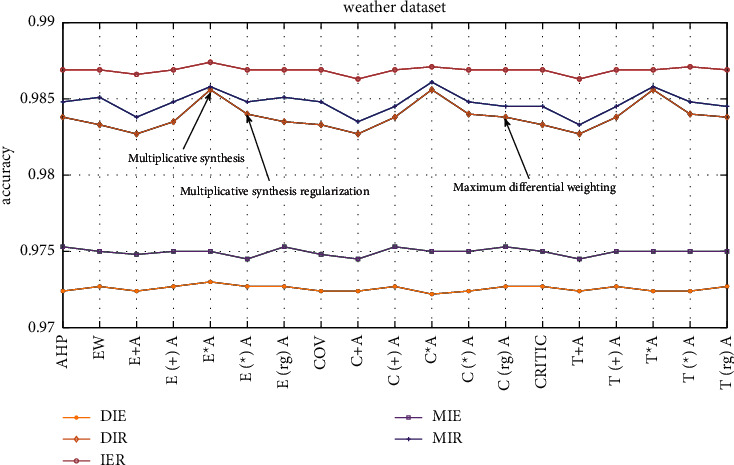
As an extension of Dempster-Shafer (D-S) theory, the evidential reasoning (ER) rule can be used as a combination strategy in ensemble learning to deeply mine classifier information through decision-making reasoning. The weight of evidence is an important parameter in the ER rule, which has a significant effect on the result of ensemble learning. However, current research results on the weight of evidence are not ideal, leveraging expert knowledge to assign weights leads to the excessive subjectivity, and using sample statistical methods to assign weights relies too heavily on the samples, so the determined weights sometimes differ greatly from the actual importance of the attributes. Therefore, to solve the problem of excessive subjectivity and objectivity of the weights of evidence, and further improve the accuracy of ensemble learning based on the ER rule, we propose a novel combination weighting method to determine the weight of evidence. The combined weights are calculated by leveraging our proposed method to combine subjective and objective weights of evidence. The regularization of these weights is studied. Then, the evidential reasoning rule is used to integrate different classifiers. Five case studies of image classification datasets have been conducted to demonstrate the effectiveness of the combination weighting method.
作为 Dempster-Shafer(D-S)理论的扩展,证据推理(ER)规则可用作集成学习中的组合策略,通过决策推理深入挖掘分类器信息。证据权重是 ER 规则中的一个重要参数,对集成学习的结果有重大影响。然而,目前关于证据权重的研究结果并不理想,利用专家知识分配权重会导致过度的主观性,而使用样本统计方法分配权重则过于依赖样本,因此确定的权重有时与属性的实际重要性有很大差异。因此,为了解决证据权重的主观性和客观性问题,并进一步提高基于 ER 规则的集成学习的准确性,我们提出了一种新的组合加权方法来确定证据权重。通过我们提出的方法来组合主观和客观的证据权重来计算组合权重。研究了这些权重的正则化。然后,使用证据推理规则来整合不同的分类器。通过五个图像分类数据集的案例研究,验证了组合加权方法的有效性。