
术前全身免疫炎症指数(SII)作为Ⅰ-Ⅱ期胃癌根治术后患者长期生存结果的更佳预测指标
Preoperative Systemic Immune-Inflammation Index (SII) as a Superior Predictor of Long-Term Survival Outcome in Patients With Stage I-II Gastric Cancer After Radical Surgery.
作者信息
He Kang, Si Lixiang, Pan Xiaohua, Sun Ling, Wang Yajing, Lu Jianwei, Wang Xiaohua
机构信息
The Department of Oncology, The Affiliated Cancer Hospital of Nanjing Medical University, and Jiangsu Cancer Hospital and Jiangsu Institute of Cancer Research, Nanjing, China.
出版信息
Front Oncol. 2022 Feb 28;12:829689. doi: 10.3389/fonc.2022.829689. eCollection 2022.
BACKGROUND
Systemic immune-inflammation index (SII), calculated by immunoinflammatory cell counts of peripheral blood, is considered a predictor of survival outcome in several solid tumors, including gastric cancer (GC). However, there is no study focusing on the prognostic value of SII in the early stage of GC. This study aims to compare prognostic prediction capabilities of several inflammatory indices, nutritional indices, and tumor markers to further verify the superior prognostic value of SII in stage I-II GC patients after surgery.
METHODS
In this study, 548 patients (358 in the training group and 190 in the validation group) with stage I-II GC after radical surgery were retrospectively analyzed. The peripheral blood indices of interest were SII, neutrophil-to-lymphocyte ratio (NLR), platelet-to-lymphocyte ratio (PLR), monocyte-to-lymphocyte ratio (MLR), advanced lung cancer inflammation index (ALI), systemic inflammation score (SIS), prognostic nutritional index (PNI), body mass index (BMI), albumin, carcinoembryonic antigen (CEA), cancer antigen 125 (CA125), carbohydrate-associated antigen 19-9 (CA19-9), and alpha-fetoprotein (AFP). The time-dependent receiver operating characteristic (t-ROC) curves and the area under the curve (AUC) were used to determine the optimal cutoff value and prognostic ability of each parameter. Kaplan-Meier curves and multivariable Cox regression models were used to evaluate independent prognostic factors. The nomogram was constructed based on the result of bidirectional stepwise regression model.
RESULTS
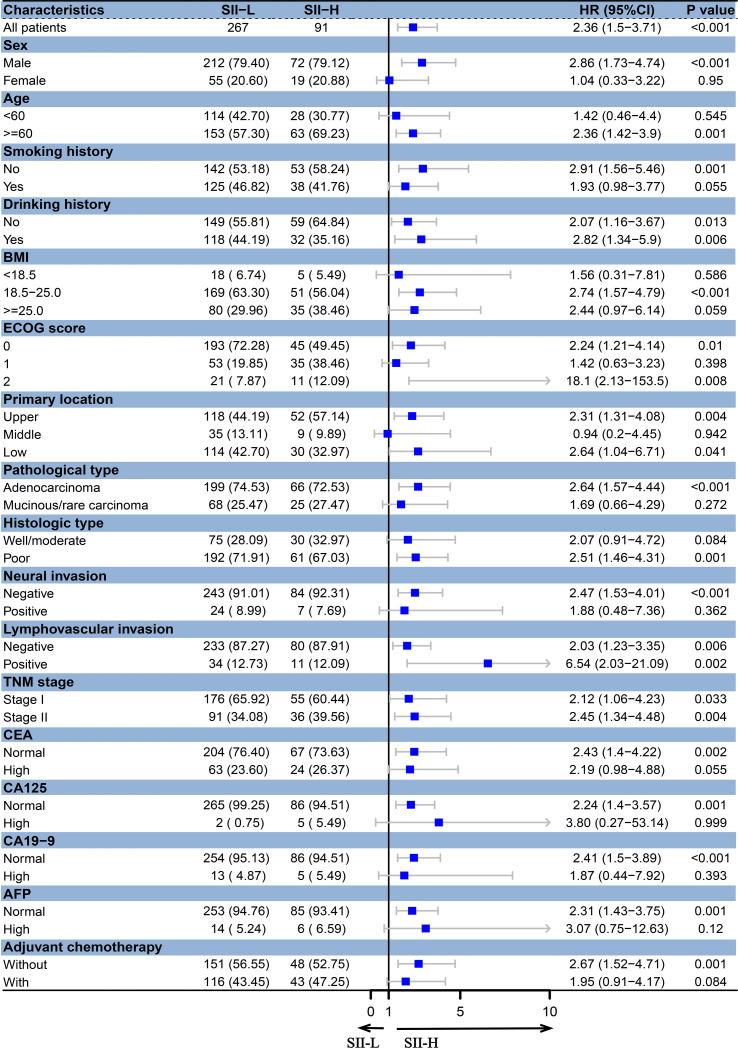
The optimal cutoff value of SII was 508.3. The 5-year overall survival rate of the low SII (SII-L) group was significantly higher than that of the high SII (SII-H) group (92% vs. 80%, P < 0.001), especially in the elderly and stage II patients (91% vs. 73%, P = 0.001; 86% vs. 67%, P = 0.003, respectively). The significant prognostic values of SII were consistent in most subgroups. In multivariate analysis, SII and CA19-9 were the only two independent prognostic hematology indices. The AUC value of SII (0.624) was greater than that of CA19-9 (0.528) and other prognostic parameters. Adding SII to the conventional model improved the predictive ability of 5-year overall survival as shown by the significantly increased net reclassification improvement (NRI) and integrated discrimination improvement (IDI) (P = 0.033, P = 0.053, respectively) and modestly improved consistency index (C-index) (increased by 1.6%). External validation of SII-based nomogram demonstrated favorable predictive performance and discrimination. In addition, interactive web dynamic nomogram was published to facilitate clinical use.
CONCLUSION
SII is a simple but powerful index with a high predictive value to predict survival outcome in patients with stage I-II GC after radical operation. The SII-based nomogram can provide intuitive and accurate prognosis prediction of individual patients.
背景
全身免疫炎症指数(SII)通过外周血免疫炎症细胞计数计算得出,被认为是包括胃癌(GC)在内的多种实体肿瘤生存结局的预测指标。然而,尚无研究关注SII在GC早期的预后价值。本研究旨在比较几种炎症指标、营养指标和肿瘤标志物的预后预测能力,以进一步验证SII在I-II期GC患者术后的优越预后价值。
方法
本研究回顾性分析了548例根治性手术后的I-II期GC患者(训练组358例,验证组190例)。感兴趣的外周血指标包括SII、中性粒细胞与淋巴细胞比值(NLR)、血小板与淋巴细胞比值(PLR)、单核细胞与淋巴细胞比值(MLR)、晚期肺癌炎症指数(ALI)、全身炎症评分(SIS)、预后营养指数(PNI)、体重指数(BMI)、白蛋白、癌胚抗原(CEA)、癌抗原125(CA125)、糖类抗原19-9(CA19-9)和甲胎蛋白(AFP)。采用时间依赖性受试者工作特征(t-ROC)曲线和曲线下面积(AUC)来确定每个参数的最佳截断值和预后能力。采用Kaplan-Meier曲线和多变量Cox回归模型评估独立预后因素。基于双向逐步回归模型的结果构建列线图。
结果
SII的最佳截断值为508.3。低SII(SII-L)组的5年总生存率显著高于高SII(SII-H)组(92%对80%,P<0.001),尤其是在老年患者和II期患者中(分别为91%对73%,P=0.001;86%对67%,P=0.003)。SII的显著预后价值在大多数亚组中是一致的。在多变量分析中,SII和CA19-9是仅有的两个独立预后血液学指标。SII的AUC值(0.624)大于CA19-9(0.528)和其他预后参数。将SII添加到传统模型中可提高5年总生存的预测能力,净重新分类改善(NRI)和综合判别改善(IDI)显著增加(分别为P=0.033,P=0.053),一致性指数(C-index)适度提高(增加1.6%)。基于SII的列线图的外部验证显示出良好的预测性能和判别能力。此外,发布了交互式网络动态列线图以方便临床使用。
结论
SII是一个简单但强大的指标,对预测根治性手术后I-II期GC患者生存结局具有较高的预测价值。基于SII的列线图可为个体患者提供直观准确的预后预测。




 Zotero 插件