Armauer Hansen Research Institute, Addis Ababa, Ethiopia.
Department of Medical Microbiology, School of Biomedical and Laboratory Sciences, College of Medicine and Health Sciences, University of Gondar, Gondar, Ethiopia.
BMC Infect Dis. 2022 Mar 16;22(1):261. doi: 10.1186/s12879-022-07247-z.
COVID-19 pandemic has a devastating impact on the economies and health care system of sub-Saharan Africa. Healthcare workers (HWs), the main actors of the health system, are at higher risk because of their occupation. Serology-based estimates of SARS-CoV-2 infection among HWs represent a measure of HWs' exposure to the virus and could be used as a guide to the prevalence of SARS-CoV-2 in the community and valuable in combating COVID-19. This information is currently lacking in Ethiopia and other African countries. This study aimed to develop an in-house antibody testing assay, assess the prevalence of SARS-CoV-2 antibodies among Ethiopian high-risk frontline HWs.
We developed and validated an in-house Enzyme-Linked Immunosorbent Assay (ELISA) for specific detection of anti-SARS-CoV-2 receptor binding domain immunoglobin G (IgG) antibodies. We then used this assay to assess the seroprevalence among HWs in five public hospitals located in different geographic regions of Ethiopia. From consenting HWs, blood samples were collected between December 2020 and February 2021, the period between the two peaks of COVID-19 in Ethiopia. Socio-demographic and clinical data were collected using questionnaire-based interviews. Descriptive statistics and bivariate and multivariate logistic regression were used to determine the overall and post-stratified seroprevalence and the association between seropositivity and potential risk factors.
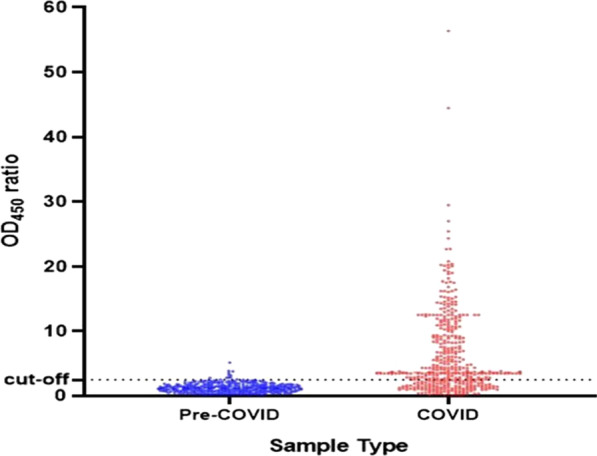
Our successfully developed in-house assay sensitivity was 100% in serum samples collected 2- weeks after the first onset of symptoms whereas its specificity in pre-COVID-19 pandemic sera was 97.7%. Using this assay, we analyzed a total of 1997 sera collected from HWs. Of 1997 HWs who provided a blood sample, and demographic and clinical data, 51.7% were females, 74.0% had no symptoms compatible with COVID-19, and 29.0% had a history of contact with suspected or confirmed patients with SARS-CoV-2 infection. The overall seroprevalence was 39.6%. The lowest (24.5%) and the highest (48.0%) seroprevalence rates were found in Hiwot Fana Specialized Hospital in Harar and ALERT Hospital in Addis Ababa, respectively. Of the 821 seropositive HWs, 224(27.3%) of them had a history of symptoms consistent with COVID-19 while 436 (> 53%) of them had no contact with COVID-19 cases as well as no history of COVID-19 like symptoms. A history of close contact with suspected/confirmed COVID-19 cases is associated with seropositivity (Adjusted Odds Ratio (AOR) = 1.4, 95% CI 1.1-1.8; p = 0.015).
High SARS-CoV-2 seroprevalence levels were observed in the five Ethiopian hospitals. These findings highlight the significant burden of asymptomatic infection in Ethiopia and may reflect the scale of transmission in the general population.
COVID-19 大流行对撒哈拉以南非洲的经济和医疗保健系统造成了毁灭性的影响。医护人员(HWs)作为医疗系统的主要参与者,由于其职业而处于更高的风险之中。基于血清学的 SARS-CoV-2 感染估计代表了 HWs 接触病毒的程度,可作为社区中 SARS-CoV-2 流行情况的指南,并有助于抗击 COVID-19。目前,埃塞俄比亚和其他非洲国家都缺乏此类信息。本研究旨在开发一种内部抗体检测试验,评估埃塞俄比亚高风险一线 HWs 中 SARS-CoV-2 抗体的流行率。
我们开发并验证了一种内部酶联免疫吸附测定(ELISA),用于特异性检测抗 SARS-CoV-2 受体结合域免疫球蛋白 G(IgG)抗体。然后,我们使用该检测方法评估了位于埃塞俄比亚五个不同地理位置的公立医院中 HWs 的血清阳性率。在 2020 年 12 月至 2021 年 2 月期间(埃塞俄比亚 COVID-19 两次高峰之间),从同意的 HWs 中采集血样。使用基于问卷的访谈收集社会人口统计学和临床数据。使用描述性统计以及双变量和多变量逻辑回归来确定总体和分层后的血清阳性率以及血清阳性与潜在危险因素之间的关联。
我们成功开发的内部检测方法在出现症状后两周采集的血清样本中的灵敏度为 100%,而在 COVID-19 大流行前血清中的特异性为 97.7%。使用该检测方法,我们分析了总共 1997 份来自 HWs 的血清。在 1997 名提供血液样本和人口统计学及临床数据的 HWs 中,51.7%为女性,74.0%没有与 COVID-19 相符的症状,29.0%有与 SARS-CoV-2 感染的疑似或确诊患者接触的病史。总体血清阳性率为 39.6%。在 Harar 的 Hiwot Fana 专科医院和 Addis Ababa 的 ALERT 医院中,血清阳性率最低(24.5%)和最高(48.0%)。在 821 名血清阳性的 HWs 中,有 224 名(27.3%)有与 COVID-19 相符的症状史,而有 436 名(超过 53%)没有与 COVID-19 病例接触,也没有 COVID-19 样症状史。与疑似/确诊 COVID-19 病例的密切接触与血清阳性相关(调整后的优势比(AOR)= 1.4,95%CI 1.1-1.8;p= 0.015)。
在埃塞俄比亚的五家医院中观察到 SARS-CoV-2 血清阳性率很高。这些发现突显了埃塞俄比亚无症状感染的巨大负担,可能反映了普通人群中的传播规模。